Triumph Spitfire vs MG Midget: the cheapest way into a British sports car, compared
Two small roadsters built to the same brief, sold against each other for eighteen years, and in their final form sharing the same engine. Backbone chassis against monocoque, swing axle against live axle, and which is the better first classic at under £6,000.
Part of: Owning and running a classic car in the UK, the practical guide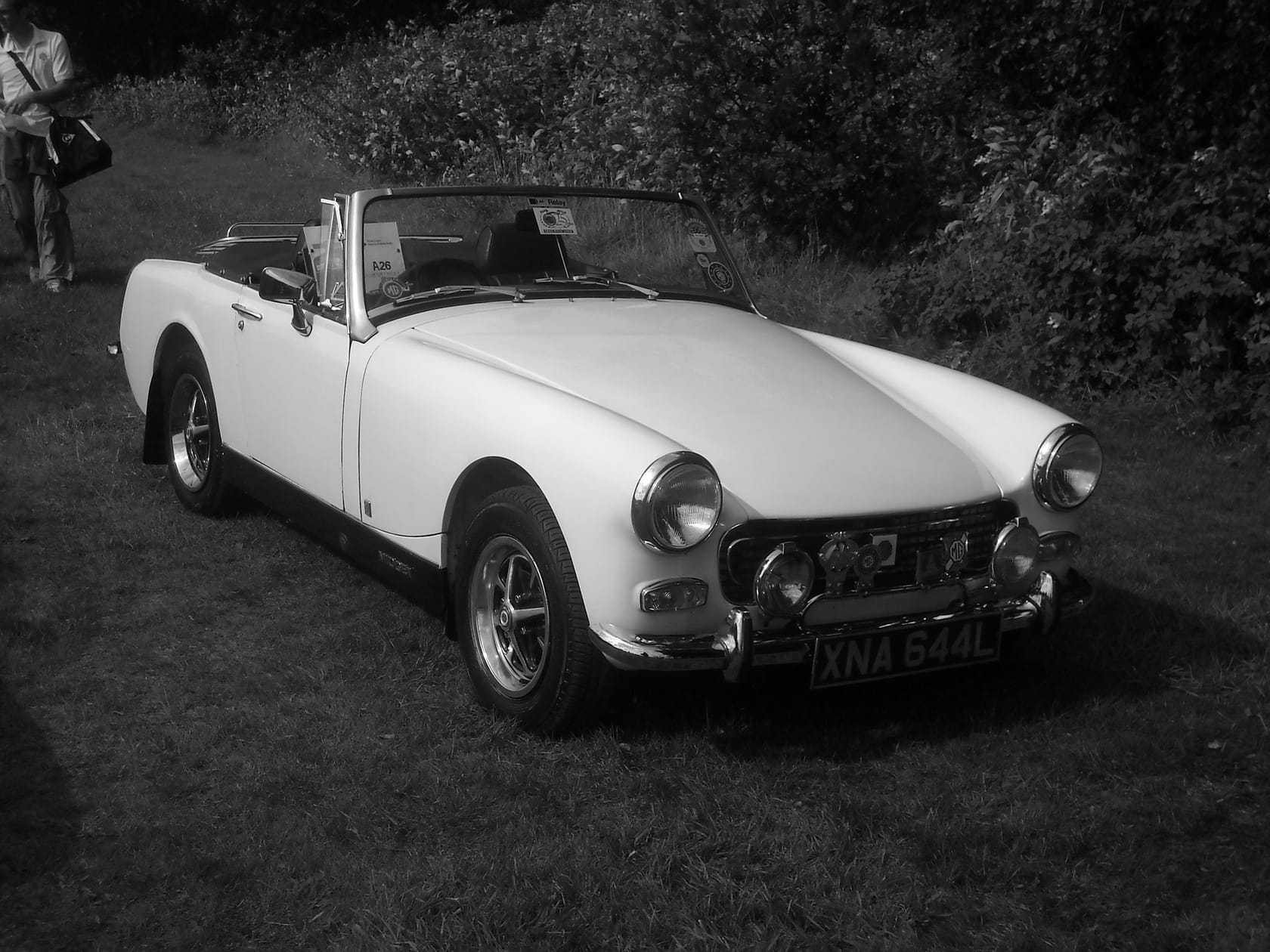
The guides
A young driver with a little money and a lot of optimism, at any point between 1962 and 1980, chose between these two. They were built to the same brief, a cheap two-seat roadster on saloon-car mechanicals, priced within pounds of each other, and sold in the same showrooms once British Leyland owned both. They are still the cheapest real sports cars in Britain, and the comparison is still live.
At a glance
| Triumph Spitfire | MG Midget | |
|---|---|---|
| Built | 1962 to 1980, Canley | 1961 to 1979, Abingdon |
| Production | Around 314,000 across five marks | About 226,000, plus 129,000 Austin-Healey Sprite twins |
| Engines | 1,147, 1,296 and 1,493cc Triumph fours | 948, 1,098 and 1,275cc A-series; 1,493cc Triumph engine from 1974 |
| Power | 63 to 75 bhp | Around 46 to 65 bhp |
| Top speed | Around 90 to 100 mph (1500) | Around 85 to 100 mph (1500) |
| Construction | Body on shortened Herald backbone chassis | Steel monocoque |
| Rear suspension | Swing axle (revised from Mk4) | Live axle on leaf springs |
| Median auction price | £6,016 (487 sales) | £4,705 (712 sales) |
| Price range, middle half | £3,800 to £8,900 | £3,100 to £7,000 |
Auction figures are from our own dataset of UK results, compiled to 10 August 2026, using the median sold price.
What they were
The Midget came first, in 1961, as a badge-engineered twin of the Austin-Healey Sprite that had arrived three years earlier. BMC took the Sprite, gave it a conventional nose in place of the Frogeye’s bulging headlamps, added MG badges and sold the pair side by side for a decade, a combination the enthusiast world calls the Spridget. It was a monocoque, which was advanced for a cheap car in 1958, with a live rear axle and the A-series engine in whatever size BMC was fitting that year.
The Spitfire arrived in 1962 as Triumph’s answer, and took a different route. Giovanni Michelotti styled a body for a shortened Triumph Herald backbone chassis, which gave the car its remarkable turning circle and its one-piece lift-forward bonnet, the most accessible engine bay in classic motoring. It inherited the Herald’s swing-axle rear suspension too, which was the car’s reputation for the first eight years.
Then the companies merged. British Leyland owned both from 1968, and by 1974 the logic of two rivals in one firm produced the strangest twist in the story: the Midget’s 1,275cc A-series could not be made to meet American emissions rules, so the last Midgets were fitted with the 1,493cc engine from the Spitfire 1500. For five years the two rivals shared a power unit.
What they are like
The Midget is the purer drive. It is small in a way that modern cars are not, with a cockpit that fits a compact driver and challenges a tall one, and a chassis that does nothing surprising. The live axle is predictable, the steering is direct, and a 1,275 Midget on a B-road is a car that flatters its driver at speeds that would not trouble a modern hatchback. It is, for the money, the most honest sports-car experience available.
The Spitfire is the more grown-up one, by a small margin. There is a little more room, a proper boot, wind-up windows from the start, and the bonnet that lifts to reveal everything. The early swing-axle cars have a reputation: push too hard into a corner and the inside rear wheel could tuck under, producing oversteer with no warning. Triumph’s revised rear suspension from the Mk4 of 1970 cured the worst of it, and a late Spitfire handles conventionally. An early one is a car to learn before pressing.
The Spitfire’s turning circle, inherited from the Herald, is a genuine party piece: it will turn in a space that embarrasses cars half its length.
What they cost to own
Both are exceptionally well supported, and the differences are at the margin.
The Midget shares the A-series and the Sprite’s parts with the biggest classic parts industry in Britain, and for the 1500 shares its engine with the Spitfire. Weak points: sills and floors rot, the front chassis legs and rear spring hangers need checking, and the A-series has the thrust washer question that every A-series has. The monocoque means structural rust is a welding job rather than a chassis swap.
The Spitfire’s backbone chassis is its advantage and its trap. The body bolts off, which makes restoration simpler than on a monocoque, but the chassis outriggers and the body-mounting points rot where the body hides them, and a car can look sound above while being soft below. The engine is simple and the bonnet makes it easy to work on. The 1500’s Triumph four has a reputation for crankshaft thrust washer wear, shared with the Triumph six.
Both are long past the forty-year line for tax and MOT exemption, both are cheap to insure on a classic policy, and both are among the cars specialist insurers and broker schemes will consider for a younger driver, which is not true of much else on four wheels with a hood.
What the auction record says
Our dataset holds 712 Midget sales and 487 Spitfire sales.
The median Midget sold for £4,705, with the middle half between £3,100 and £7,000. The median Spitfire sold for £6,016, with the middle half between £3,800 and £8,900. The Spitfire carries a premium of roughly a fifth, and it has done so consistently: in the most recent three years the Midget’s median ran around £4,700 and the Spitfire’s around £6,000, almost unchanged.
Both have held their real value better than most British classics over the decade, which is to say they have drifted only slightly, and both sell readily: around four in five cars offered find a buyer. They are liquid in a way that expensive classics are not.
On the Midget, the chrome-bumper cars command a premium over the post-1974 rubber-bumper 1500, and the early cars with the 1,275 A-series sit above the Triumph-engined 1500 on both looks and the reputation of the later engine’s small-journal crankshaft. On the Spitfire, which kept its chrome bumpers in Britain to the end, the early Mk1 and Mk2 cars are the collectors’ choice and the Mk4 and 1500 the drivers’. In both cases the shell matters more than the badge.
The question behind the question
“Which is the better first classic?” Either. This is the rare comparison where both answers are fully correct, and the decision should be made by sitting in both. The Midget suits a smaller driver and a smaller budget; the Spitfire suits a taller one and offers the easier engine access. Neither will bankrupt anyone.
“Which is the better investment?” Neither is an investment, and both are so plentiful that neither will become scarce. That is the point of them. They are the classics you buy to drive, and the auction record shows people doing exactly that.
“Which is faster?” The Spitfire 1500 and the Midget 1500 are, with the same engine, close to identical. Among earlier cars the 1,275 Midget is the lively one and the early Spitfires the gentler. None of them is fast by any modern measure, and the pleasure is entirely in doing 50 mph with the hood down and the engine working.
The honest verdict
These are the same car built two different ways, and the market prices them within a few hundred pounds of each other for that reason. Buy the one whose looks you prefer, in the best shell you can afford, and spend the difference on tyres. The full histories are in our pages on the Spitfire and the Midget, and the Midget’s Austin-Healey twin has its own story in the Sprite.
Frequently asked questions
Which is cheaper, a Spitfire or a Midget?
Did the Spitfire and Midget share an engine?
Which handles better?
Which is the better first classic?
Did both cars get rubber bumpers?
Related across themes


More from Owning & running


Recently added

Land Rover Discovery 1 values: the newest record on this site, and the cheapest coil-sprung Land Rover

TVR Tuscan: two eras of Blackpool at full volume (1967–1971, 1999–2006)

MGB vs Triumph TR6: the two British roadsters everybody cross-shops, compared on the numbers
