Jaguar E-Type vs Austin-Healey 3000: the two big British sixes, and what the auction record says about each
A twin-cam monocoque that claimed 150 mph against a pushrod six on a separate chassis that claimed 115. Both sold mostly to America, both were killed by American rules, and both have lost a third or more of their real value since 2014. Five thousand auction results on which is the better buy now.
Part of: Owning and running a classic car in the UK, the practical guide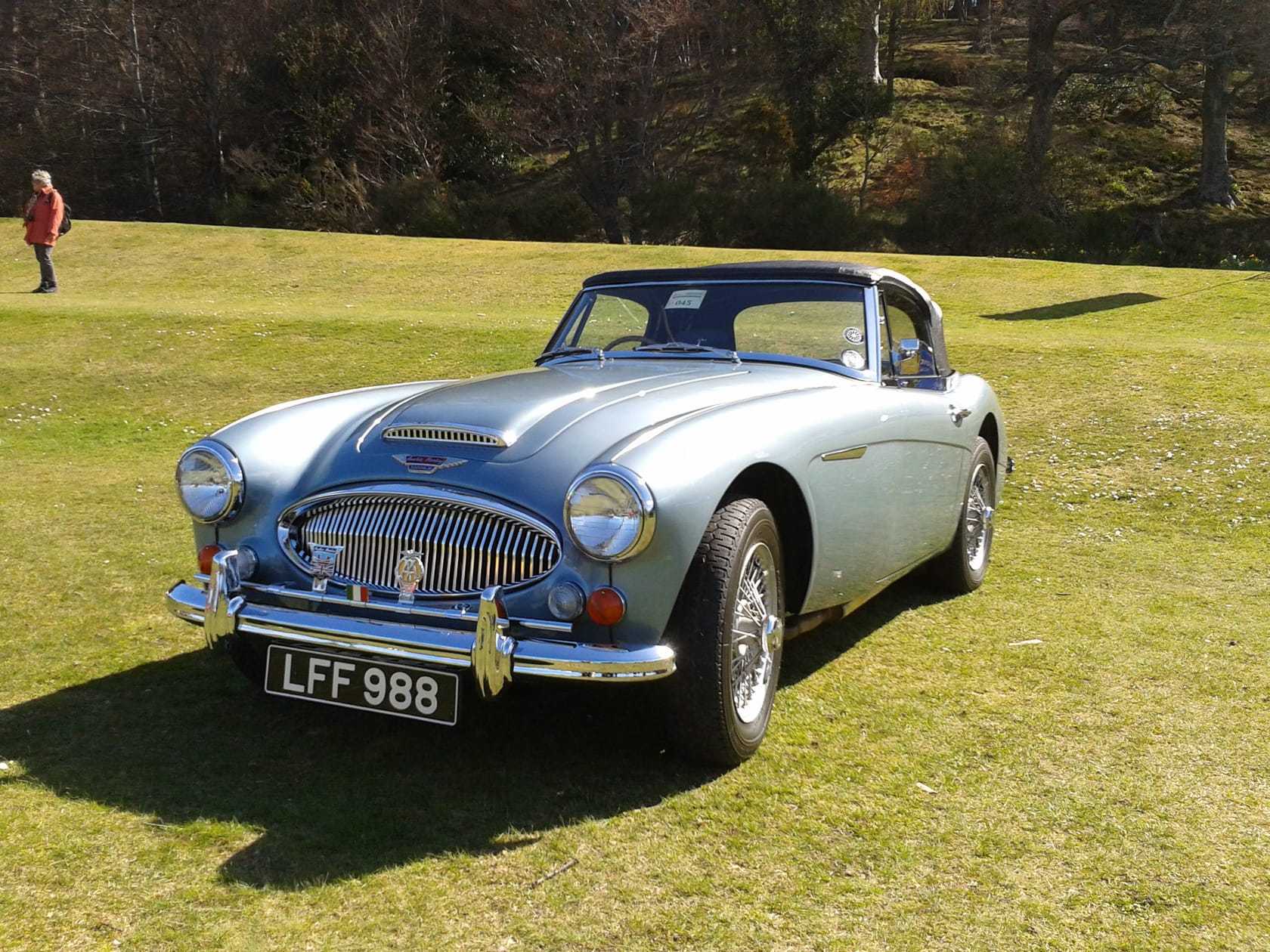
The guides
Jaguar E-Type vs Austin-Healey 3000 was the choice an American sports-car buyer faced in the early 1960s, and the two sat in the same showrooms at very different prices. The E-Type was the car that made the front pages at Geneva; the Healey was the one that had been winning rallies for years and cost about half as much. Sixty years on the gap has narrowed more than most people realise, and the auction record says why.
At a glance
| Jaguar E-Type | Austin-Healey 3000 | |
|---|---|---|
| Built | 1961 to 1975, Coventry | 1959 to 1967; bodies by Jensen, assembled at Abingdon |
| Production | About 72,500 across three series | 42,926 across Mk I, II and III |
| Engine | 3.8 and 4.2 XK twin-cam six; 5.3 V12 from 1971 | 2,912cc BMC C-series pushrod six |
| Power | 265 bhp (six), 272 bhp (V12), as claimed | 124 bhp (Mk I) to 148 bhp (Mk III) |
| Top speed | 150 mph claimed; press cars recorded it | 115 mph (Mk I, period test); around 120 mph (Mk III) |
| Construction | Steel monocoque with tubular front subframe, independent rear suspension | Separate ladder chassis, live rear axle, steel body with aluminium shrouds |
| Launch price | £2,097 (roadster, 1961, with tax) | Under £1,200 (1959, with tax) |
| Median auction price | £56,250 (4,029 sales) | £37,098 (1,184 sales) |
| Price range, middle half | £36,250 to £82,250 | £29,000 to £48,300 |
Auction figures are from our own dataset of UK results, compiled to 10 August 2026, using the median sold price.
What they were
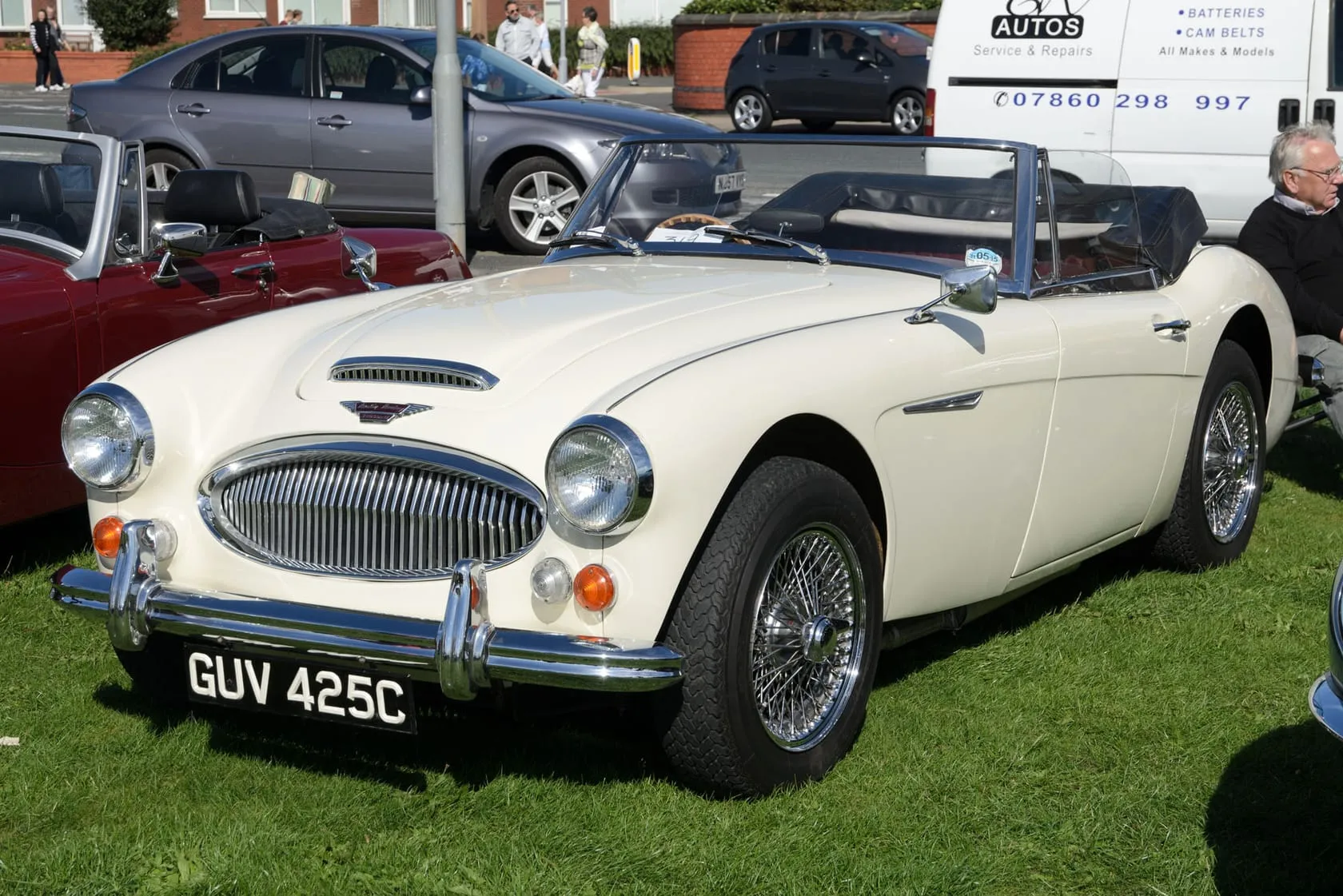
The Austin-Healey 3000 was the final form of the Big Healey, the car Donald Healey had first shown in 1952 and BMC had built ever since. It was announced on 1 July 1959 with the C-series six bored out to 2,912cc, and it went through three marks: the Mk I with 124 bhp, the Mk II with triple carburettors and then the proper wind-up windows of the BJ7, and from 1964 the Mk III with 148 bhp, a walnut dashboard and the ground clearance finally sorted. Bodies came from Jensen in West Bromwich and assembly was at Abingdon alongside the MGs. It was a serious rally car: Pat Moss and Ann Wisdom won the 1960 Liège-Rome-Liège outright in one, the first all-female crew to win a major international rally.
The E-Type arrived at Geneva in March 1961 and changed what a production sports car was allowed to look like. It was a monocoque with a tubular front subframe, independent rear suspension with inboard discs, and the XK twin-cam six from the D-Type, and it claimed 150 mph at a price that undercut everything else capable of it. Jaguar built about 72,500 over three series, the Series 2 reshaped by American regulations from 1968 and the Series 3 with the 5.3 V12 from 1971. Our complete guide to the E-Type covers the three series in detail.
Both were dollar-earners. More than 90 per cent of Healeys went abroad, most to the United States, and the great majority of E-Types did the same. Both were ended by American rules: BMC dropped the Healey at the end of 1967 rather than re-engineer it for the 1968 safety and emissions regulations, and the E-Type was progressively reshaped by the same requirements until the V12 replaced it.
What they are like
The E-Type is the modern car. Even a 1961 example has independent rear suspension, disc brakes all round and a chassis that was a generation ahead of anything from Abingdon. It rides well, it steers precisely, the XK six is smooth to its red line and the V12 is smoother still. The 3.8 cars carry the Moss gearbox, which needs a double declutch and a patient driver; the 4.2 of 1964 brought an all-synchro box and better seats. It is a fast, comfortable, long-legged car that can be driven across a country.
The Healey is the vintage one, deliberately. It sits on a separate chassis with a live rear axle on leaf springs, it rides low enough that the exhaust grounds, it is hot inside because the exhaust runs under the driver, and it makes a noise that the E-Type does not. The steering is heavy at low speed and the handling is period. What it has is character in a concentrated form, and a toughness that came from being built to survive the Liège. Owners of both tend to say the Jaguar is the better car and the Healey the bigger event.
What they cost to own
This is where the comparison turns.
The E-Type is the more expensive car to own by a wide margin, and the reason is the structure. It rusts at the sill-to-floor join, the rear wheel arches, the floors, the bonnet seams and the brazed tubular front subframe, and a monocoque that has gone at those points is a specialist restoration rather than a welding job. The cooling is marginal on Series 1 cars and on the V12; the inboard rear brakes are awkward to service; the Moss gearbox on 3.8 cars is a known quantity that some buyers avoid. The bonnet alone is a major assembly. A full restoration routinely passes six figures, which is why our guide to what a restoration really costs uses cars like this as its cautionary case.
The Healey is simpler. The ladder chassis rots at the outriggers and the body rots at the sills and floors, and the aluminium shrouds corrode where they meet steel, but the body comes off the frame and every panel and mechanical part is available. The C-series is a tough, low-stressed engine. The ground clearance is the car’s running joke: the exhaust on pre-Phase II cars hangs low enough to ground on a speed hump, which is why the late BJ8 with its reshaped chassis rails and tucked-up exhaust is the one to drive. A Healey restoration is expensive by any ordinary standard and about half an E-Type’s.
Both are decades past the forty-year line for tax and MOT exemption, both need agreed value cover at these prices, and both are cars where a pre-purchase inspection by a marque specialist is the best money in the transaction.
What the auction record says
Our dataset holds 4,029 E-Type sales and 1,184 Healey 3000 sales, which makes this the best-evidenced pairing on the site.
The median E-Type sold for £56,250, with the middle half between £36,250 and £82,250. The median Healey sold for £37,098, with the middle half between £29,000 and £48,300. The headline gap is about £19,000, but the E-Type figure averages three very different cars.
Within the E-Type the split by series is stark: a Series 1 roadster sells for a median of £96,000 to £105,000 depending on engine, a Series 1 fixed-head around £70,000, a Series 2 roadster around £55,000, a Series 3 V12 roadster the same, and a Series 3 coupe around £34,000. Our pages on the Series 2 and the Series 3 set out why the later cars are the value play.
Within the Healey the Mk III BJ8, at around £42,000, accounts for four sales in ten and commands the premium; the Mk I and Mk II cars sit at £32,000 to £34,000, with the rare two-seat BN7 Mk I above them.
Put those side by side and the comparison changes shape. A Mk III Healey costs the same as a Series 2 fixed-head E-Type. A Series 3 coupe is cheaper than any Healey. Only the Series 1 roadster lives in a different market, and it always has.
Both have lost real value since 2014. The E-Type’s median peaked at around £72,800 in 2018 and has run around £51,000 in the last three years, a fall of roughly a third in real terms. The Healey has fallen further: its inflation-adjusted median is down by nearly half from 2014, with the last three years around £32,500. That is the sharpest real-terms fall of any model in this comparison series, and it has made the Big Healey cheaper relative to the E-Type than at any point in a generation. The wider pattern is in our guide to buying at auction.
The question behind the question
“Which is the better investment?” Neither has been, over the last decade, and the Healey has been the worse. If the question is which will hold value best from here, a Series 1 E-Type roadster with its heritage certificate and matching numbers is the asset the market has always treated differently. Everything else is a car.
“Which would I rather drive?” The E-Type is the better car in every measurable way and the more comfortable one over distance. The Healey is louder, rougher, hotter and, for some people, more fun for exactly those reasons. Drive both before deciding, because the difference is not subtle.
“Which is the sensible buy?” A Mk III Healey or a Series 2 E-Type, which cost the same, are the best-developed versions of each, and are cheaper to keep than the cars on either side of them. Buy the soundest shell or chassis you can find, because in both cases the restoration bill is the only number that can go badly wrong.
The honest verdict
The E-Type is the greater car and the Healey is the better value, and the last decade has widened the second point while leaving the first alone. For the price of a median E-Type you can buy a Mk III Healey and bank the difference against its running; for the price of a Series 1 roadster you can buy two of them. The buyer who wants the shape that stopped Geneva will pay for it, as they always have. The full histories are in our pages on the E-Type and the Austin-Healey 3000.