Mini Cooper vs Austin-Healey Sprite: two A-series icons, two kinds of fun
The same engine in two completely different cars. A front-drive saloon that won Monte Carlo three times against a rear-drive roadster with frog's eyes, both built by BMC, both priced in the low teens at auction, and both stolen more often than they should be.
Part of: Owning and running a classic car in the UK, the practical guide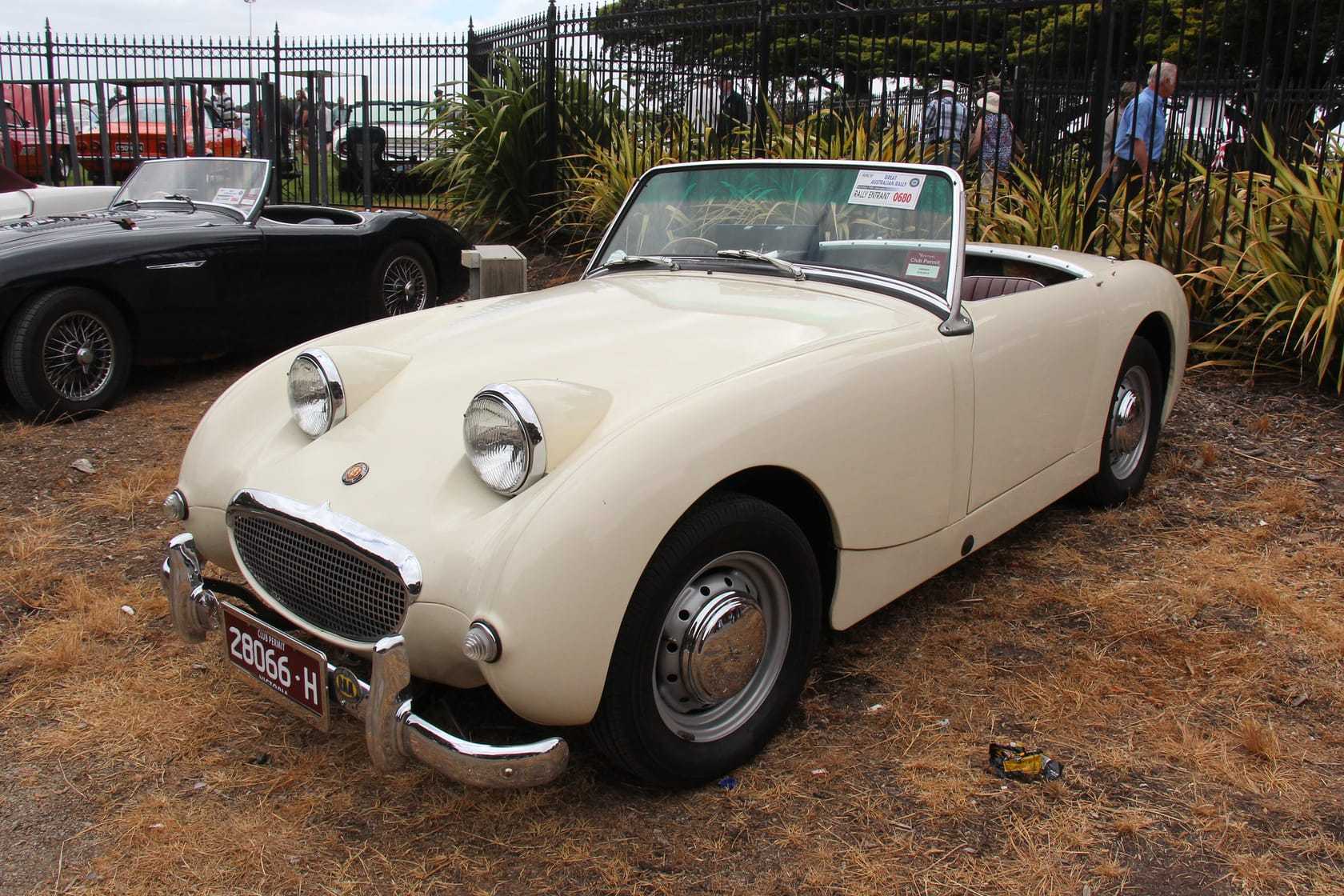
The guides
The British Motor Corporation built both of these, at the same time, with the same engine, for roughly the same money, and they could not be more different. One is a four-seat saloon that won the Monte Carlo Rally three times and drives its front wheels. The other is a two-seat roadster with headlamps on top of its bonnet that drives its rear ones. They share a heart, an era and a price bracket, and the choice between them is a choice about what fun means.
At a glance
| Mini Cooper / Cooper S | Austin-Healey Sprite | |
|---|---|---|
| Built | 1961 to 1971; revived 1990 to 2000 | 1958 to 1971 |
| Production | Something over 100,000 original Coopers (the totals are disputed); many more 1990s cars | About 130,000 across four marks |
| Engine | A-series: 997/998 (Cooper), 970/1,071/1,275 (S), 1,275 (1990s) | A-series: 948, 1,098, 1,275cc |
| Power | Around 55 bhp (998 Cooper) to 76 bhp (1275 S) | Around 43 bhp (Frogeye) to 65 bhp (1275 Mk4) |
| Layout | Transverse engine, front-wheel drive, gearbox in sump | Front engine, rear-wheel drive |
| Body | Two-door four-seat saloon | Two-seat open roadster, monocoque |
| Median auction price | £13,500 (1,101 sales) | £11,708 (636 sales) |
| Price range, middle half | £8,200 to £22,600 | £7,100 to £15,700 |
Auction figures are from our own dataset of UK results, compiled to 10 August 2026, using the median sold price.
What they were
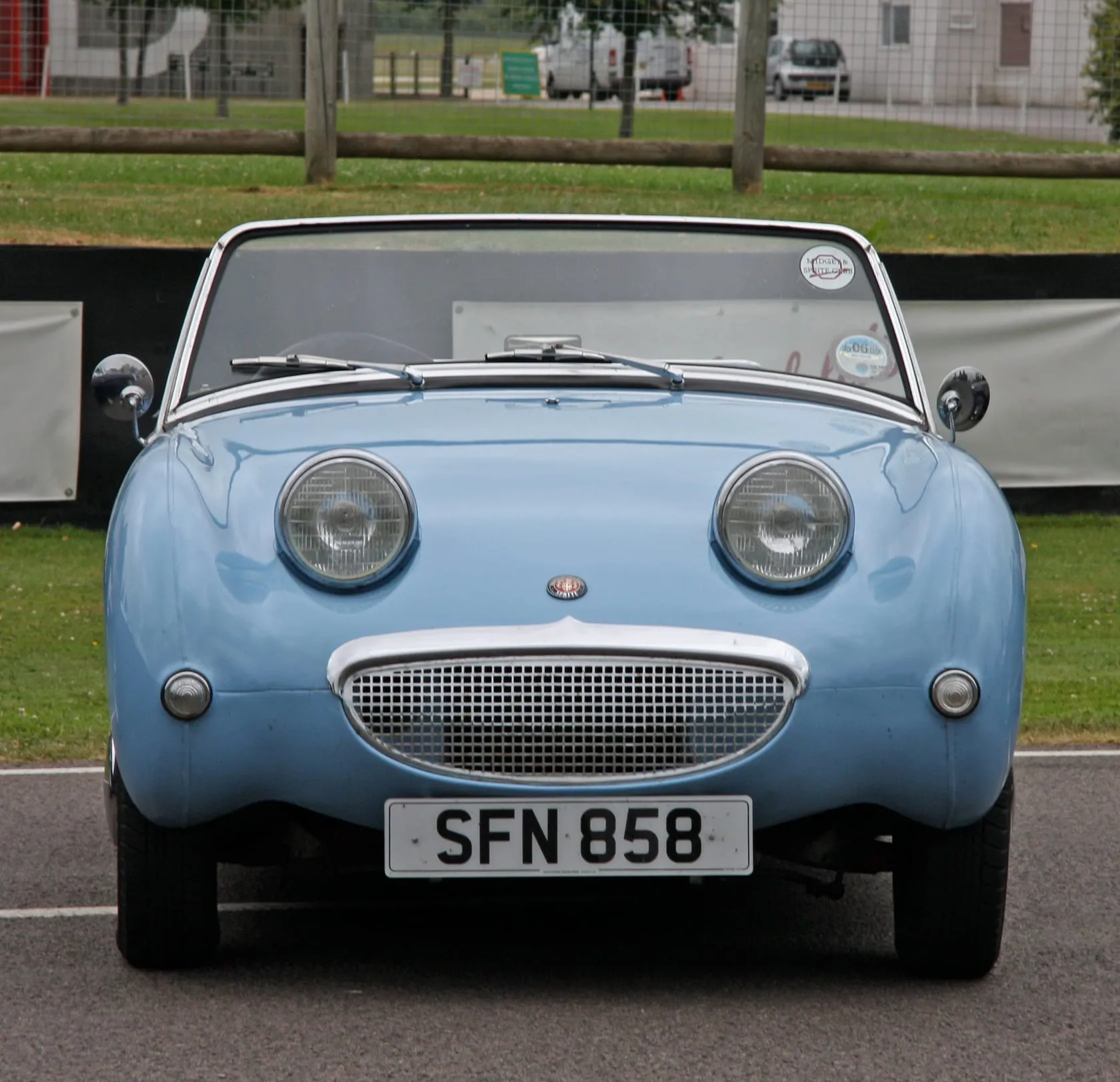
The Sprite came first, in 1958, and it was Donald Healey’s idea of a cheap sports car built from BMC parts: a 948cc A-series, Morris Minor suspension, and a unitary body that was one of the first monocoques on a cheap car. The headlamps were meant to retract; when that proved too expensive they were fixed in their raised position, and the Frogeye was born. In 1961 BMC gave it a conventional nose, added an MG-badged twin called the Midget, and sold the pair as the Spridget for a decade, growing the engine to 1,098 and then 1,275cc. The Sprite name died in 1971; the Midget carried on to 1979.
The Mini arrived in 1959 as Alec Issigonis’s answer to the Suez fuel crisis: a ten-foot car with the engine turned sideways and the gearbox in the sump, driving the front wheels, with room for four adults. John Cooper saw what it could do with more power, and the Cooper of 1961 and Cooper S of 1963 turned a city car into a giant-killer. The S won the Monte Carlo Rally in 1964, 1965 and 1967, and would have won in 1966 but for a disqualification over headlamp regulations that the French organisers have never quite lived down. The original Coopers ended in 1971. Rover revived the name in 1990 with a 1,275cc car, carburetted at first and fuel-injected from late 1991, and those 1990s Coopers are now the bulk of surviving examples. The two cars’ launch prices, three years apart, were within ten pounds of each other: £669 for the Sprite in 1958, a little under £680 for the Cooper in 1961, both with purchase tax.
What they are like
The Cooper is the usable one. Four seats, a roof, a boot, wind-up windows on later cars, and a cabin that seats four adults in a car shorter than most modern superminis. On a twisting road a 1275 Cooper S is still quick in absolute terms, with steering that goes where you look and a front-drive chassis that can be driven on the throttle in a way that converted a generation. It is a classic that can do the shopping, and that is its genius.
The Sprite is the pure one. Two seats, a hood that takes effort, a boot that holds a weekend bag, and an open cockpit that is glorious in summer and bracing otherwise. With the same 1,275 engine as the Cooper S it is lighter and rear-driven, and it feels like a proper sports car in the old sense: small, direct, involving at speeds that would not trouble anything modern. The Frogeye, with its 43 bhp, is slower than almost anything on the road and makes its driver happier than almost anyone else.
What they cost to own
Both run the A-series, which is the best-supported engine in classic motoring, with the thrust washer question and the oil leaks that every A-series owner learns about. Both have parts industries that will supply anything, and for the Mini that extends to complete new bodyshells pressed on original tooling, which is why a rotten Mini is never quite the end.
The Mini rusts everywhere: sills, floors, the front and rear subframes, the A-panels, the boot floor, the door skins. The good news is that every panel is available and a Mini is small enough that the welding bill is proportionate. The subframes are the items to check, because they carry the suspension.
The Sprite’s monocoque rusts in the sills, the floors, the rear spring hangers and the front chassis legs, and a Frogeye’s bonnet is a large, expensive, one-piece item that is often damaged. The parts are shared with the Midget and are as available as the Mini’s.
Both are past the forty-year line for tax and MOT exemption in their original forms, though a 1990s Cooper is not and pays the pre-2001 engine-size rate until it ages in.
The ownership difference that matters most is theft. The Mini is widely reported as Britain’s most-stolen classic: no immobiliser, light enough for two people to lift into a van, parts that fit millions of cars, and a Cooper badge that adds thousands to a shell worth hundreds. A Mini needs the layered approach in our guide to classic car security from the first day, and insurers price where it sleeps. A Sprite is stolen far less often, because it is worth less in pieces.
What the auction record says
Our dataset holds 1,101 Mini Cooper sales and 636 Sprite sales.
The median Cooper sold for £13,500, with the middle half between £8,200 and £22,600. The median Sprite sold for £11,708, with the middle half between £7,100 and £15,700. In the most recent three years the Cooper’s median ran around £13,400 and the Sprite’s around £10,800.
Both figures hide a split that matters more than the headline. The Cooper number blends the 1990s Rover Coopers, which make up most of the sales and sell for a median just under £10,000, with the genuine 1960s Cooper S cars, whose median is around £24,000 and whose Mk1 examples run to £34,000 and well beyond for the right car with the right history. The Sprite number is dominated by the Frogeye Mk1, which accounts for half the Sprite sales at a median near £12,900, while the later Spridget-bodied cars typically sell for £5,000 to £6,000.
The Cooper’s wide middle half, £8,200 to £22,600, is the widest of any comparison on this site, and it is the gap between those two populations. It is also where the fakes live: a genuine 1960s Cooper S is worth verifying through its heritage certificate and its body and engine numbers, because a well-built tribute is indistinguishable from the kerb.
Both have drifted in real terms over the decade, though less steeply than the grand 1960s cars, and both sell readily: around three in four Coopers and nearly four in five Sprites offered find a buyer.
The question behind the question
“Which is the better first classic?” The 1990s Mini Cooper, if usability matters: it is affordable, it has a roof and four seats, and the younger-driver insurance schemes that exist tend to recognise it. The later Sprite, if a sports car matters: it is affordable, it is simple, and it is an honest roadster for Midget money.
“Which is the better investment?” A genuine 1960s Cooper S or a Frogeye, and neither of the cheaper versions. The collectors’ cars are the ones scarcity protects; the volume cars are the ones to drive.
“Which is more fun?” This is the real question and it has two honest answers. The Cooper is fun the way a go-kart is fun, in traffic and on back roads, with friends in the back. The Sprite is fun the way a sailing dinghy is fun, alone or with one passenger, in the open air, at a pace the world has forgotten. Sit in both. The answer will be obvious.
The honest verdict
Same engine, same company, same money, two completely different cars. The Mini is the more useful and the Sprite the more romantic, and the auction record prices them within two thousand pounds of each other, which is the market saying it cannot choose either. Buy the one that matches how you will actually use it, check the numbers on the expensive versions, and lock up the Mini. The full histories are in our pages on the Mini Cooper and the Sprite.
Frequently asked questions
Which is worth more, a Mini Cooper or a Sprite?
Do the Mini Cooper and the Sprite share an engine?
Which is the more usable car?
Is the Mini Cooper really the most stolen classic?
Which should I buy?
Related across themes


More from Owning & running


Recently added

Aston Martin: power, beauty and perpetual peril from Newport Pagnell

TVR Sagaris: 406 bhp, no airbags, and the last car out of Blackpool (2005–2006)

Jaguar XJS vs Triumph Stag: two British grand tourers with a reputation to live down
