Transverse engine, explained
What a transverse engine is, why mounting it sideways unlocked compact front-wheel drive, and how the Mini made the layout the template for the small car.
Part of: the British classic car glossaryThe terms
A transverse engine sits across the car, its crankshaft running from one side to the other rather than front to back. Turning the engine ninety degrees sounds like a small change, but it rewrote the packaging of the ordinary car, because an engine mounted sideways no longer needs a long bonnet to live in and drops naturally into a compact front-wheel-drive nose.
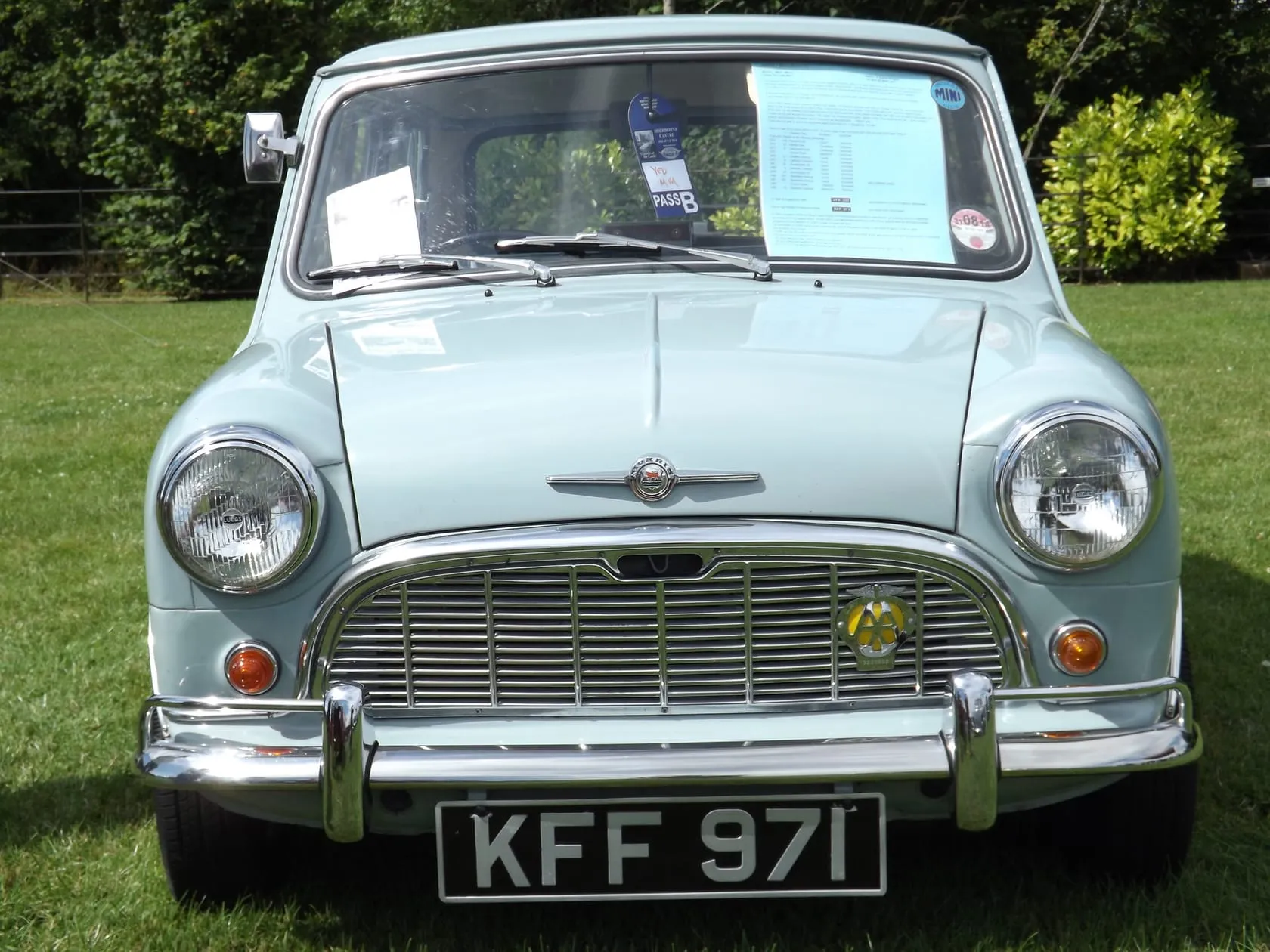
For British classics the story is really one car. The Mini of 1959 took the transverse engine from curiosity to template, and almost every small car built since has followed the layout it proved.

What a transverse engine is
In the older, conventional layout the engine sits lengthways, or longitudinally, its crankshaft pointing along the car towards a gearbox and then a propshaft running back to the rear wheels. It is a logical arrangement, but it eats space: the engine, clutch and gearbox form a long spine down the middle of the car.
A transverse engine turns that spine sideways. The crankshaft now runs across the car, the drive goes straight to the wheels alongside it, and the whole power package collapses into a short block at one end. Put it at the front, driving the front wheels, and the result is a car that is mostly cabin.
How the Mini made it the template
Alec Issigonis did not invent the sideways engine, but his Mini made it work for the mass market. The trick that made it fit was mounting the gearbox underneath the engine, in the same casing, sharing the same oil. That kept the power unit short enough to sit across a car only ten feet long.
The pay-off was space. Issigonis reckoned the Mini devoted around four-fifths of its floor area to passengers and luggage, an unheard-of proportion for so small a car, and it came almost entirely from turning the engine sideways and driving the front wheels. The handling that came with putting the weight over the driven wheels was a bonus that the racing Coopers soon exploited.
Where BMC took it next
Having proved the layout on the Mini, BMC and then British Leyland rolled it out across the range:
- The 1100 and 1300 (ADO16) of 1962 scaled the idea up into a roomy family car that became Britain’s best-seller.
- The Austin Maxi of 1969 added a five-door body and a five-speed gearbox to the same basic front-drive, transverse-engine recipe.
- The Allegro of 1973 carried it on, if to a cooler reception.
- The Austin Princess stretched the layout to a big family car, its transverse engine and front-wheel drive giving the long bonnet that the wedge styling made the most of.
Many of these cars paired the sideways engine with another piece of the same engineering school, the interconnected hydrolastic suspension developed alongside it.
Why it still matters under the bonnet
For an owner the transverse layout shapes how the car is worked on. The engine bay is full, with the gearbox and final drive built into the same unit, so jobs that are simple on a rear-drive classic, a clutch change above all, can mean dropping the whole power unit. The shared-oil gearbox on the early cars also means the right oil and regular changes matter more than usual.
None of that makes these cars hard to live with, but it does explain why a front-drive BMC classic asks for a different set of habits, and a different specialist, from a traditional rear-drive sports car of the same era.
Related
- The 1960s page covers the decade the Mini’s layout was born into.
- For the broader scope question, see which cars count as British classics.