British classic cars of the 1960s
Britain's high-water mark as a car maker, the British cars of the 1960s running from the Mini and the E-Type to the Cortina, the DB5, and the export boom that briefly made it the world's sports-car factory.
Part of: British classic cars by decade, the full guide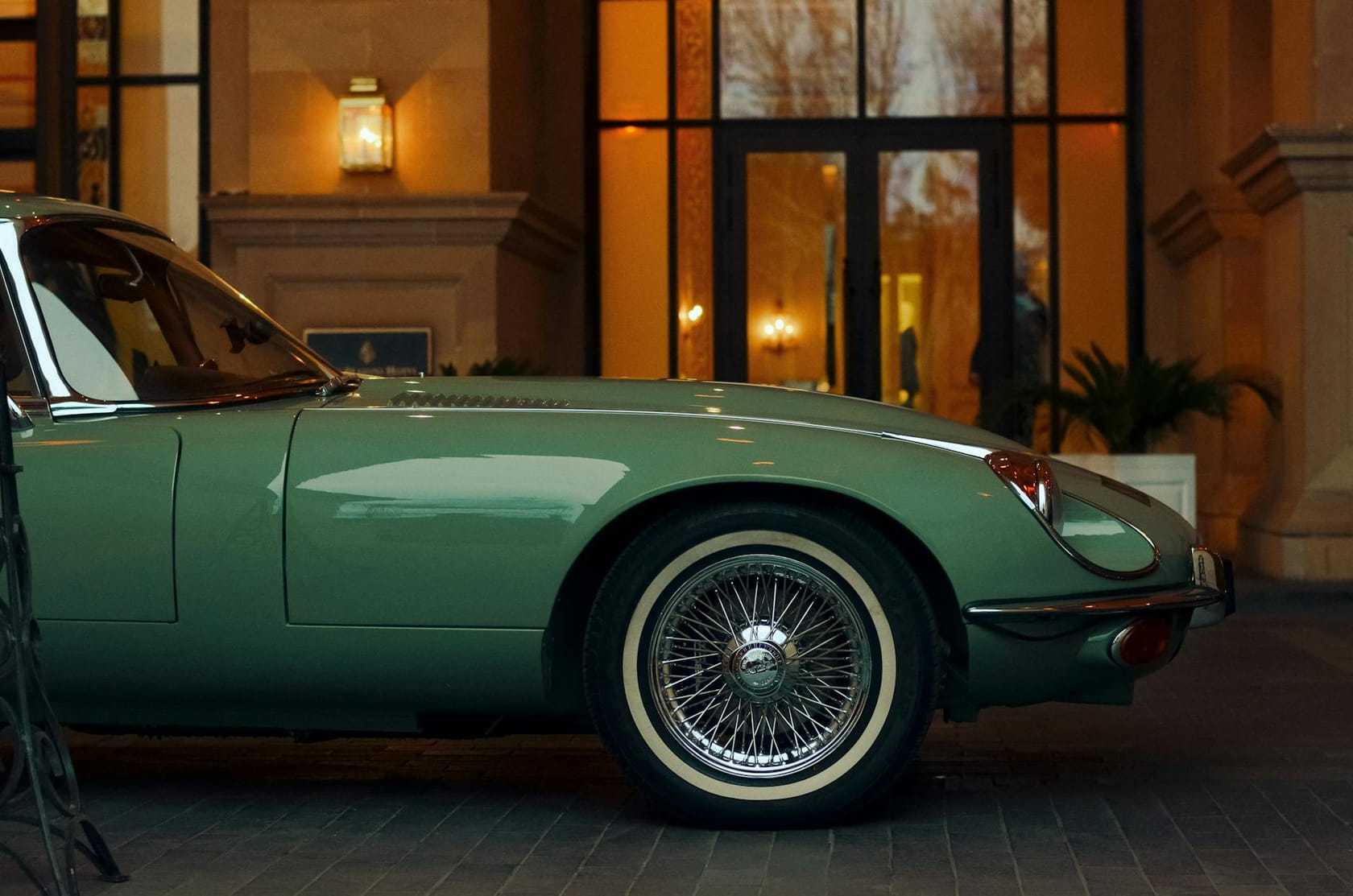
The decades
The British cars of the 1960s are what most enthusiasts mean when they say “the good old days.” This is the decade of the E-Type and the DB5, of the Mini that won the Monte Carlo Rally three years running, of the MGB and the Cortina Lotus and the Aston Martin DB6. It’s also the decade when British car manufacturing was at its peak output, before British Leyland was formed in 1968 and the industrial story of the following twenty years started to unfold.
The Mini and the small car
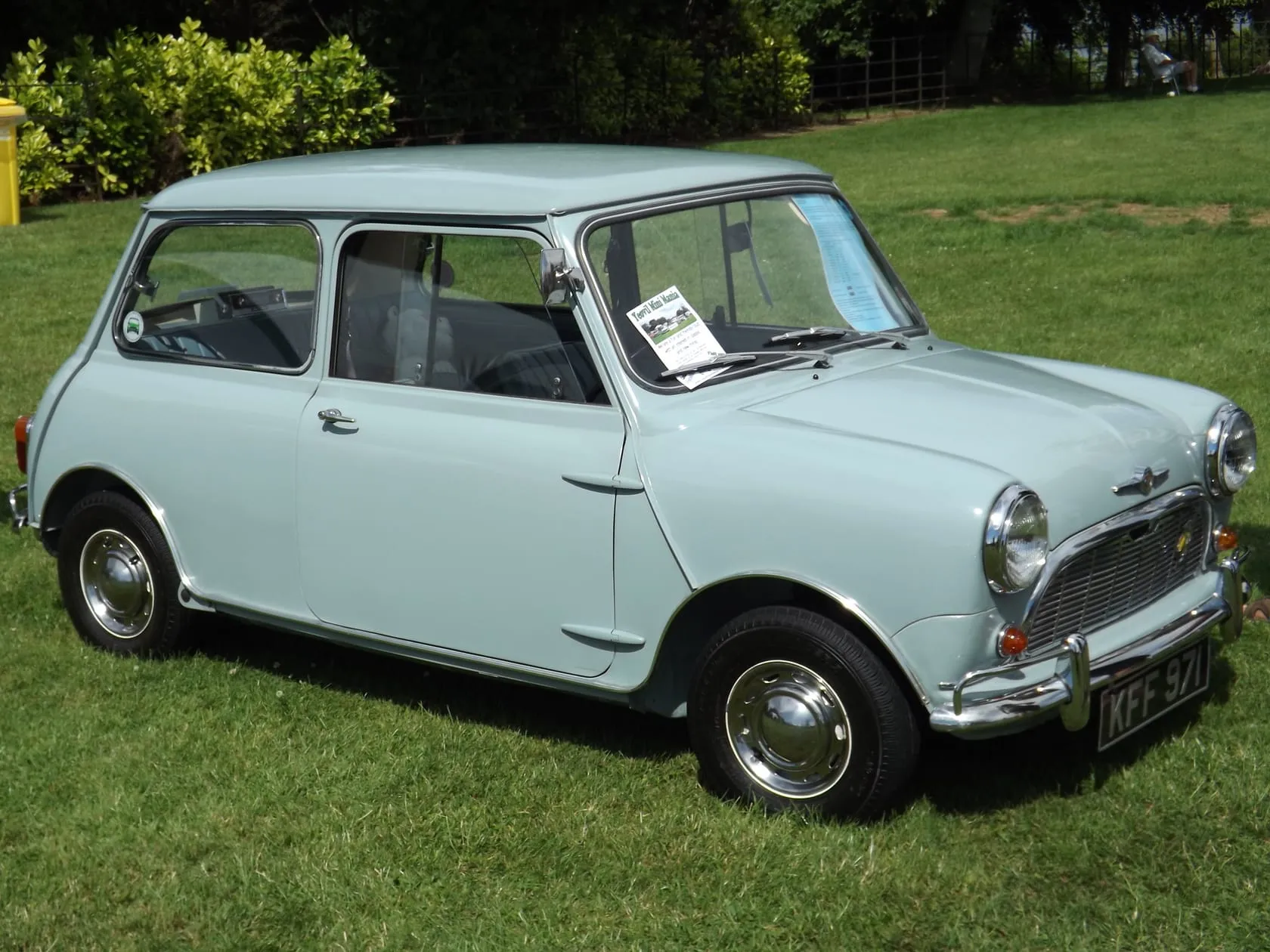
The Mini’s launch in 1959 was a 1960s story. Alec Issigonis’s design for BMC packaged four adults and their luggage into a car ten feet long by laying the engine sideways and putting the gearbox in the sump. It changed every small car that came after it. The 1960s saw the Mini grow from “interesting new economy car” into “national phenomenon.” Mini Cooper (1961) added a tuned A-series engine and disc brakes. Cooper S (1963) added more of everything. Mini Cooper S works rally cars won the Monte Carlo Rally in 1964, 1965 and 1967, and were controversially disqualified from a win in 1966 over a headlamp regulation. By the end of the decade the Mini was the default small car of British motoring culture, and a London Carnaby-Street accessory in a way no car has quite been since. The Italian Job sealed the image in 1969, sending three Cooper S’s through Turin with the gold in the back.
The Hillman Imp (1963 to 1976) was the Rootes Group’s attempt at a Mini-rival, with a rear-engined aluminium-block design that was technically interesting but never matched the Mini’s commercial success. Imps are now interesting classics precisely because so few survived.
The Austin/Morris 1100 and 1300 (1962 to 1974) was the slightly bigger family car using the same Issigonis transverse-engine front-wheel-drive package as the Mini. Enormous seller in its day, now relatively rare. The MG 1100 and MG 1300 (1962 onward) were the sporting versions.
At the opposite extreme of the small-car idea sat the Peel P50, built on the Isle of Man from 1962 and still the smallest production car ever made: a single-seat, three-wheeled microcar with a 49cc engine and no reverse gear, more a curiosity than everyday transport even when new.

The E-Type and the British supercar moment
The Jaguar E-Type launched at the Geneva Motor Show in March 1961 and became, in a phrase often attributed to Enzo Ferrari, “the most beautiful car ever made.” It was a 150 mph car selling for under £2,000, with covered headlamps, a six-cylinder engine derived from the Le Mans-winning D-Type, and styling by Malcolm Sayer that remains the benchmark for British sports-car design.
The E-Type Series 1 (1961 to 1968) is the purest expression of the design, with the small bumpers and uncovered headlamps appearing gradually with US-market regulations through the late 1960s. The Series 1.5 (1968) added some federalised changes. The Series 2 (1968 to 1971) carried the model into the next decade. The 4.2-litre engine arrived in 1964; the 2+2 body in 1966; the V12 came in 1971 in Series 3 form (just outside our 1960s scope).
The E-Type is the British sports car everyone has heard of. It sold around 72,000 units across all variants by the end of production in 1975, and remains the single most recognised British classic worldwide. Survivors today are six-figure cars in good condition.

Sports cars and the export boom
Outside the E-Type, the 1960s was the peak decade for British sports cars in volume terms. The MGB launched in 1962 and ran until 1980, with the 1960s versions (chrome bumpers, all-steel construction, properly sorted by the mid-decade) being the ones collectors particularly value. The MG Midget (1961 onward) was the smaller, cheaper version sharing components with the Austin-Healey Sprite “Frogeye.”
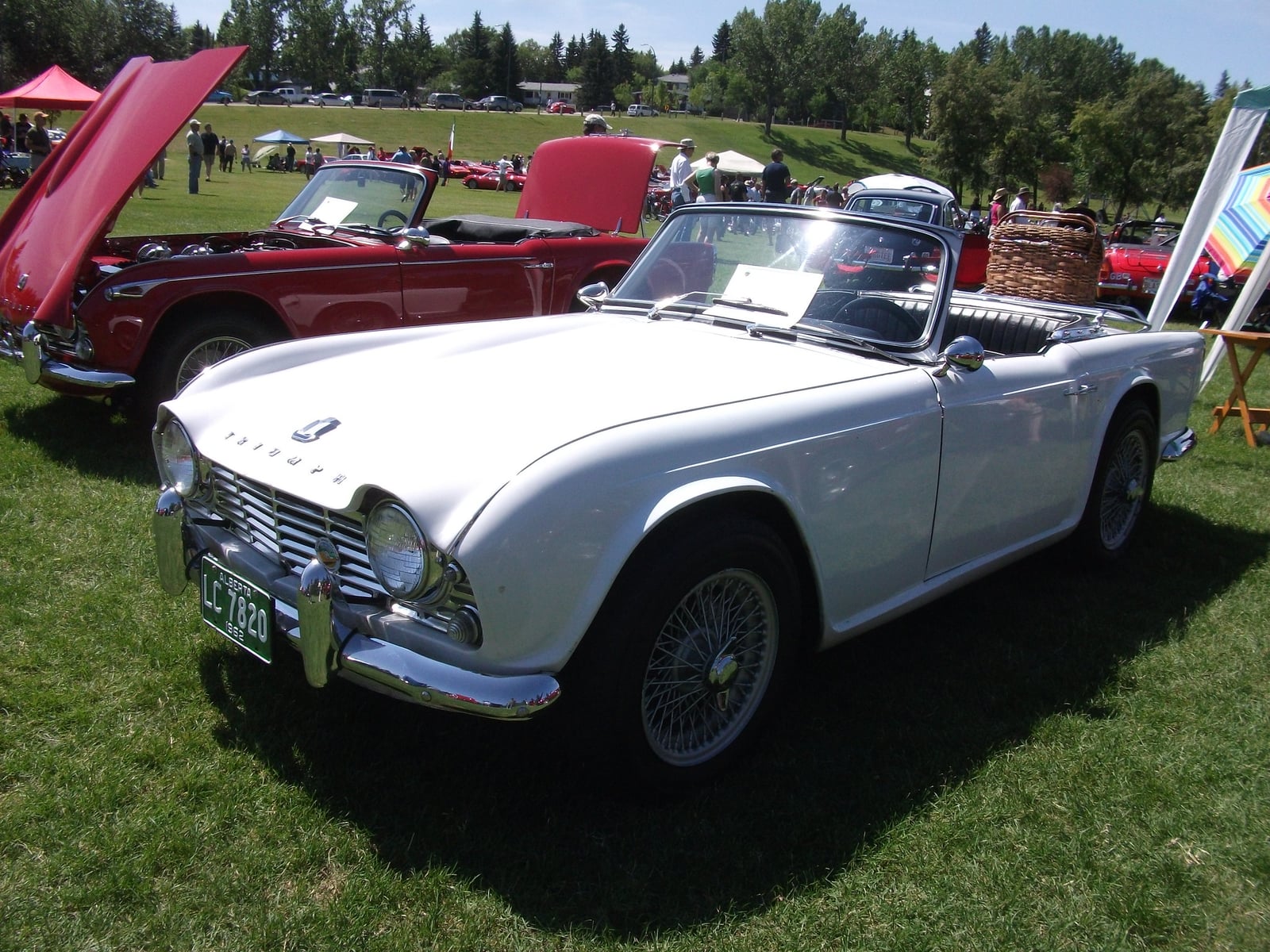
Triumph’s 1960s ran from the TR3A (1957 to 1962, briefly into the decade) through the TR4 (1961 to 1965), TR4A with independent rear suspension (1965 to 1967), TR5 with the 2.5 PI fuel-injected straight-six (1967 to 1969), and into the TR6 introduced in 1968. The Spitfire (1962 to 1980) was the smaller, cheaper Triumph sports car running through Mk1, Mk2 and Mk3 versions through the decade.
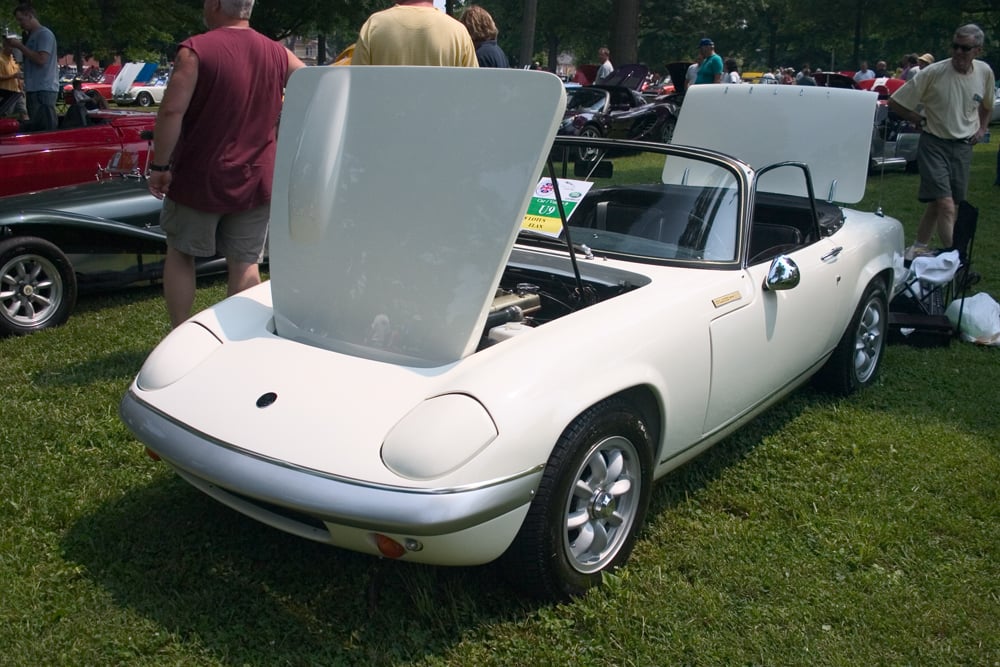
Lotus’s 1960s was the Elan years. The Lotus Elan (1962 to 1973) was the lightweight twin-cam sports car that defined what a Lotus should be: small, light, perfectly balanced, fast for its capacity. Elans are among the most expensive 1960s British sports cars today. The Elan +2 (1967 onward) added two small rear seats and became a 2+2 GT.
The Austin-Healey 3000 (1959 to 1968) ran through the early-mid 1960s in Mk1, Mk2 and Mk3 forms, with the Mk3 being the most sought-after. The Sunbeam Tiger (1964 to 1967) was the Rootes Group’s answer: an Alpine bodyshell with a Ford V8 engine. Few built; survivors are six-figure cars.
The Sunbeam Alpine (1959 to 1968) was the more sensible four-cylinder sports car from the same family, and ran in five series across the decade. It’s the affordable end of 1960s British sports-car ownership.

Saloons
Jaguar’s 1960s split between two cars. The Mk2 (1959 to 1967) was the compact sporting saloon of the decade, with the 3.4 and 3.8 versions giving rise to the bank-robbery getaway-car cliché. The 240/340 facelift carried the design into 1969. The XJ6 launched in 1968 and is largely a 1970s story, but the design and engineering that defined the next twenty years of Jaguar saloons started in the late 1960s.
Rover’s 1960s ran on two parallel lines. The Rover P5 (1958 to 1973) was the traditional wood-and-leather executive saloon, the P5B (1967 onward) added a Buick-derived 3.5-litre V8. The P6 (1963 to 1977) was the modern hatchback-shaped saloon competing with the new Triumph 2000 and Volvo 144. The Rover P6 V8 (1968 onward) combined the new chassis with the V8 engine and was the original post-Issigonis-Mini British driver’s saloon.
Ford’s 1960s gave us the Cortina. The Mk1 Cortina (1962 to 1966) was the rear-wheel-drive family saloon that became Ford UK’s best seller and the template for British family motoring through the next decade. The Lotus Cortina (1963 to 1966) was the touring-car homologation, a twin-cam-engined Cortina that won touring-car championships in the hands of Jim Clark. The Mk2 Cortina (1966 to 1970) softened the styling but kept the formula. Cortina GT and 1600E became the aspirational versions.
The Ford Anglia 105E (1959 to 1967) sat below the Cortina and was the small Ford of the era. Famous for the reverse-rake rear window, and given a second cultural life in the Harry Potter films thirty years later. Anglia 105E values have risen substantially in the past decade.

Grand tourers
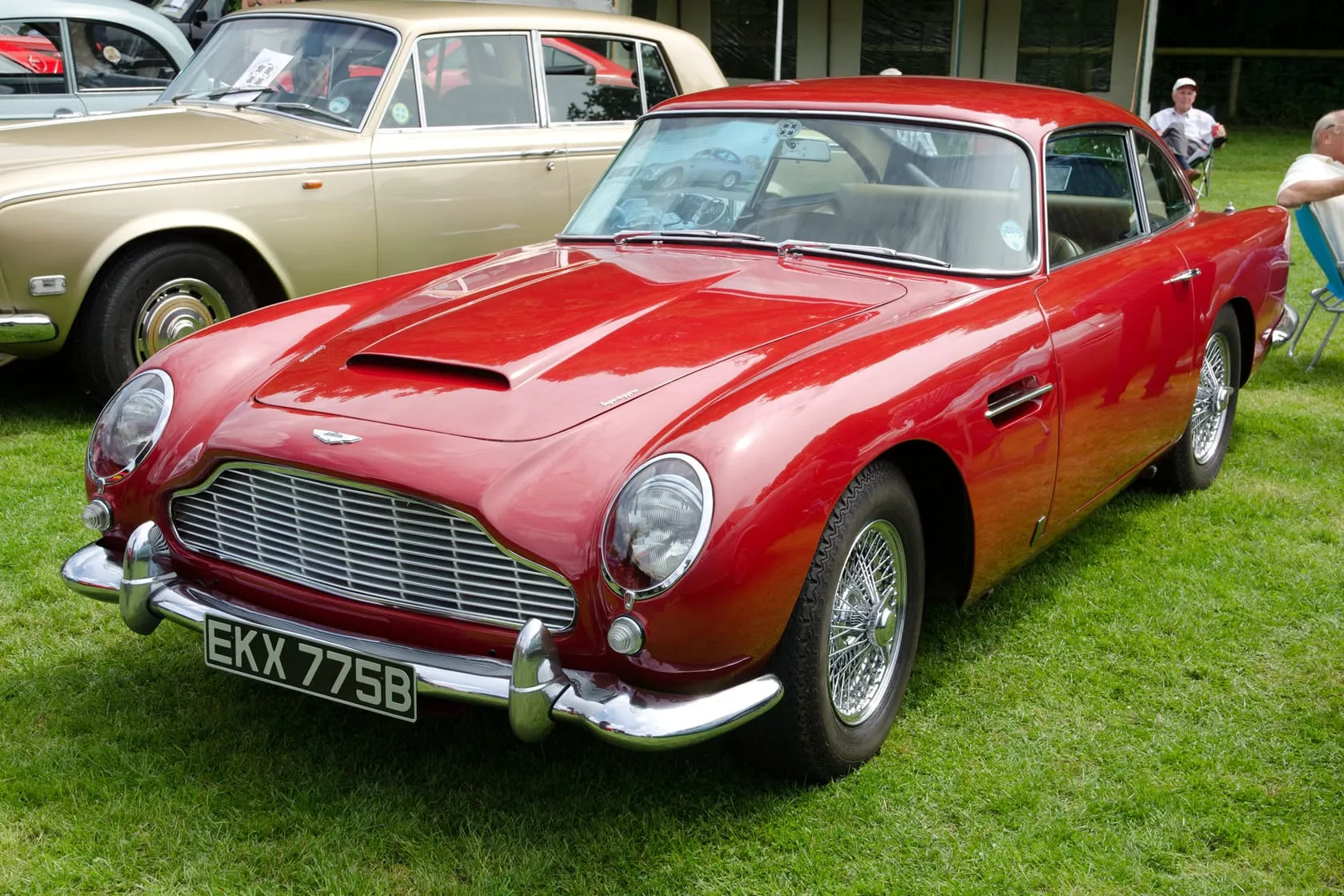
The Aston Martin 1960s were the DB years. The DB4 (1958 to 1963) ran into the decade in DB4 and DB4 GT forms. The DB5 (1963 to 1965) was the Bond-film Aston, recognised globally after Goldfinger released in 1964. The DB6 (1965 to 1971) was the bigger, more practical successor. The DBS launched in 1967 and bridged into the 1970s.
DB5s are now among the most expensive British classics in existence, with the silver Goldfinger continuation cars selling at seven figures.
Jensen started its 1960s with the CV8 (1962 to 1966) and ran into the original Interceptor (1966 to 1976), an Italian-bodied British GT with a Chrysler 6.3-litre V8. The Jensen FF (1966 to 1971) was the four-wheel-drive variant of the Interceptor and a technical landmark: the first production car with both four-wheel drive and anti-lock brakes.
Bristol’s 1960s ran through the 407, 408 and 409 (all 1961 to 1966), the 410 (1968 to 1969), and into the 411 (1969 to 1976). Hand-built, low-volume, idiosyncratic GTs from Filton.

Land Rover and the heavy 4x4
Land Rover’s 1960s was the Series II and Series IIA decade. Production of the Series II started in 1958 and ran into 1961. The Series IIA (1961 to 1971) was the mainstream Land Rover of the decade and the model that defined “Land Rover” for a generation. 1960s IIA Land Rovers in 88-inch and 109-inch wheelbases are now among the most sought-after working classics.
The Range Rover was launched in 1970, but its development was substantially a 1960s story. Land Rover’s engineering team had been working on a more comfortable, road-capable 4x4 from the early 1960s, and the prototype “Velar” test mules were running by 1968. The 1960s set up the 1970s launch.

The everyday cars
Beyond the famous ones, the 1960s was the decade when British small saloons sold in enormous volumes:
- Vauxhall Victor and Vauxhall Cresta (early 1960s): the British Vauxhall equivalents of period American styling, now rare survivors.
- Singer Chamois and Singer Gazelle: the Rootes Group’s upmarket-branded versions of the Hillman Imp and Minx, sold through dealers competing with Austin Cambridges.
- Wolseley Hornet and Riley Elf (1961 to 1969): badge- engineered Minis with longer boots and more chrome, sold at higher prices to a slightly older demographic.
- Morris Oxford / Austin Cambridge “Farina”: the medium saloon of the early decade, with Pininfarina-designed bodywork.
These cars are now genuinely rare. They were scrapped in enormous numbers in the 1980s and 1990s when British saloons of this era were just “old cars” with no collector value. Survivors today have become unexpectedly interesting precisely because of how few there are.

Racing: the decade Britain owned the grid
The 1950s had put Britain on the podium; the 1960s put it in charge. British constructors (Cooper, BRM, Lotus and Brabham) won seven of the decade’s ten Formula One constructors’ championships, and Graham Hill, Jim Clark, John Surtees and Jackie Stewart took six drivers’ titles between them. Clark’s Lotus 25, with its pioneering monocoque chassis, and the Cosworth DFV engine of 1967, built in Northampton and destined to win more Grands Prix than any engine before or since, made the British “garagiste” constructors the permanent centre of the sport.
The road cars fed off it directly. The Lotus Cortina won touring-car championships with Clark sliding it on three wheels, the Mini Cooper S took its three Monte Carlo wins, and the Elan and the E-Type sold on the same racing green. The motorsport-engineering belt that still runs through Oxfordshire and Northamptonshire today was laid down in these years.

What made the 1960s distinctive
Three threads sit at the heart of the decade.
The first is British manufacturing volume. By the mid-1960s the UK was producing around 2 million cars per year and was a major net exporter of sports cars in particular. Every American suburb had an MG, a Healey, or a Triumph in the driveway. The export economy that the British sports-car industry built in this decade is what sustained the marques into the 1970s when the domestic market weakened.
The second is the design moment. The E-Type, the Mini, the DB5, the Elan, the Mk1 Cortina, the Range Rover prototype work, the Aston DB6. These cars came out of a particular British design culture that combined engineering pragmatism (Issigonis, Chapman, Sayer) with traditional craft (wood, leather, chrome, hand-built small-volume production). That combination peaked in this decade and never quite repeated itself.
The third is the corporate consolidation that defined what followed. The British Motor Corporation merged with Jaguar in 1966 to form British Motor Holdings. BMH merged with Leyland Motors in 1968 to form British Leyland. By the end of the decade most of the independent British marques (Austin, Morris, MG, Riley, Wolseley, Triumph, Jaguar, Daimler, Rover, Land Rover) sat inside a single corporate structure. The story of how that structure handled the 1970s is the 1970s page story; the 1960s set the stage.
The decade closed with the Range Rover in development, the XJ6 just launched, the E-Type still in production, the Mini still selling, and British sports cars dominant in their global market. By 1979 most of those positions had reversed. The 1960s remains the high-water mark of British post-war motoring and the cars from this decade are, broadly, the most valuable of any British classic era.
If you want to read forward, the 1970s page picks up the story. Reading backwards, the 1950s covers the decade the 1960s grew out of (the MGA, the XK140 and XK150, the Austin-Healey 100, the Bentley R-Type Continental, the Land Rover Series I) and the 1940s goes back to the post-war restart and the “Export or Die” policy that built the American sports-car market the 1960s lived off. For broader scope, see which cars count as British classics.

More photos
The cars of the 1960s
53 guides1960


1967


Frequently asked questions
What are the best British classic cars of the 1960s?
Why is the 1960s seen as the peak of British car making?
How many Jaguar E-Types were made?
What rallies did the Mini win in the 1960s?
When was British Leyland formed?
Did Britain dominate Formula One in the 1960s?
What were the most popular British cars from the 60s?
Related across themes
Recently added

Bentley S-series: the quiet twin with the beautiful secrets (1955–1965)

Rolls-Royce Silver Spirit and Silver Spur: the last Crewe bargain (1980–1999)

Rolls-Royce Corniche: the coachbuilt survivor that outlived its makers (1971–1995)
