British classic cars of the 1980s
The turbo era and the birth of the hot hatch, the British cars of the 1980s running from the Sierra Cosworth and the Esprit Turbo to the Range Rover, the XJ40, and the performance cars that landed on everyone's neighbour's driveway.
Part of: British classic cars by decade, the full guide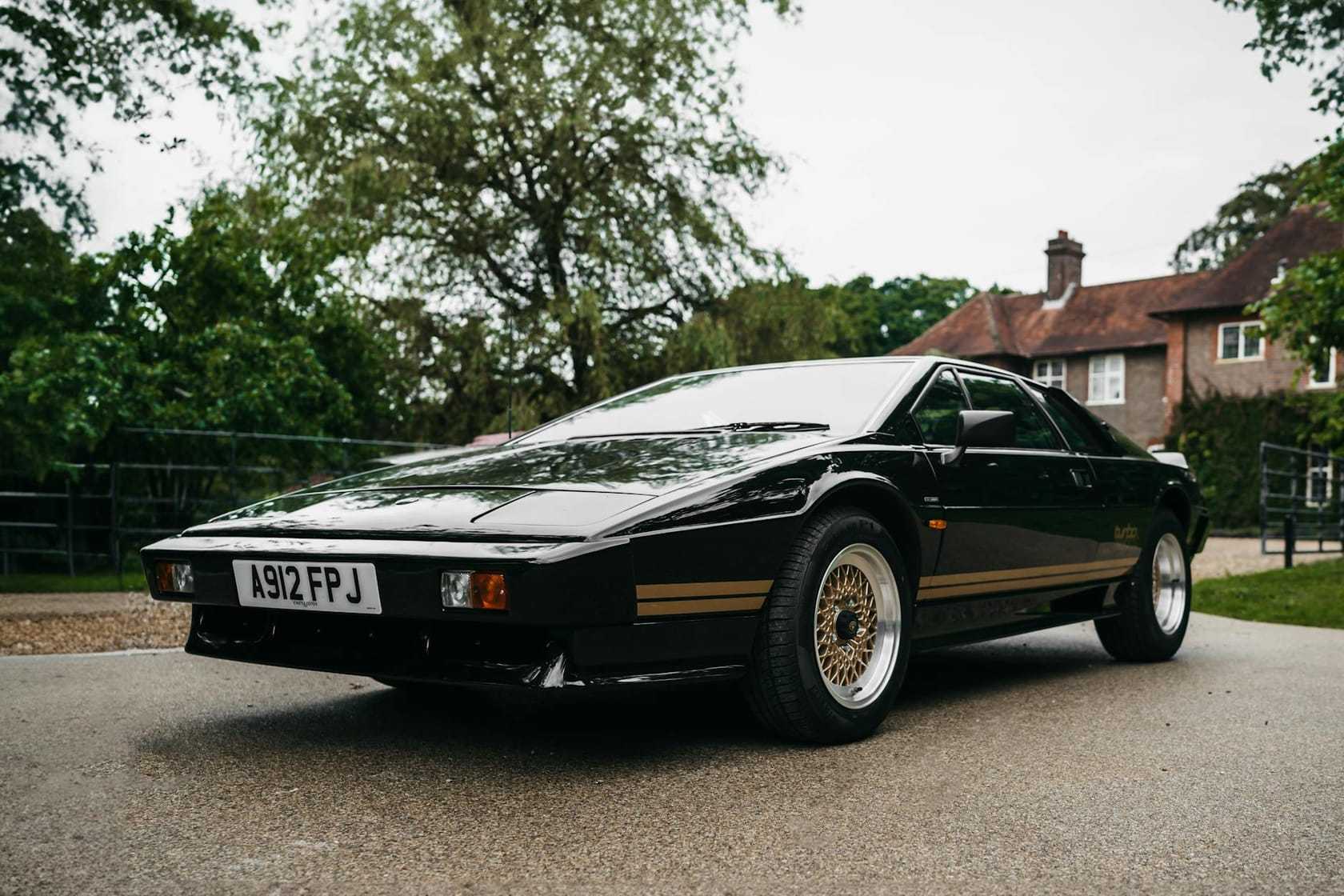
The decades
The British cars of the 1980s came out of a decade that picked itself up off the floor. The chaotic years that produced the Allegro and the Princess gave way to Austin Rover, then to the sale of Jaguar and Land Rover into private hands, and eventually to the rise of two cars that defined an entire enthusiast generation: the Ford Sierra Cosworth and its Sapphire saloon sibling. The decade also saw the hot hatch arrive in everyone’s neighbour’s driveway, the Range Rover quietly become the most copied car in the world, and TVR relaunched as a serious sports-car maker. By 1989, British motoring felt more confident than it had at any point in the previous fifteen years.
Fast Fords and the Cosworth era
The Cosworth-Ford story is the defining performance-car narrative of the 1980s. The Sierra RS Cosworth, launched in 1986, was a 2.0-litre turbocharged four-cylinder built specifically for Group A touring-car homologation, and it did exactly what was needed. The three-door bodyshell with the enormous rear wing became one of the most thefted cars in the UK during the late 1980s for the same reason that made it irresistible to enthusiasts: 204 horsepower from the road car, more again from the racing versions, in a Ford that started life as a sensible family saloon.
The Sapphire RS Cosworth (1988 to 1992) brought the same engine into a four-door bodyshell and shifted the demographic slightly upward without softening the performance. The Escort RS Cosworth arrived right at the end of the decade in 1992, missing the 80s cut-off, but its development was a 1980s story.
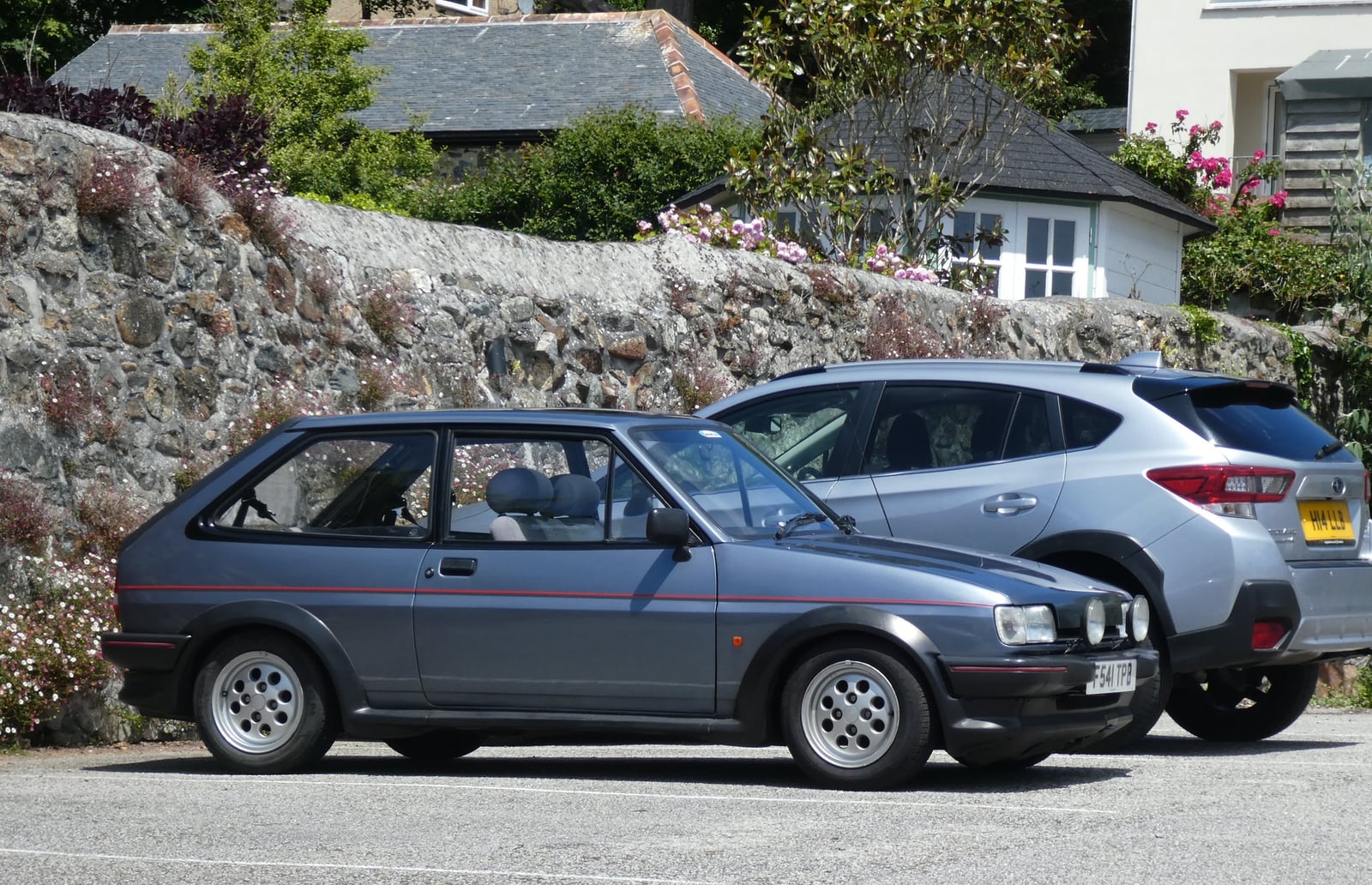
Below the Cosworth tier, the Escort XR3i (1983 onward) and the Fiesta XR2 (Mk1 1981–1983, Mk2 1984–1989) democratised the fast Ford concept. These were the cars that filled the spaces in suburban driveways where the previous decade’s Capri had been. Escort RS Turbo (1984 to 1986 as the Mk3 RS Turbo, then continued as the RS Turbo Mk4 to 1990) sat between the XR3i and the Cosworth, with a turbocharged four-cylinder and a distinct sub-culture of its own.

Sports cars and supercars
Lotus spent the 1980s with the Esprit. The original Giugiaro-wedge Esprit had launched in 1976; the Stevens-restyled version with softer corners replaced it in 1987 and ran into the 1990s. The Turbo version, available from 1980, was the British supercar that sat next to Ferraris in the school car parks. The Esprit became a 1980s pop-culture object as much as a car, helped by film appearances and a quietly evolving engineering reputation.
TVR’s 1980s is the Peter Wheeler era. Wheeler bought the company in 1982 and turned it from the small-volume kit-car-derived manufacturer of the M-series and the Tasmin into something recognisably TVR-as-we-came-to-know-it: glassfibre-bodied, big-engined, dramatic. The 350i (1983 to 1990) used the Rover V8 and was the first proper Wheeler-era car. The 450 SE arrived in 1988 with more power again. By the end of the decade TVR was selling more cars than at any point in its history.
Aston Martin’s 1980s started with the V8 Vantage (the savage version of the long-running V8) and ended with the Virage, which launched in 1989 and ran into the 1990s. The Vantage Volante, the soft-top with the bodykit, has become one of the most sought-after 1980s Astons. The Zagato (1986 to 1989) was the special-bodied edition that made the period’s enthusiast press. Throughout the decade Aston was changing ownership again, with Ford acquiring a substantial stake in 1987 and full control in 1991.
The Vauxhall Lotus Carlton arrived at the very end of the decade (launched 1990, but the development was very much 1980s) and is worth mentioning as the British car the tabloid press tried to ban for being too fast. A 377-horsepower twin-turbo six in a four-door saloon, capable of 176 mph. Embarrassing for the establishment; glorious for everyone else.

Jaguar goes racing again
One story of the decade tends to get lost between the Cosworths and the privatisations: Jaguar went back to the front of world motorsport. The ground had been prepared in America, where Bob Tullius’s Group 44 team raced V12 XJ-Ss and then took the marque back to Le Mans, and at home Tom Walkinshaw’s TWR operation won the 1984 European Touring Car Championship outright in an XJ-S.
TWR then built the works Group C programme, and the purple Silk Cut prototypes became one of the sights of late-1980s racing. The XJR-8 won the World Sportscar Championship in 1987, and in 1988 the XJR-9 won it again and took the Le Mans 24 Hours, Jaguar’s first win there since 1957 and Britain’s first since Aston Martin in 1959. For a company that had been a struggling corner of British Leyland a few years earlier, it was the clearest signal of the decade that the confidence was back.

Executive saloons
Jaguar’s 1980s belongs to two cars. The XJ Series 3 (1979 to 1992 for the 6-cylinder, 1979 to 1986 for the V12) was the run-out version of the original Lyons-era XJ shape, and it was beautifully sorted by the end. The XJ40 (1986 to 1994) was the new XJ, the first fundamentally new big Jaguar saloon in two decades, with square-cut styling that took some getting used to but a chassis that was a significant step forward.
Both cars saw Jaguar through privatisation in 1984. The company was bought by Ford in 1989, and that’s largely a 1990s story, but the foundations laid in the 1980s (build quality finally taken seriously, XJ40 properly engineered, the XJR sub-brand becoming a real thing in 1988) are why Jaguar was a credible business going into Ford ownership.
The Rover SD1 finished its production run in 1986 and was replaced by the Rover 800 (1986 onward), the British half of a joint development project with Honda that became the Legend. The 800 moved Rover upmarket but never quite cracked the executive segment the way the SD1 had. Sterling versions sold poorly in America and contributed to Rover’s eventual retreat from the US market.
Ford’s executive contender was the Granada Mk3 (1985 to 1994), which replaced the bulkier Mk2 with smoother hatchback styling and became a normal sight on company-car schemes through the late 80s and early 90s. Scorpio versions sit at the top of the tree.

Luxury
Bentley reinvented itself in the 1980s. The Mulsanne (1980 to 1992) was the entry-level Bentley saloon for most of the decade, but the Turbo R (1985 to 1997) was the car that mattered. Turbocharging the 6.75-litre V8, lowering the suspension, fitting wider wheels, and selling it as a sports saloon rather than a chauffeur-driven limousine, was a marketing reinvention as much as an engineering one. Bentley sales by the end of the decade exceeded Rolls-Royce for the first time in living memory.
Rolls-Royce in parallel ran the Silver Spirit and Silver Spur (1980 to 1998) as the traditional Rolls products, with relatively modest mid-cycle updates. These are the comfortable, slightly old- fashioned Rolls of the period, and they’re now affordable used classics in good cosmetic condition (though running costs remain considerable).
Daimler continued as the badge-engineered upmarket Jaguar through the decade. The Daimler Double Six was the V12 XJ in Daimler trim; the Sovereign was the equivalent 6-cylinder. Both ran alongside the Jaguar versions.

The Range Rover and the rise of the British 4x4
The Range Rover Classic (introduced 1970, ran until 1996) spent the 1980s gradually transforming from “useful country vehicle” into “socially aspirational object.” Four-door versions arrived in 1981; Vogue trim appeared in 1981 as well; the V8 EFI Vogue SE came in 1984; the LSE long-wheelbase version arrived at the end of the decade. By 1990 the Range Rover had been adopted by everyone from the Royal Family to City brokers, and the term “Chelsea tractor” hadn’t yet been coined.
The Land Rover 90 and 110 launched in 1983 (renamed Defender in 1990), replacing the Series III with coil springs, more comfortable interiors, and the same essential mechanical layout that would run through to the end of production in 2016. The hundred-inch-wheelbase Defender 90 became the working-classic of choice for anyone with a smallholding, a horsebox, or a fortieth-birthday photograph in the Lake District.
The Discovery launched in 1989, also too late to be a 1980s car in sales terms but a 1980s development story. Land Rover entered the 1990s with three distinct model lines for the first time in its history.

Hot hatches and the small-car explosion
The Austin Metro (1980 to 1990) replaced the Mini as Austin’s volume small car and sold well for most of its run. The MG Metro Turbo (1982 onward) was the sporting version, with a turbocharged 1.3-litre engine and the MG badge applied liberally. Surprisingly fast for the size. The MG Metro 6R4 (1985) was the Group B rally homologation: a mid-engined, four-wheel-drive 250-horsepower V6 monster that bore essentially no resemblance to the road Metro. Group B got banned after the 1986 season; the 6R4 became a sought-after rally-historic-class car.
The Austin Maestro (1983 to 1994) and Montego (1984 to 1994) were the larger saloons in the same Austin Rover range. Neither has aged into nostalgia the way the period Fords have, but the MG Maestro Turbo (1989 to 1991) is now a sought-after enthusiast piece.
Outside the Austin Rover stable, the period’s hot-hatch landscape was dominated by the Volkswagen Golf GTI, the Peugeot 205 GTI, and the Renault 5 GT Turbo (all non-British). British counterparts came from the XR3i, the Astra GTE (Vauxhall, 1983 onward), and the Cavalier SRi (Vauxhall, 1984 onward). The Vauxhall Astra GTE in particular has aged into a respected classic; survivors are becoming hard to find.

The everyday cars
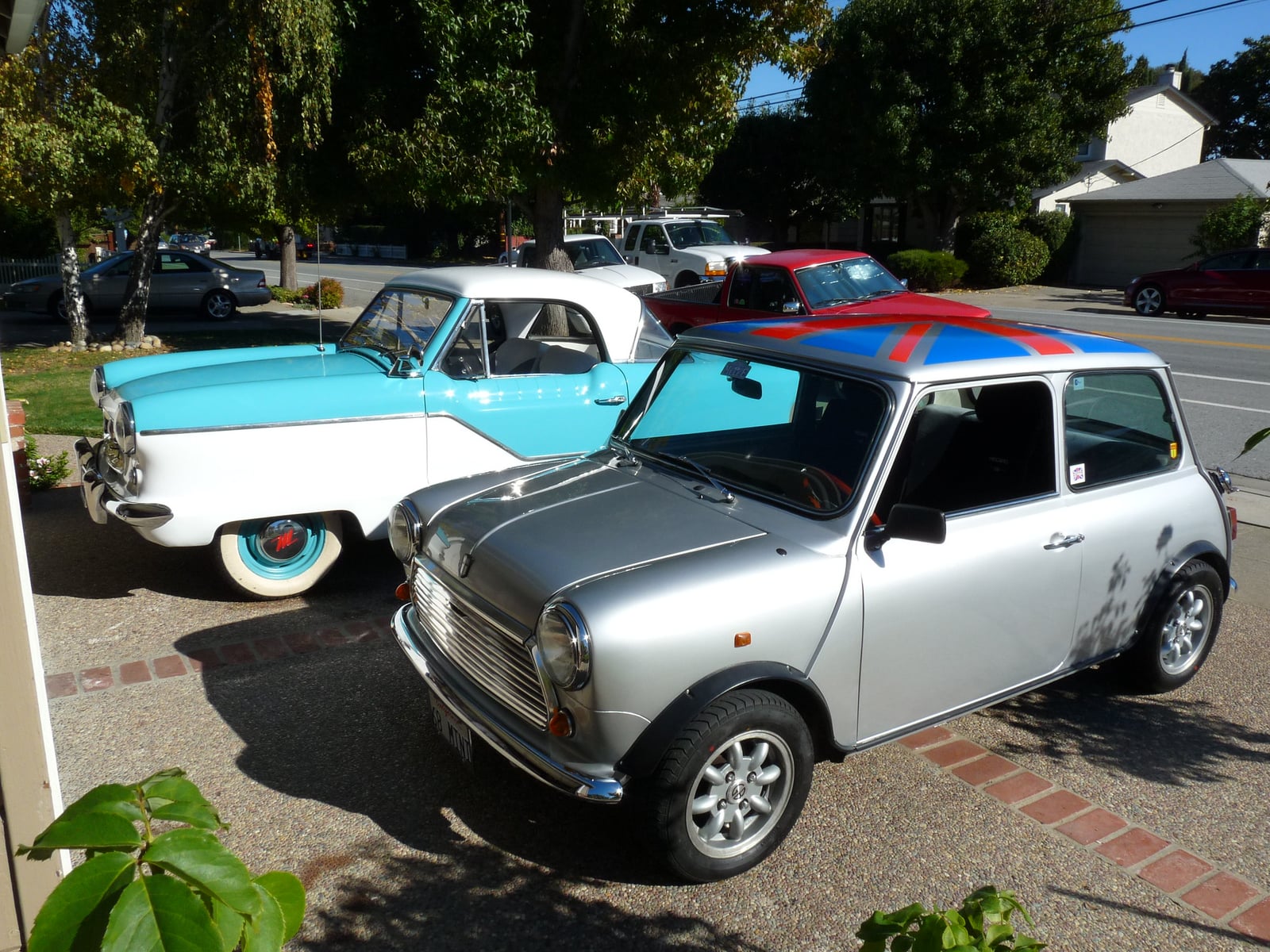
The Mini soldiered on through the entire decade in essentially the same form as the 1959 original, with periodic special editions keeping it interesting. The Mini Mayfair, Mini Park Lane, Mini Cooper (reintroduced 1990 as the John Cooper conversion, then properly back in 1991) all kept the model culturally alive while the rest of the supermini market modernised around it.
The Ford Sierra (1982 to 1993) replaced the Cortina and represents the moment Ford fully committed to aerodynamic styling at the cost of the upright tradition the Cortina had embodied for two decades. Sierras were divisive new but have aged into appreciation. Sapphire (the saloon, 1987 onward) and the Sierra estate were the practical-classic shapes; the three-door RS Cosworth was the performance one.
The Ford Fiesta Mk2 (1983 to 1989) and Vauxhall Nova (1983 to 1993) were the volume British-market superminis. Nova SR and Nova GTE versions have a small dedicated following; survivors are now rare.

Holdovers from the 1970s
Several 1970s British family saloons ran into the early 1980s without much attention. They belong to the decade’s industrial story more than its enthusiast one.
The Vauxhall Chevette hatch and saloon carried on until January 1984 alongside the Astra Mk1 that was already replacing it. The HS rally homologation had wrapped up by 1980 with the further-developed HSR variant; the standard 1.3 hatchback finished its run as the budget option in the Vauxhall range, nine years after launch. By 1984 the Astra had taken over as the volume small Vauxhall and the Chevette was a finance-deal car.
The Morris Marina became the Morris Ital in July 1980, with Italdesign’s name on a modest front-end facelift and a new dashboard. The mechanical platform underneath was the same Marina launched in 1971, with a front suspension adapted from the 1948 Morris Minor. The Ital ran at Cowley until 1984 and was the last new car to wear the Morris badge.
The Hillman Avenger finished as the Talbot Avenger from late 1979, after Peugeot bought Chrysler Europe and rebranded the range. The car had been a Hillman from 1970, a Chrysler from 1976, and was a Talbot for its final two model years until 1981. The same Coventry-built saloon underneath all three badges.
The Austin Ambassador arrived in March 1982 as the hatchback facelift the wedge Princess should always have been. BL added a proper tailgate, redesigned the rear pillar, fitted the O-series engines, and ran the car for just over two years until 1984. Around 43,000 were built. By the time it arrived, the Cavalier Mk2 and the Granada Mk2 owned the segment, and the underlying platform was seven years old.

What made the 1980s distinctive
Three threads connect the decade.
The first is the privatisation and breakup of British Leyland. Austin Rover Group formed in 1982. Jaguar was sold off in 1984. The Rover Group was sold to British Aerospace in 1988. By the end of the decade the nationalised industry that had defined British motoring in the 1970s had been broken up into separate companies, some thriving (Jaguar going into Ford ownership; Land Rover expanding), some struggling (Austin Rover), and the badge- engineered overlap of the 1970s was finally being unwound.
The second is the Cosworth era. The Sierra RS Cosworth, Sapphire RS Cosworth, and later the Escort Cosworth gave British performance motoring its most identifiable run of cars since the original RS Escorts of the 1970s. The Cosworth engineering connection ran through Group A touring cars, Formula One, and the rally homologation specials, and it gave Ford’s road cars a credible performance-engineering story that competitors struggled to match.
The third is the hot hatch democratisation of performance. By the end of the decade you could buy a 130-horsepower, sub-9-second hatchback for the price of a sensible saloon. That changed the whole shape of the British car market. The traditional “sports car” segment that the MGB and the TR6 had defined effectively collapsed during the 1980s, partly because the hot hatches did the same job better.
The decade that followed would be where the Cosworth Escort arrived properly, Land Rover finished the Discovery, Aston Martin launched the DB7, and the Mini finally went out of production. But by 1989 the cars that defined British motoring for collectors had mostly arrived: the Cosworth Fords, the late-Esprit Lotus, the V8 Astons, the Turbo R Bentley, the Vogue Range Rover. The 1990s would consolidate them; the 1980s built them.
If you want to read forward, the 1990s page picks up the thread. Reading backwards, the 1970s is where most of these stories began. For broader scope, see which cars count as British classics.

More photos
The cars of the 1980s
14 guides


1981

1982


1983


1984


1989

Frequently asked questions
What are the best British classic cars of the 1980s?
What is the Ford Sierra RS Cosworth?
When did the hot hatch arrive in Britain?
What happened to British Leyland in the 1980s?
Did any British car win Le Mans in the 1980s?
What were the most popular 80s British cars?
Related across themes
Recently added

Bentley S-series: the quiet twin with the beautiful secrets (1955–1965)

Rolls-Royce Silver Spirit and Silver Spur: the last Crewe bargain (1980–1999)

Rolls-Royce Corniche: the coachbuilt survivor that outlived its makers (1971–1995)
