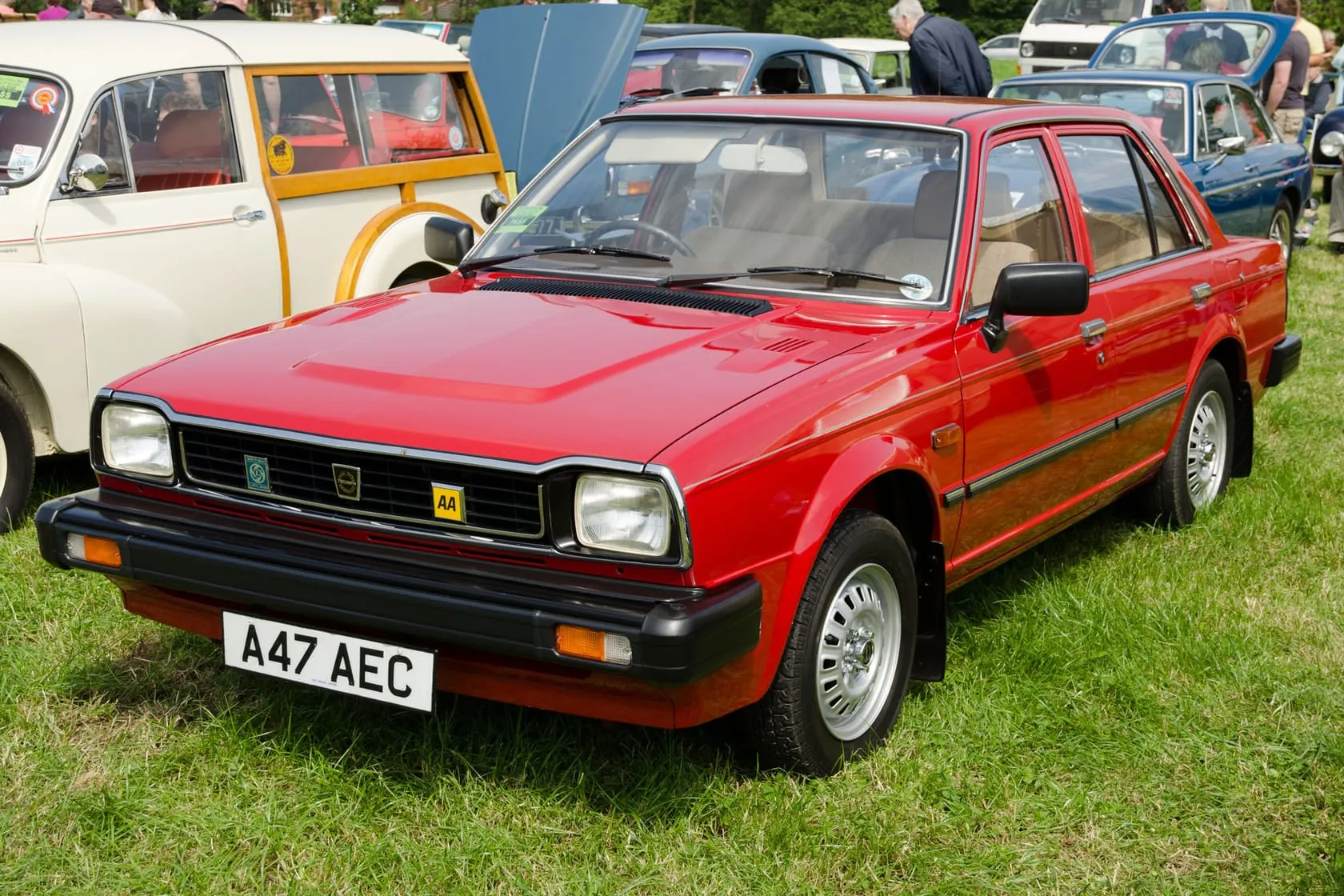
Morris Marina: British Leyland's million-selling problem child (1971–1980)
The Morris Marina sold over a million cars, finished last in nearly every road test, ran on a front suspension dating from 1948, and survived in such small numbers that finding a clean one today is a real search. A guide to the lineage, the Ital handover, what to look for, and what they're worth.
Built 1971–1980 31 recorded sales

At a glance
- Years
- 1971–1980
- Body styles
- Four-door saloon, two-door coupe, five-door estate, van
- Drivetrain
- Rear-wheel drive
- Engines
- 1.3 A-series four; 1.8 B-series four; 1.7 O-series four
- Power
- 57-85 bhp (85 bhp 1.8 TC/GT)
- Trim levels
- De Luxe, Super, HL, TC, GT
- Production
- 1,135,343 Marinas (over 1.4 million with the Morris Ital)
- Assembly
- Cowley, Oxford
- Designer
- Roy Haynes
- UK survivors
- Around 350-500 Marinas and Itals on the DVLA register
- Values
- Saloon £2,500-£6,000, coupe/estate to £7,500; best to around £10,000
- Successor
- Facelifted into the Morris Ital (1980–1984), the last Morris-badged car
The cars
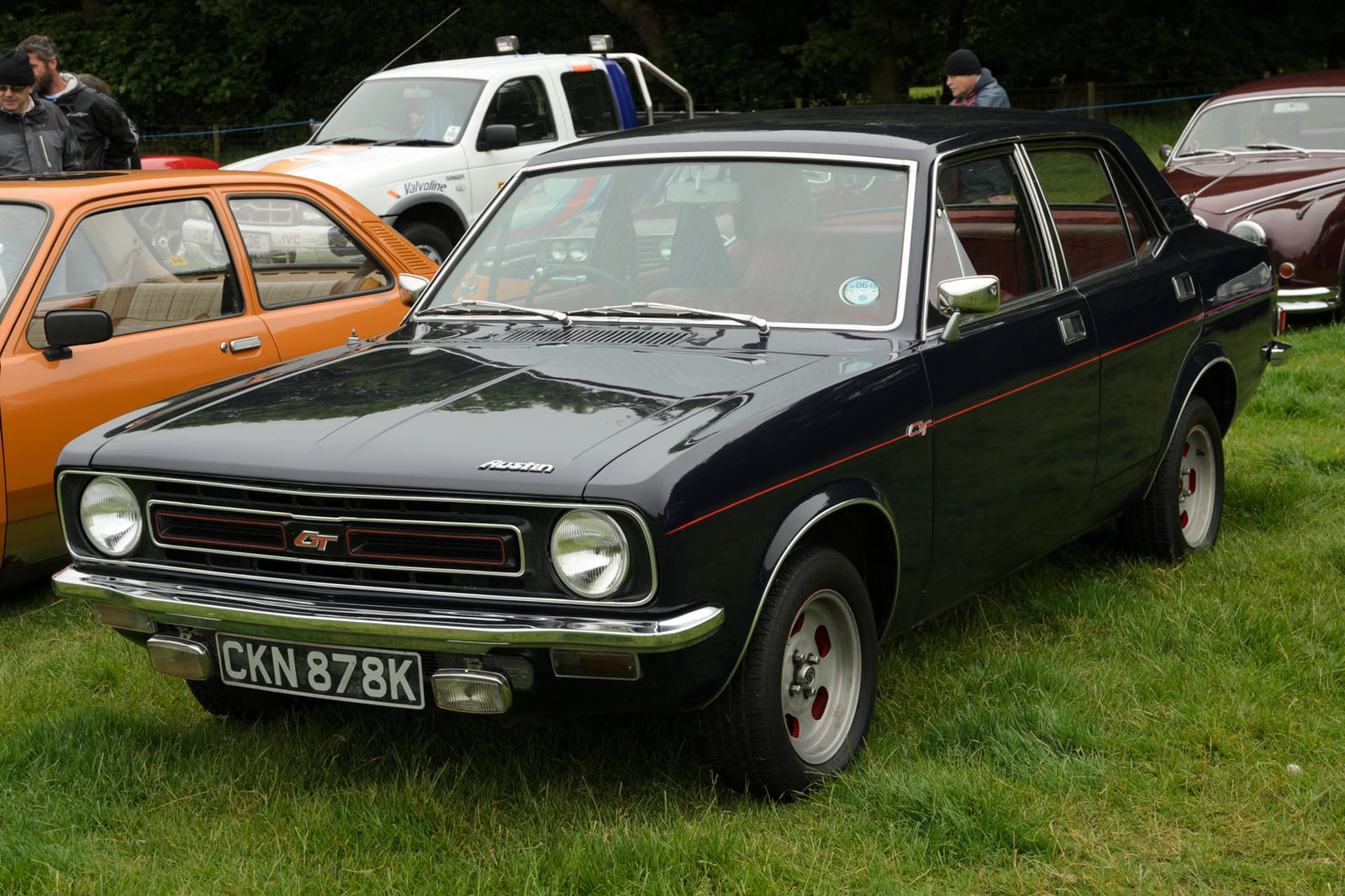
British Leyland sold over a million Morris Marinas, and almost nobody now defends a single one. The car finished last in nearly every period road test and rode on a front suspension that dated from 1948. It ran from 1971 to 1980 as the Marina, then continued as the Italdesign-facelifted Morris Ital until 1984, taking the Morris badge with it when it finally died. For nearly the entire 1970s the Marina was the biggest-selling British Leyland car in Britain, outselling the Allegro, the Maxi, the Mini, and the Princess combined in some months, despite the road-test press never being kind to it.
That combination is most of why the Marina matters. It is the car that explains how British Leyland’s UK volumes held up through a decade when nearly every model in its range was being beaten by the Cortina, the Escort, the Avenger, the Chevette, and the Allegro respectively. The Marina was the dealer-network car. It sold because there were 5,000 BL dealers across the UK and because the price was sharp. Whether it was any good was a secondary question, then and now.
Where the Marina came from
The Marina was developed under the codename ADO28 from 1968 onwards, with a development budget that was small even by BL standards. The brief was simple: build a conventional rear-drive booted saloon to compete with the Cortina Mk3, ship it inside three years, and use as many existing British Leyland mechanical parts as possible to keep the engineering cost down.
The body styling came from Roy Haynes, recently recruited from Ford where he had styled the Cortina Mk2. The shape was conservative on purpose: a clean three-box saloon with a sensible boot, glass area BL’s market research had said the sector wanted, and a face that looked Morris-traditional without being old-fashioned. The coupe and estate variants joined the saloon at launch, sharing the same wheelbase and front-end sheet metal.
The engineering choices were where the rush showed. The front suspension was a torsion-bar lever-arm layout adapted from the Morris Minor, a car that had launched in 1948. The rear was a live axle on cart springs, similar to the contemporary Cortina but executed with less care. The rear axle was the BMC unit also used in the MG Magnette. The engines were the A-series 1275cc and the B-series 1798cc, both well-proven units pulled from elsewhere in the BL parts bin. None of this was inherently bad, but the front-suspension layout in particular gave the Marina a period road-test reputation for vague handling that the car never shook off. The Mk1 also had a quirk where the steering column was offset from the seat by enough that long-legged drivers complained, a problem the Mk2 addressed.
Production was at Cowley, Oxford, with later overflow to other BL plants. The Marina was also assembled in South Africa (through Leykor), Australia (through Leyland Australia), and New Zealand, with various local market-specific changes.
Marina-badged production ran to 1,135,343 cars between 1971 and 1980, of which around 38 per cent were exported, a strong export share for a car remembered as a parochial BL also-ran. The Morris Ital that followed added several hundred thousand more on the same platform through to 1984, taking combined Marina and Ital production comfortably past 1.4 million. The underpinnings outlived the Morris badge entirely: a derivative was built in China as the Huandu CAC6430 estate into the late 1990s, more than a decade after the last Ital left Cowley.
What the period press made of it
The Marina’s reputation was nearly sunk before it reached showrooms. The styling job had been a genuine contest: British Leyland took proposals from Michelotti and Pininfarina before settling on Roy Haynes’s in-house design, the ex-Ford stylist BL had hired precisely to apply the Cortina lesson of wrapping conventional mechanicals in aspirational sheet metal. The engineering, by contrast, was improvised. Period accounts record early development hacks that included Morris Minor floorpans clothed in Vauxhall Viva bodies as running test mules, a reminder of how much the Marina leaned on the parts bin.
The launch itself produced the moment that defined the car’s press image. When Motor and Autocar first drove the 1.8-litre cars in 1971, both were alarmed enough by the understeer that the two rival magazines jointly raised it with BL’s technical director Harry Webster. BL conceded the press cars were pre-production examples missing a revised front-suspension mounting, developed to add negative camber in corners, that production cars would carry. The magazines softened their initial verdicts, but the episode stuck, and the Minor-derived front end gave the Marina a handling reputation it never escaped, fairly or not. Read the actual road tests rather than the later “worst cars” listicles and a more measured picture emerges: contemporary testers generally rated the Marina a credible second to the Cortina and clearly ahead of the early Japanese imports on driving manners, if not on equipment.
Body styles and trim levels
The Marina ran in three body styles:
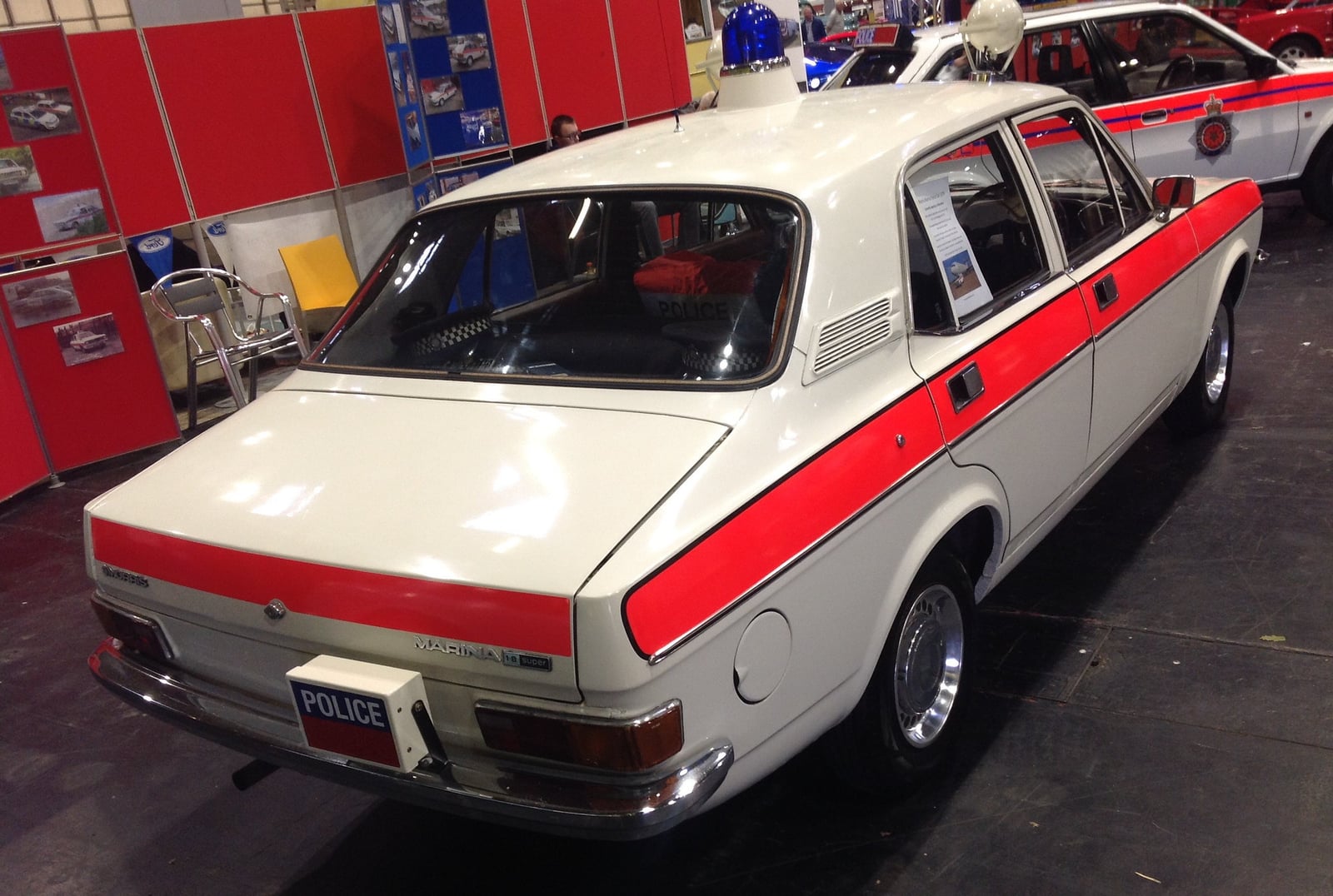
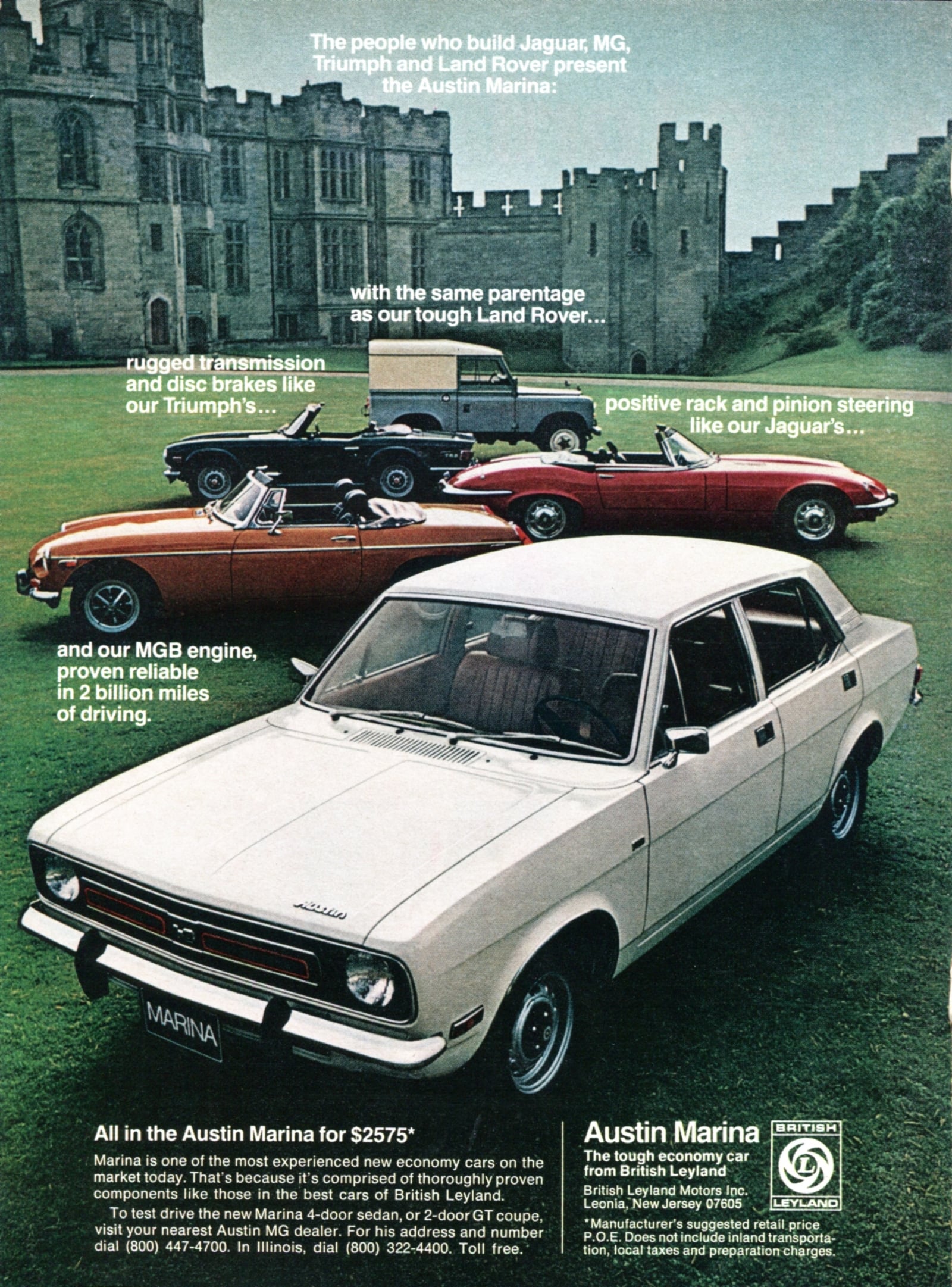
- Four-door saloon (1971–1980): the volume seller and the variant the model is most remembered for. Built throughout the production run.
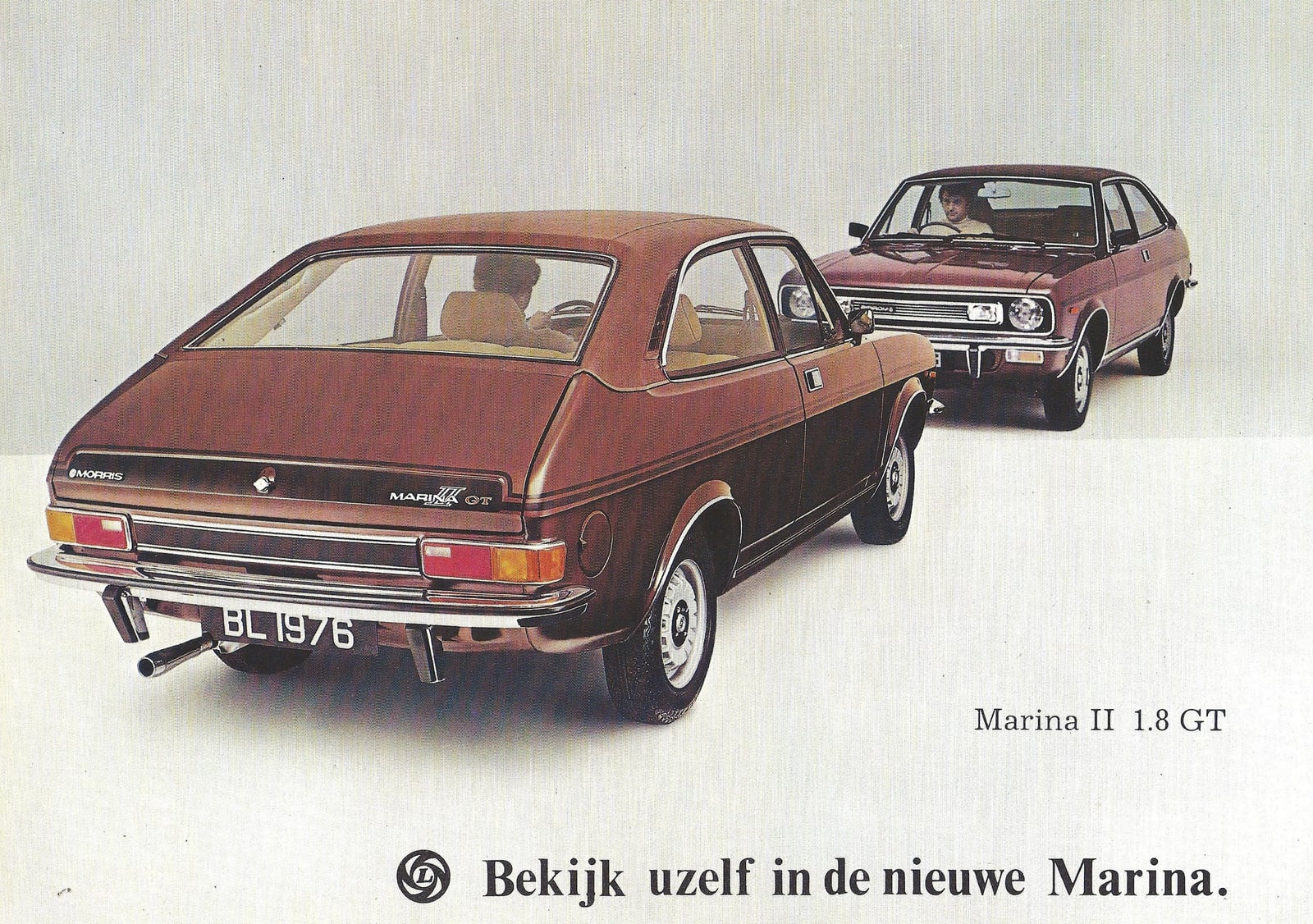
- Two-door coupe (1971–1975 on Mk1, dropped on Mk2): a fastback profile with a sloping rear screen and reduced rear seat headroom. Sold in much smaller numbers than the saloon and was dropped during the Mk2 facelift.
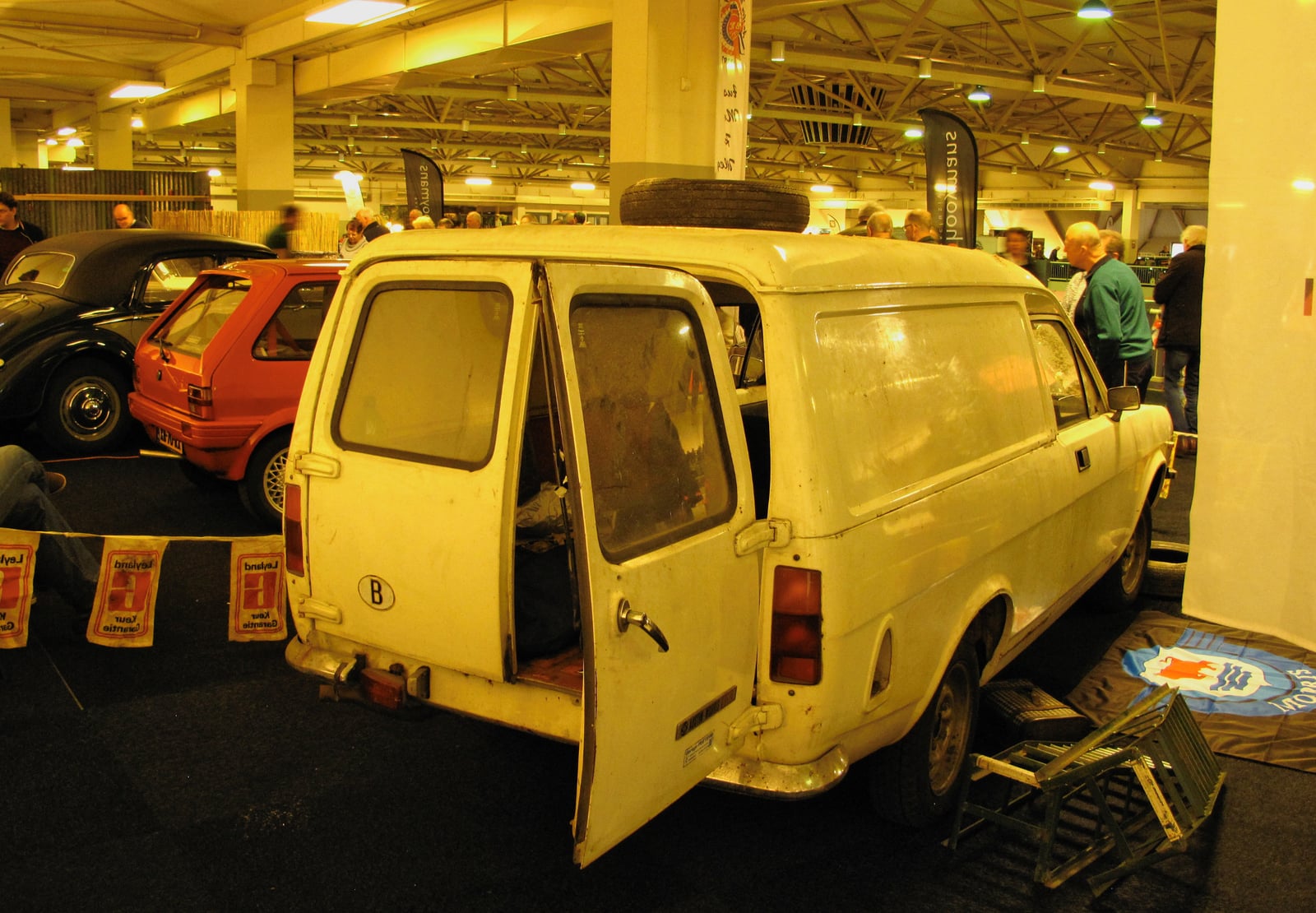
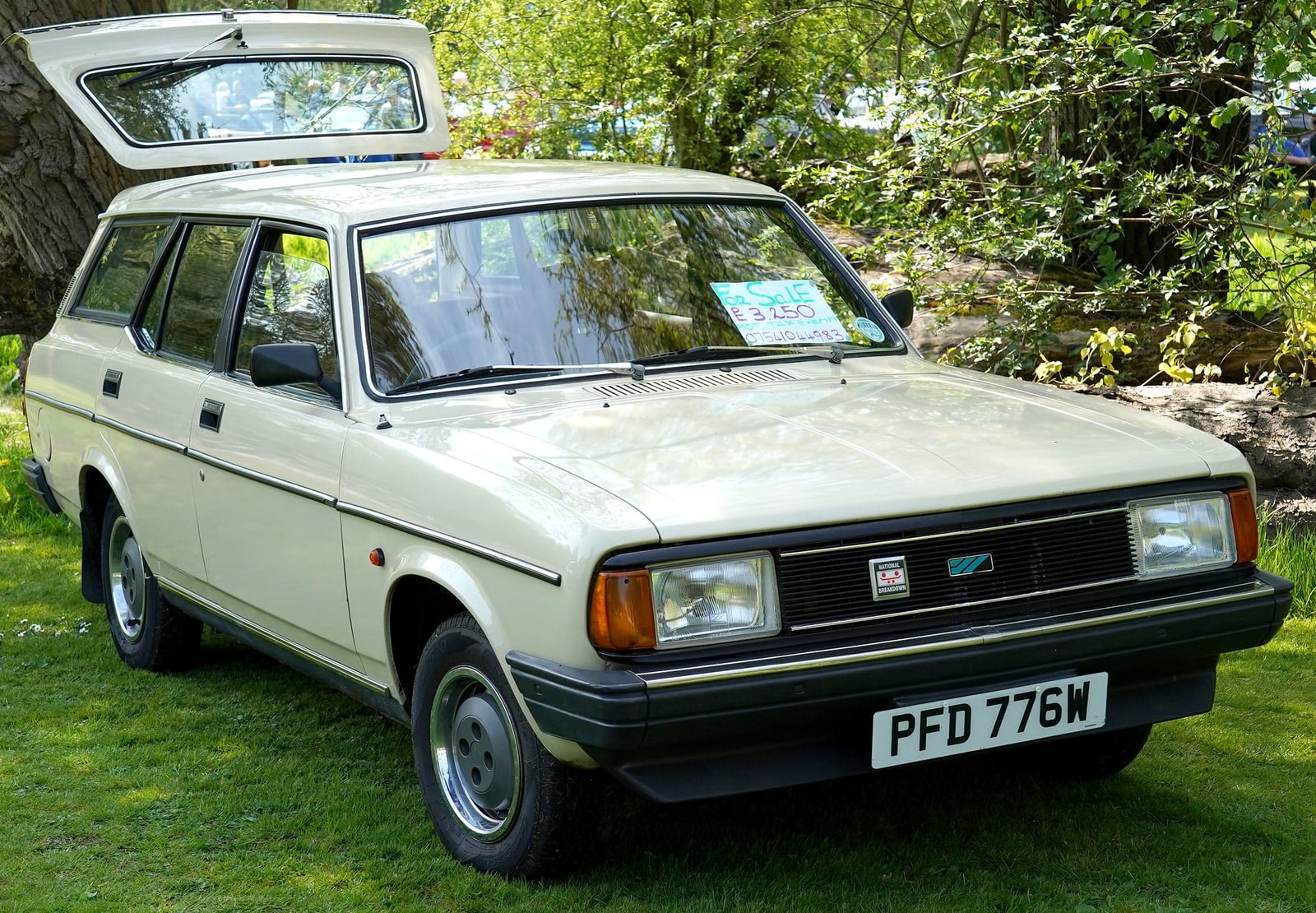
- Five-door estate (1972–1980): a separate body from the saloon’s boot, with a long roof, a side-hinged tailgate (on early cars) replaced by a top-hinged tailgate (on later cars), and useful load space. The estate was generally regarded as the best Marina to drive, partly because the additional rear weight settled the back end.
Trim levels through the Mk1 era ran De Luxe, Super, and TC (twin-carb 1.8). The 1.8 GT coupe joined the range in 1972 with twin SUs, a higher compression ratio, and a four-speed close- ratio gearbox. From 1973 the trim hierarchy was simplified to De Luxe, HL, and TC.

The Mk2 facelift and the Ital handover
The Mk2 Marina arrived in October 1975 with a redesigned bonnet that incorporated revised headlights and a flatter grille, a new dashboard, improved seat trim, and a redesigned column package. The Mk2 also addressed some of the chassis criticism with revised spring rates and damper settings, although the underlying front-suspension layout did not change.
A further series of revisions came in 1978, including the arrival of the O-series 1.7-litre engine to replace the 1.8 B- series on some markets. The O-series was a new BL overhead-cam unit and was a meaningful step forward on refinement, although the older B-series 1.8 continued in some variants alongside it.
The Italdesign-facelifted Morris Ital arrived in July 1980. The revisions were more extensive than the Mk2 changes: new front end with rectangular headlights, a longer boot, revised dashboard, new seats, and improved sound insulation. The mechanical platform was carried over directly from the late Marina, which is why most of the buying guide on this page applies equally to the Ital. Italdesign’s involvement was modest in the end, more a marketing badge than a fundamental redesign, but the Ital ran for four years until 1984 and is the model that finally retired the Morris badge from new-car production.

Engines and mechanicals
Across the production run the Marina and the Ital offered:
- 1275cc A-series OHV four (1971–1980, 1980–1984 Ital): 57 to 60 bhp. The same long-serving unit used in the Mini Cooper, the MG Midget 1275, and the Austin 1300.
- 1798cc B-series OHV four (1971–1980): 72 bhp standard, 85 bhp in the 1.8 TC and GT variants with twin SUs.
- 1695cc O-series OHC four (1978–1980, then in Ital 1980–1984): 75 to 84 bhp depending on tune.
The gearboxes were a BL-sourced four-speed manual on the saloon and estate, a close-ratio four-speed on the TC and GT, and a three-speed Borg-Warner automatic optional on HL trim. Overdrive on fourth was available but rarely specified.
Mechanically the cars are tough. The A-series and B-series engines are both BMC units with 50 years of service knowledge behind them and parts availability that has never gone away. The O-series is rarer but well-understood by Austin Maestro and Montego specialists, who use the same engine. The gearboxes and the rear axle are standard BMC units and parts move freely.
What a Marina is like to drive today
The driving experience surprises people who arrive expecting the disaster of the jokes. The understeer that dominated the launch coverage is, on a sorted car at normal road speeds, unremarkable: the front end pushes wide if provoked, but the rack-and-pinion steering inherited from the Morris Minor is more accurate than many rivals of the period, and the ride is acceptable if a little bouncy over broken surfaces where the live rear axle and leaf springs show their age. The Triumph-sourced gearbox shifts more positively than the old Minor unit it replaced.
Performance is adequate rather than brisk in 1.3 form, where around 57bhp pulls a car some 300kg lighter than an equivalent Cortina, so the two feel closely matched in period terms. The 1.8 TC is the one to seek out for pace: with twin SUs it was genuinely quick for a family saloon, with a higher top speed than the contemporary MGB. Owners today report the cars as easy to live with day to day, the appeal being mechanical simplicity, cheap parts, and the novelty of a survivor almost nobody else has, rather than driving thrills. As a usable classic the Marina asks little and returns a particular kind of unfashionable charm.
Buying guide: what to look for
Marinas rust catastrophically. The standard 1970s British family-saloon rust traps all apply: sills, rear wheel arches, floor pans, front suspension turrets, boot floor, door bottoms, and windscreen surrounds. The Marina has additional traps the others do not. The front cross-member rusts from the inside out where the torsion-bar mounts collect water. The rear axle trumpets rust where the U-bolts attach to the leaf springs. The boot floor on the saloon rusts from the spare-wheel well upwards and is one of the first places to check. The estate’s rear inner-arch panel rusts where the carpet collected water from leaking tailgate seals.
A solid Marina is now a rare find. Most surviving cars have had significant body restoration at least once, and the quality of that restoration is the main thing to assess. Look for consistent panel gaps, check for over-filled body work with a magnet, and inspect the underseal for recent application that might be hiding pin-holing in the panels beneath.
Mechanically the engines are durable and parts are cheap. The 1.3 A-series will run forever on regular oil changes. The 1.8 B-series is the same unit as the MGB and is well-supported. The 1.7 O-series needs cambelt changes every five years but is otherwise straightforward. The gearbox synchros wear on second gear first on high-mileage cars, and the rear axle pinion bearing whines when worn but rarely fails outright.
The Marina-specific things to check are steering and front-end geometry. The torsion-bar suspension settles over time and the ride height drops, sometimes to the point that the front wings foul the wheels under heavy braking. Resetting the torsion-bar ride height is a specialist job. The kingpins wear if not greased regularly and replacement requires removing the front upright assembly.
On the coupe and the GT, additional checks. The coupe’s rear screen seal leaks water onto the boot floor, and many coupes now have rusted boot floors as a result. The GT’s twin SU setup needs careful balancing and the linkages wear. A well-set-up 1.8 TC or GT pulls cleanly to 6,000 rpm; a poorly set-up one hesitates badly between 3,000 and 4,000 rpm.

Current Morris Marina price and value range
The Marina market is unusual because so few cars survived. The result is that a clean, documented car sells for materially more than the period reputation would suggest.
- Marina 1.3 saloon (Mk1 and Mk2): £2,500 to £6,000 for good cars, £8,000 for the very best.
- Marina 1.8 TC saloon: £3,500 to £7,500.
- Marina coupe (1.3 and 1.8 GT): £3,000 to £7,000, with the 1.8 GT at the top of the bracket.
- Marina estate (1.3 and 1.8): £3,500 to £7,500. The estate has held its value best.
- Morris Ital saloon (1980–1984): £1,800 to £4,500.
- Morris Ital estate (1980–1984): £2,500 to £5,500.
The 1.8 TC and the GT coupe are the variants the market prefers, partly for the slightly livelier engine and partly because they are scarcer. The Ital generally trades below the Marina even when the underlying car is mechanically equivalent, because the badge is even less collectable than the late-Marina period.
Owners’ clubs and parts supply
The Morris Marina Owners’ Club is the model-specific organisation and covers the Marina, the Ital, and several overseas-market variants. It runs a spares scheme and is the practical first stop for service-item supply and bodywork- repair sourcing. The Morris Register also covers Marina ownership as part of its broader Morris remit.
Mechanical parts are well supplied because the engines and running gear are shared with so many other BL cars. A-series 1.3 parts come through the same channels as Mini and MG Midget parts. B-series 1.8 parts come through MGB channels. The rear axle and the gearbox share with several BMC products. Body panels are the bottleneck. Door skins and sill repair sections are sometimes available through the club; tailgates and rear quarter panels are harder to find and may require sourcing from breakers.
Where the Marina sits in the British motoring story
The Marina is the car that explains British Leyland’s UK volumes in the 1970s and explains why BL kept losing money even while selling cars in big numbers. The Marina sold because it was cheap, available, and reasonably durable, and because BL’s dealer network had the volume to push it. It also sold because the alternatives within the BL range, the Allegro and the Princess, were less popular than the Marina at their respective launches. The Marina won by being the least disliked.
The Marina also explains what was happening to the British mid-market mainstream. The Cortina Mk3 was more refined. The Chevette was more modern. The Avenger handled better. The Cavalier of 1975 was more European. Yet the Marina kept selling because the BL badge, the dealer network, and the price meant something to a generation of buyers who had bought Morris cars since the 1950s. When that generation stopped buying new cars in the early 1980s, the Marina and the Ital lost their natural audience, and Morris went with them.

The Marina in dates
- 1971Launched as ADO28 on a small budget: Roy Haynes' deliberately conservative three-box, Minor-derived front suspension, and proven A-series and B-series engines.
- 1972Coupe and estate join the saloon; the 1.8 TC brings twin carburettors and 85 bhp.
- 1975Facelifts and trim shuffles keep the dealer-network car selling against the Cortina.
- 1978The O-series 1.7 replaces the B-series.
- 1980The Italdesign-facelifted Morris Ital takes over, carrying the Morris badge to its 1984 end; 1,135,343 Marinas were built.
Marina: what to check before you buy
The Marina-specific rust
- The front cross-member, rusting from the inside out where the torsion-bar mounts collect water
- Rear axle trumpets where the U-bolts attach to the leaf springs
- The saloon's boot floor, from the spare-wheel well upwards
- The estate's rear inner-arch panel, where leaking tailgate seals fed the carpet
The standard traps
- Sills, rear arches, floor pans and front suspension turrets
- Boot floor, door bottoms and windscreen surrounds
- Check over-filled bodywork with a magnet and be suspicious of fresh underseal
- Consistent panel gaps are the tell of a proper restoration
Mechanical and version
- A-series and B-series parts are everywhere; the O-series shares with the Princess and Maestro
- The lever-arm front end is simple and crude, and correct that way
- TC and GT cars carry the enthusiast interest
- With 350 to 500 survivors, condition beats specification every time
What the Marina sells for at auction
The Marina comes to auction only occasionally: 31 recorded sales since 2016, typically making between £1,995 and £5,320 . With so few sales, treat any single result as a data point rather than a market price.
- £8,520Marina
- £6,500Marina
- £2,060Marina
- £4,260Marina
- £4,500Marina
Thin evidence. Only 31 recorded sales: read the figures as a sketch of the market, not a price. Based on 31 sold results from public classic car auctions (2016 to 10 August 2026). Sold prices, not asking prices, and not a valuation: condition, history and specification vary from car to car. Inflation-adjusted figures use the ONS CPIH index, in 2025 money.
Related across British family saloons
The other 1970s British family cars in this cohort sit alongside the Marina: the Vauxhall Victor (1957–1976), the Vauxhall Chevette (1975–1984), the Hillman Avenger (1970–1981), and the Austin Princess (1975–1981). For the wider context on these five cars as a group, see Britain’s troubled 1970s family saloons. For the broader period (the Ital ran into 1984), see British classic cars of the 1970s and British classic cars of the 1980s.
More photos