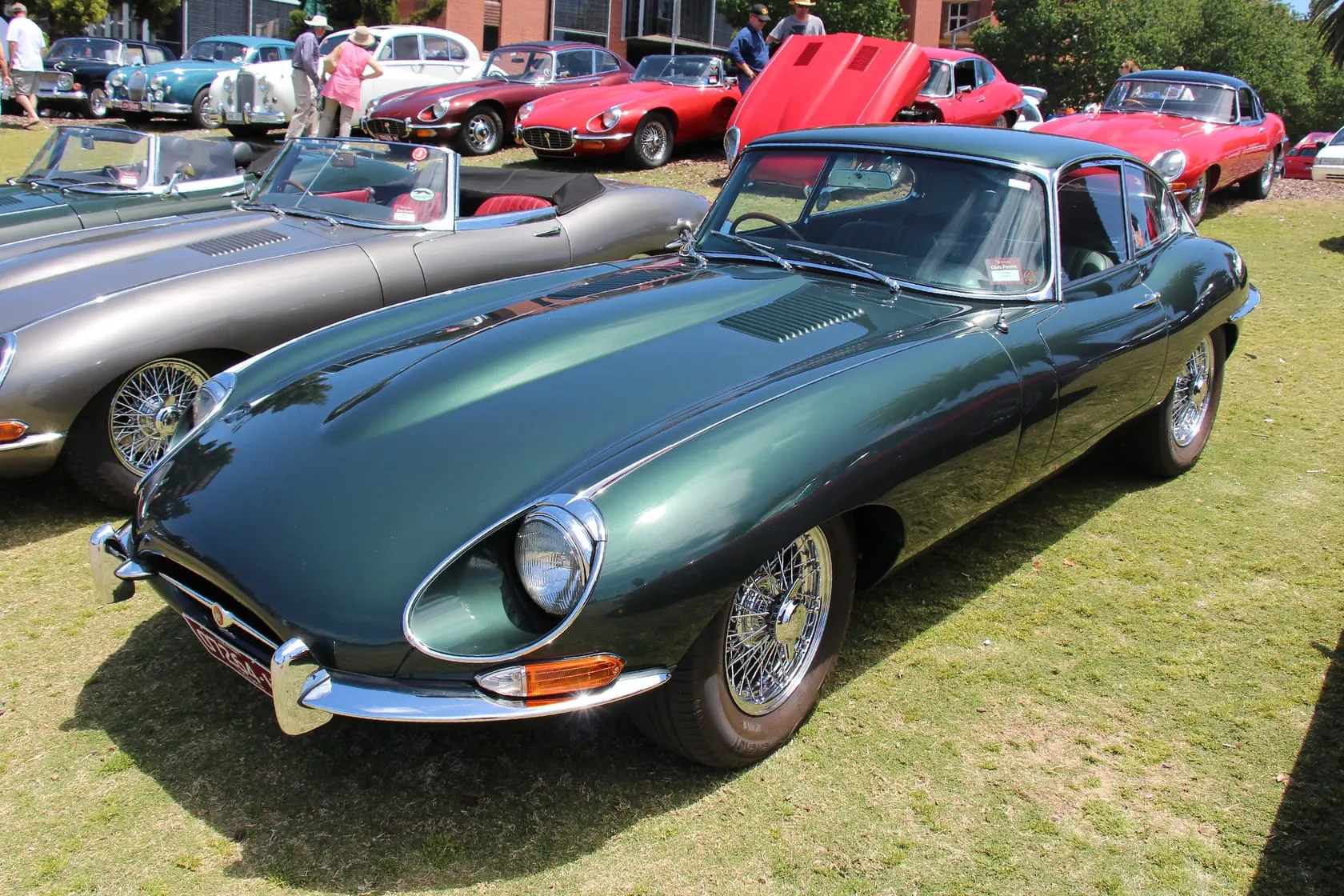
Jaguar E-Type Series 1: the original of the most beautiful car (1961–1968)
The Series 1 is the E-Type as Geneva first saw it, covered headlamps, slender bumpers and the 150 mph legend, and it is the generation the collector market prizes above all. A guide to the 3.8 and 4.2 cars, flat floors and 2+2s, buying checks and what the deepest E-Type market pays.
Built 1961–1968 1,782 recorded sales

At a glance
- Years
- 1961–1968
- Body styles
- Roadster, fixed-head coupe; 2+2 from 1966
- Drivetrain
- Front engine, rear-wheel drive; independent rear suspension
- Engines
- 3781cc XK six (1961–64); 4235cc XK six (1964–68)
- Power
- 265 bhp (claimed)
- Top speed
- Around 150 mph (the famous claim; near enough in the metal)
- Trim levels
- Roadster and FHC; 2+2; flat-floor and outside-latch early cars
- Production
- Around 38,400 of about 72,500 E-Types
- Assembly
- Browns Lane, Coventry
- Designer
- Malcolm Sayer; William Heynes (engineering)
- Values
- Usable from around £55,000; good cars £70,000-£110,000; flat-floors and the best beyond £150,000
- The identifiers
- Covered headlamps, slim bumpers, small mouth: the shape as Sayer drew it
- The premium
- The collector market pays roughly double Series 2 money for a Series 1
The models
March 1961, Geneva: the Jaguar E-Type Series 1 arrives with covered headlamps, slender bumpers, a mouth barely open, and a 150 mph claim that makes the launch a riot. This is the E-Type exactly as Malcolm Sayer first drew it and as the collector market now defines it, the early flat-floor cars first among them, and with 1,782 measured sales behind this page’s figures, the deepest market of any car on this site, its premium over the later cars is not opinion but arithmetic.
Geneva, 1961: the shape arrives
The Series 1 landed as a genuine shock: Jaguar brought Le Mans-bred monocoque construction, independent rear suspension, disc brakes all round, the 3.8-litre XK six with 265 claimed horsepower, and that body, priced at £2,097 when rivals with less of everything cost double. The 150 mph road tests, press cars lovingly prepared, sealed the myth. Demand overwhelmed Browns Lane from the first morning, and Jaguar instantly reset what a production sports car was allowed to look like and cost, a reset the industry arguably never repeated.
3.8 to 4.2: the original refined
The first cars carried the 3.8 engine and the Moss gearbox, its non-synchromesh first gear a piece of vintage technique preserved in a modern car. October 1964 brought the 4.2: same claimed power, more torque, an all-synchromesh box, better seats, improved cooling and electrics, the car the original should perhaps always have been, wearing an identical body. Purists split happily over 3.8 crispness versus 4.2 usability, the market prices them nearly level, and both wear the covered-lamp nose that separates Series 1 from everything after.

Flat floors, 2+2s and the collector map
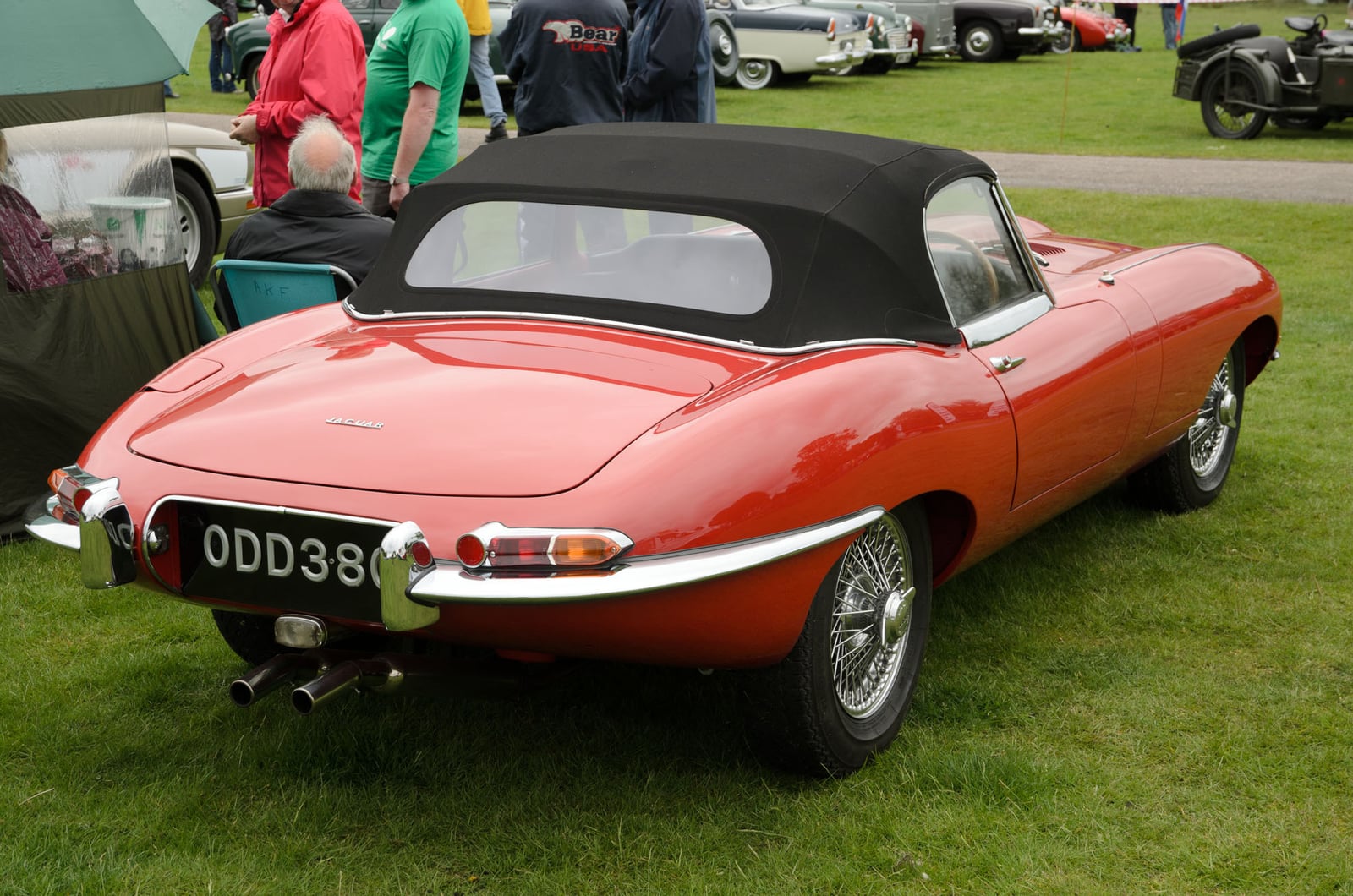
Within the Series 1, the collector map is precise. Earliest of all are the flat-floor cars built to mid-1962, without the later recessed footwells, the first of those with outside bonnet latches, the E-Type’s rarest and dearest mainstream form. The 1966 2+2 stretched the coupe for two small seats and an automatic option, useful then, discounted now. And the 1967–68 transitional cars, headlamp covers gone but everything else Series 1, are the breed the club world calls Series 1.5, a footnote that has become its own collecting field. Originality, matching numbers and history divide the money more than any of it.


Racing blood, priced accordingly
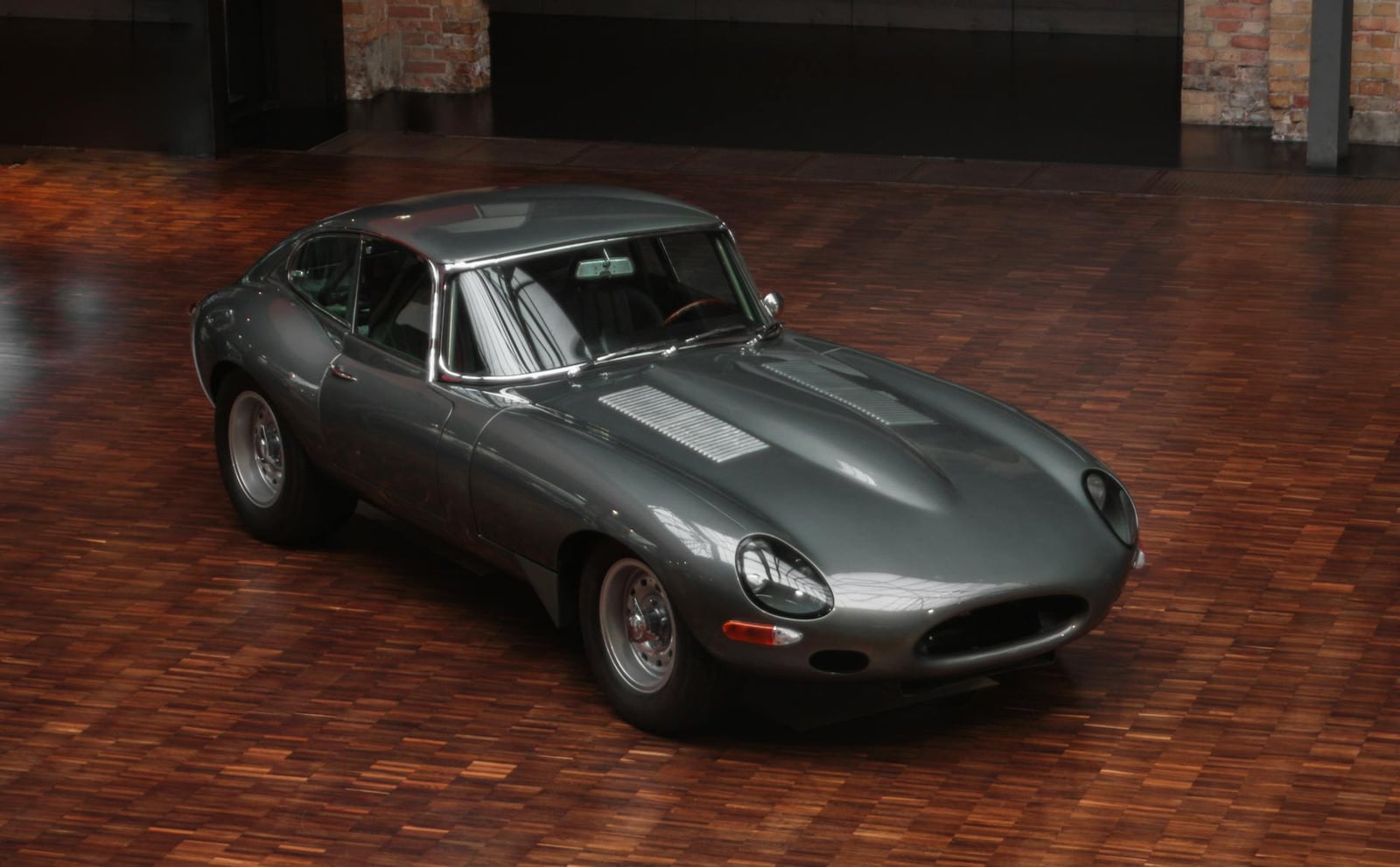
The Series 1 era also holds the E-Type’s competition chapter: works-blessed Lightweights and semi-lightweights raced the world’s GTs in period, and their originals now trade in the millions, with recreations a market of their own. That racing shadow matters to ordinary Series 1 buying in one practical way: period competition history, even club-level, adds documented value, while racing-style modifications without history subtract it. The same era’s sister racers, the C-Type and D-Type, complete the bloodline story, and a Series 1 with an honest file of period paperwork sits at the top of whatever band its condition earns. The generation’s collectability rests on being closest to that competition source.

What a Series 1 is like to drive
The Series 1 asks the most of its driver and returns the most atmosphere: heavier unassisted steering at parking speeds that lightens beautifully with pace, brakes and cooling that reward sympathetic modern upgrades, the Moss box (in a 3.8) demanding deliberate first-gear manners, and above all the XK six’s surge and soundtrack pulling that bonnet toward the horizon. It is the least filtered E-Type experience, which is exactly why the originals command the premium: nothing later feels quite so much like 1961.

Buying a Series 1 today
At Series 1 money, provenance is the purchase: matching numbers verified against the Heritage certificate, continuous history, and structural honesty in the monocoque, sills, floors, bulkheads and the bonnet’s vast and costly panelwork. Restoration quality varies wildly beneath shiny paint, so specialist inspection is cheap insurance at this level. Right-hand-drive UK cars carry premiums over imports; sympathetic upgrades (cooling, brakes, five-speed conversions) are accepted when reversible and documented. The XK120 bloodline and racing pedigree stories add context a seller will happily invoice for.

Values: the premium generation
One thousand seven hundred and eighty-two measured sales at a £77,000 median make this the best-documented market on the site, and its verdict is stable: driver-grade Series 1s from £55,000, good cars £70,000 to £110,000, flat-floors and the finest well past £150,000, roadsters over coupes, 2+2s at a discount, and roughly double equivalent Series 2 money throughout. Among 1960s icons the Series 1 is the reference asset, and its arithmetic has held through every market season the record covers.

More photos


Key dates for the Series 1
- 1961The E-Type arrives at Geneva with the 3.8 XK six and a shape that made its reputation instantly.
- Mid-1962The flat-floor cars end, recessed footwells arriving in their place.
- 1964The 4.2 replaces the 3.8, bringing more torque and a better gearbox.
- 1966The 2+2 stretches the coupe for two small seats and an automatic option, useful then and discounted now.
- 1967The headlamp covers go, creating the transitional cars the club world calls Series 1.5.
- 1968Series 1 production ends.
Before you buy a Series 1
Provenance is the purchase
- Matching numbers verified against the Heritage certificate
- Continuous history, with restoration quality proven by more than shine
- Specialist inspection is cheap insurance at this level
Structure
- Monocoque honesty through the sills, floors and bulkheads
- The bonnet's vast and expensive panelwork
Where a car sits on the collector map
- Flat-floor cars built to mid-1962, the earliest with outside bonnet latches, are the rarest and dearest mainstream form
- The 1966 2+2 was useful in period and is discounted now
- The 1967 to 1968 transitional cars, covers gone but everything else Series 1, are their own collecting field
What the E-Type Series 1 sells for at auction
In 2025 the median E-Type Series 1 sold for £68,357 across 129 sales, 12% down on 2024. In real terms, typical E-Type Series 1 prices were down about 36% over the five years to 2025, once inflation is accounted for.
| Variant | Sold | Typical range | Median |
|---|---|---|---|
| E-Type Series I Roadster 3.8 | 415 | £76,352 - £147,300 | £105,009 |
| E-Type Series I Roadster 4.2 | 376 | £71,269 - £130,440 | £96,123 |
| E-Type Series I FHC 4.2 | 194 | £52,204 - £95,053 | £68,454 |
| E-Type Series I FHC 3.8 | 190 | £54,012 - £97,773 | £71,968 |
| E-Type Series I 2+2 4.2 | 85 | £28,687 - £47,040 | £36,168 |
Show the year-by-year mediansHide the year-by-year medians
| Year | Sold | Median | In 2025 money |
|---|---|---|---|
| 2026 (so far) | 78 | £63,154 | |
| 2025 | 129 | £68,357 | £68,357 |
| 2024 | 112 | £77,265 | £80,230 |
| 2023 | 116 | £94,864 | £101,798 |
| 2022 | 126 | £98,896 | £113,259 |
| 2021 | 131 | £92,296 | £114,129 |
| 2020 | 113 | £84,925 | £107,618 |
| 2019 | 106 | £81,268 | £104,036 |
| 2018 | 106 | £103,300 | £134,486 |
| 2017 | 113 | £97,440 | £129,795 |
| 2016 | 94 | £96,143 | £131,364 |
| 2015 | 104 | £101,587 | £140,190 |
| 2014 | 71 | £71,350 | £98,858 |
| 2013 | 57 | £67,177 | £94,404 |
| 2012 | 43 | £61,980 | £89,096 |
| 2011 | 53 | £57,050 | £84,112 |
| 2010 | 34 | £55,125 | £84,431 |
| 2009 | 23 | £49,313 | £77,420 |
| 2008 | 23 | £34,650 | £55,472 |
| 2007 | 18 | £37,469 | £62,073 |
| 2006 | 22 | £41,741 | £70,765 |
| 2005 | 37 | £33,350 | £57,963 |
| 2004 | 22 | £27,084 | £48,042 |
| 2003 | 10 | £50,736 | £91,286 |
| 2002 | 8 | £32,260 | £58,809 |
| 2001 | 7 | £28,774 | £53,228 |
| 1999 | 4 | £28,558 | £54,284 |
| 1998 | 6 | £24,200 | £46,839 |
| 1997 | 6 | £23,168 | £45,673 |
| 1996 | 5 | £22,271 | £44,867 |
| 1995 | 3 | £17,822 | £36,928 |
- £21,892E-Type Series I 2+2 4.2
- £74,014E-Type Series I Roadster 4.2
- £62,627E-Type Series I Roadster 3.8
- £141,562E-Type Series I Roadster 4.2
- £85,500E-Type Series I Roadster 4.2
Strong evidence. 1,782 recorded sales and a dozen or more a year: the median and the range are well founded. Based on 1,782 sold results from public classic car auctions (1993 to 10 August 2026). Sold prices, not asking prices, and not a valuation: condition, history and specification vary from car to car. Inflation-adjusted figures use the ONS CPIH index, in 2025 money.