Jaguar E-Type Series 2: the sensible one, and the shrewd way in (1968–1971)
The Series 2 is the E-Type that American regulators redrew, open headlamps, bigger mouth, better brakes and cooling, and it remains the most usable route into six-cylinder E-Type ownership. A guide to what changed, why collectors rate it below the Series 1, and the buying checks that matter.
Built 1968–1971 946 recorded sales

At a glance
- Years
- 1968–1971
- Body styles
- Roadster, fixed-head coupe, 2+2
- Drivetrain
- Front engine, rear-wheel drive; independent rear suspension
- Engines
- 4235cc XK six
- Power
- 265 bhp (UK spec, claimed); US cars detuned by emissions equipment
- Top speed
- Around 140-plus mph (UK spec)
- Trim levels
- Roadster, FHC, 2+2 (raked screen); optional steel wheels, air conditioning
- Production
- Around 18,800
- Assembly
- Browns Lane, Coventry
- Designer
- Malcolm Sayer's shape, revised to US federal requirements
- Values
- Usable from around £35,000; good cars £45,000-£65,000; the best roadsters beyond £80,000
- The identifiers
- Open headlamps, bigger grille, wrap-around bumpers, tail lights below the bumper
- The case
- The best-sorted six-cylinder E-Type at roughly half Series 1 money
The models
Between the sainted original and the twelve-cylinder finale sits the E-Type that nobody ever writes poems about, and for the buyer that neglect is precisely the opportunity worth understanding. The Series 2 of 1968 is the E-Type as American regulators redrew it, headlamps uncovered, mouth widened, bumpers heavier, and as Jaguar’s engineers quietly perfected it underneath. The measured market discounts the edits to roughly half Series 1 money, which makes the Series 2 the informed buyer’s route into six-cylinder E-Type ownership.
What the regulators changed
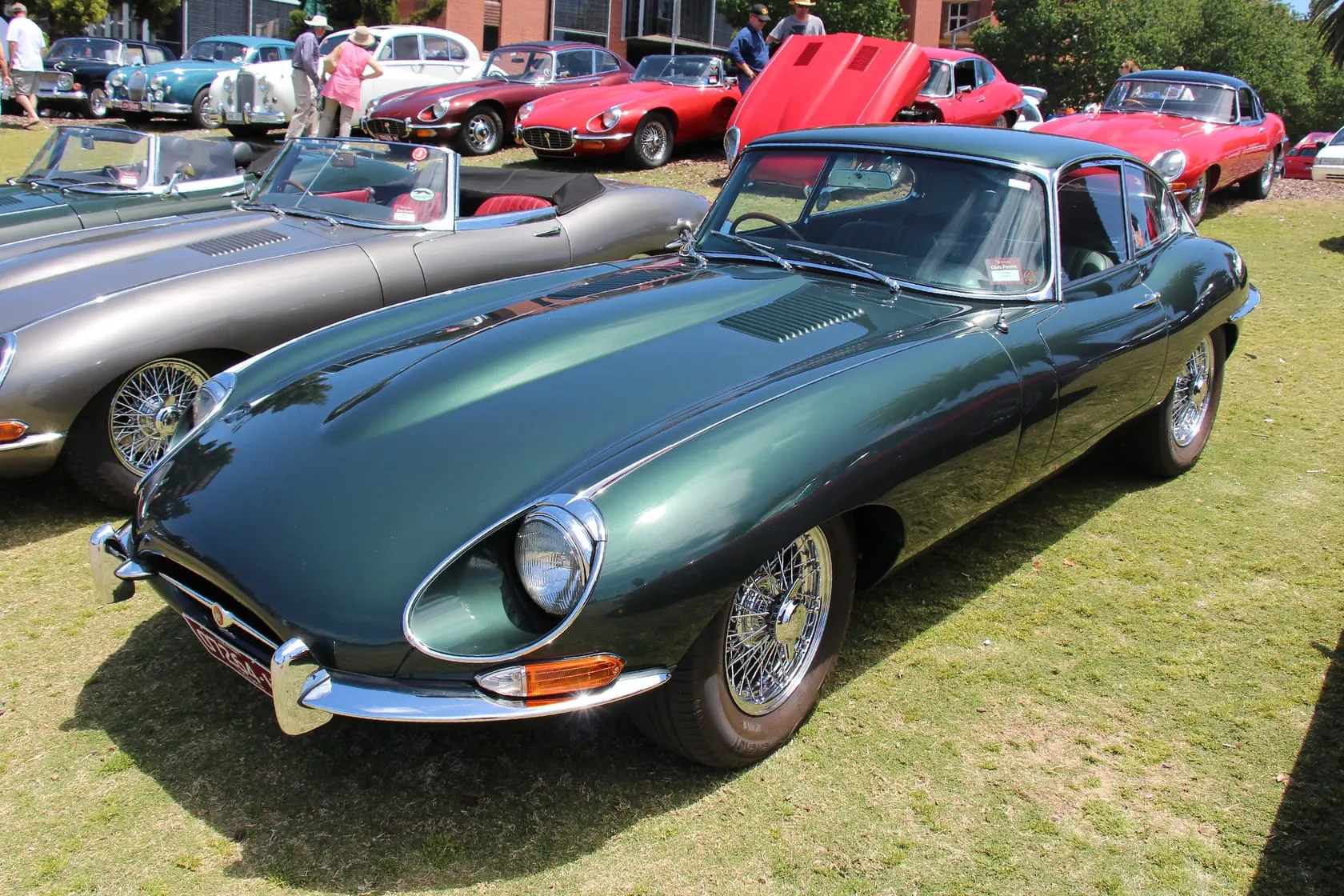
The 1968 revisions were written in Washington: US federal lighting rules banished the glass headlamp covers and moved the lamps forward, bumpers wrapped around to meet impact requirements, tail lights dropped below the rear bumper, and the air intake nearly doubled to feed better cooling. The 2+2 gained a more raked windscreen that improved its stance, the cabin swapped toggles for rockers, and options grew American-friendly: air conditioning, power steering, even steel wheels. Around 18,800 were built in three years, every one wearing Sayer’s silhouette with federal punctuation.

The engineering underneath
The same programme fixed the E-Type’s real weaknesses. Twin electric fans finally mastered the cooling that had troubled a decade of traffic jams; the brakes grew stronger; the electrics matured; the seats improved. UK-market cars kept the triple-SU 4.2 at its full 265 claimed horsepower, so a British-specification Series 2 gives away nothing in pace to the original while starting more willingly on cold mornings. American cars took twin Strombergs and emissions gear, a distinction that survives today in the specification of the many imports since repatriated and converted.
The case for the sensible E-Type
The market’s romance discount is the buyer’s margin: the Series 2 delivers the same silhouette, the same XK soundtrack and the era’s best-sorted running gear at roughly half Series 1 money, with everything the earlier cars need retrofitting already built in. For owners who intend to drive, tour and use their E-Type rather than curate it, the argument makes itself, and the smart money in the club world has been making it for years. The romance premium buys covered headlamps; the Series 2 buys journeys.


The import factor
Series 2 buying has a transatlantic accent: America took the majority of production, so a large share of today’s market is left-hand-drive imports and right-hand-drive conversions, repatriated across recent decades. None of that is disqualifying, the work is mature and often excellent, but it moves money: original UK right-hand-drive cars carry a clear premium, documented professional conversions sit in the middle, and left-hand-drive cars trade at the accessible end while suiting continental touring perfectly. Establish the car’s original market, its conversion history if any, and the current engine specification, since many Stromberg US engines have been returned to triple-SU tune. The Heritage certificate settles origins in one document and is the first thing to request.

What a Series 2 is like to drive
Drive a good Series 2 back-to-back with an earlier car and every difference you notice lands on the side of reassurance: identical urge and soundtrack from a UK-spec engine, an all-synchromesh box as standard, brakes that inspire more commitment, and a temperature gauge that stays where it belongs in traffic. Power steering, where fitted, divides opinion and can be returned to manual. The E-Type’s fundamental magic, the bonnet, the balance, the six’s crescendo, survives the federal edits entirely intact, which one good road confirms faster than any market commentary.

Buying a Series 2 today
The checklist is the standard six-cylinder E-Type examination: monocoque honesty through the sills, floors and bulkheads, the bonnet’s vast and expensive panelwork, matching numbers checked against the Heritage certificate, and restoration quality proven by photographs and invoices rather than by shine alone. Specific to the breed: establish original market specification and current engine tune on imports, and price left-hand-drive accordingly. Sympathetic upgrades are welcomed at this money when reversible. The 2+2 remains the value door into the whole E-Type world for buyers who value usability over the purest line.

Values: half-price silhouette
Nine hundred and forty-six measured sales at a £43,000 median hold the Series 2 steady: drivers from £35,000, good cars £45,000 to £65,000, the best roadsters past £80,000, 2+2s cheapest throughout. Against the Series 1’s arithmetic that is half price for the same shape from ten paces, and against most 1960s exotica it is simply one of the great value positions in the collector market, provided the buyer can live without poetry in the headlamp covers.

More photos


The Series 2 timeline
- 1968US federal rules banish the glass headlamp covers and move the lamps forward, bumpers wrap around to meet impact requirements, tail lights drop below the rear bumper and the air intake nearly doubles.
- 1968, under the skinTwin electric fans finally master the cooling that had troubled a decade of traffic jams, and the brakes, electrics and seats all improve.
- 1968, by marketUK cars keep the triple-SU 4.2 at its full 265 claimed horsepower; American cars take twin Strombergs and emissions gear.
- 1968 to 1971Around 18,800 are built in three years, every one wearing Sayer's silhouette with federal punctuation.
- 1971The V12 Series 3 replaces it.
Buying checklist: the Series 2 in front of you
The standard six-cylinder examination
- Monocoque honesty through the sills, floors and bulkheads
- The bonnet's vast and expensive panelwork
- Matching numbers against the Heritage certificate, and restoration proven by photographs and invoices rather than shine
Specific to this generation
- Establish the original market specification and the current engine tune, since many Stromberg US engines have been returned to triple-SU
- The Heritage certificate settles origins in one document and is the first thing to request
- Original UK right-hand-drive carries a clear premium, documented professional conversions sit in the middle, left-hand-drive trades at the accessible end
Which body to buy
- The 2+2 is the value door into the whole E-Type world for buyers who put usability above the purest line
- Sympathetic upgrades are welcomed at this money when reversible
What the E-Type Series 2 sells for at auction
In 2025 the median E-Type Series 2 sold for £41,125 across 93 sales, 8% down on 2024. In real terms, typical E-Type Series 2 prices were down about 35% over the five years to 2025, once inflation is accounted for.
| Variant | Sold | Typical range | Median |
|---|---|---|---|
| E-Type Series II Roadster | 474 | £40,028 - £66,670 | £55,378 |
| E-Type Series II FHC | 182 | £29,988 - £49,627 | £40,188 |
| E-Type Series II 2+2 | 168 | £21,010 - £37,939 | £29,744 |
Show the year-by-year mediansHide the year-by-year medians
| Year | Sold | Median | In 2025 money |
|---|---|---|---|
| 2026 (so far) | 62 | £43,526 | |
| 2025 | 93 | £41,125 | £41,125 |
| 2024 | 76 | £44,619 | £46,331 |
| 2023 | 83 | £51,750 | £55,533 |
| 2022 | 90 | £49,512 | £56,703 |
| 2021 | 77 | £50,880 | £62,916 |
| 2020 | 52 | £49,750 | £63,044 |
| 2019 | 57 | £48,833 | £62,513 |
| 2018 | 50 | £51,152 | £66,594 |
| 2017 | 73 | £50,625 | £67,435 |
| 2016 | 38 | £48,112 | £65,738 |
| 2015 | 31 | £40,931 | £56,485 |
| 2014 | 28 | £38,036 | £52,700 |
| 2013 | 24 | £33,656 | £47,297 |
| 2012 | 15 | £32,770 | £47,107 |
| 2011 | 15 | £25,000 | £36,859 |
| 2010 | 8 | £23,820 | £36,484 |
| 2009 | 9 | £20,637 | £32,399 |
| 2008 | 11 | £25,755 | £41,232 |
| 2007 | 7 | £16,312 | £27,023 |
| 2006 | 7 | £13,500 | £22,887 |
| 2005 | 8 | £14,611 | £25,394 |
| 2004 | 16 | £22,214 | £39,404 |
| 2003 | 5 | £19,254 | £34,642 |
| 2002 | 3 | £10,158 | £18,518 |
| 2001 | 3 | £18,076 | £33,438 |
- £50,641E-Type Series II 2+2
- £63,019E-Type Series II FHC
- £49,904E-Type Series II Roadster
- £44,408E-Type Series II Roadster
- £55,316E-Type Series II Roadster
Strong evidence. 946 recorded sales and a dozen or more a year: the median and the range are well founded. Based on 946 sold results from public classic car auctions (1994 to 10 August 2026). Sold prices, not asking prices, and not a valuation: condition, history and specification vary from car to car. Inflation-adjusted figures use the ONS CPIH index, in 2025 money.