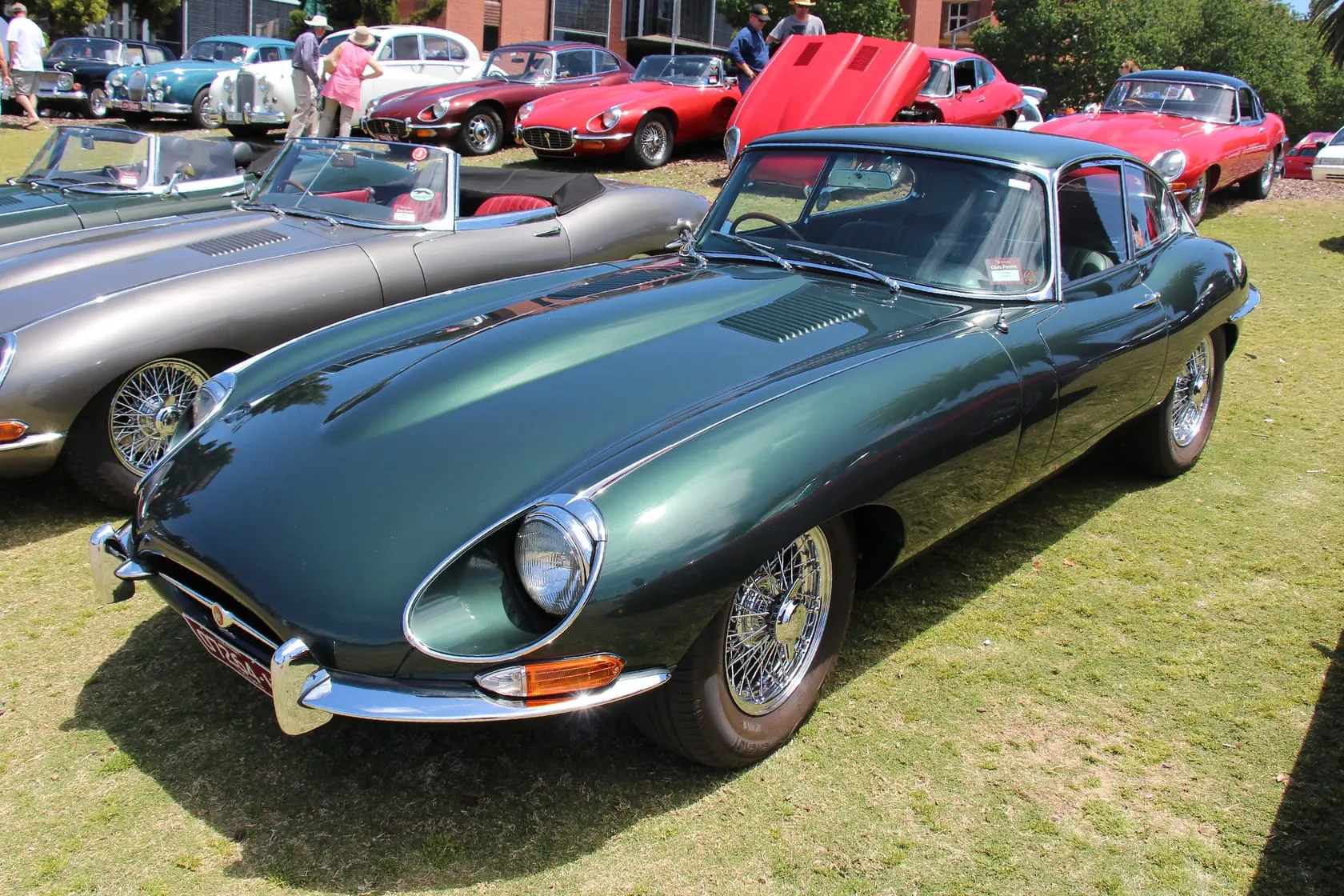
Jaguar E-Type Series 3: twelve cylinders for the grand finale (1971–1975)
The Series 3 gave the E-Type a 5.3-litre V12, a longer wheelbase and flared arches, trading the original's rawness for turbine-smooth grand touring. A guide to the V12 cars, the commemorative final fifty, what the market pays and how to buy the last of the line.
Built 1971–1975 1,021 recorded sales

At a glance
- Years
- 1971–1975
- Body styles
- Roadster and 2+2 coupe (both on the long wheelbase)
- Drivetrain
- Front engine, rear-wheel drive; independent rear suspension
- Engines
- 5343cc Jaguar V12
- Power
- 272 bhp (claimed)
- Top speed
- Around 146 mph
- Trim levels
- Roadster, 2+2; manual or automatic; power steering standard
- Production
- About 15,300
- Assembly
- Browns Lane, Coventry
- Designer
- Sayer's shape revised: cross-slat grille, flared arches, wider track
- Values
- Usable from around £35,000; good cars £45,000-£70,000; the last fifty and the best beyond
- The heart
- The 5.3 V12, the engine that went on to power Jaguar for two decades
- The farewell
- A final fifty commemorative roadsters, forty-nine black, closed the line in 1975
The models
Twelve cylinders, 5.3 litres of them, a longer wheelbase and flared arches: the Jaguar E-Type Series 3 of 1971 rewrote the ageing E-Type’s brief from sports car to luxury express, a longer, wider, softer car than the purists wanted, and it divided enthusiast opinion sharply for decades before the market made peace. With 1,021 measured sales at values now standing clear of the Series 2, the V12 E-Type has been promoted from controversial epilogue to collected chapter in its own right.
The V12: a new heart for an old shape
The Series 3 existed to launch an engine: the all-alloy 5,343cc V12, developed from Jaguar’s stillborn mid-engined racing programme into a production unit of turbine smoothness, 272 claimed horsepower and near-silence at speed. The E-Type’s long bonnet was the natural showcase, and the twelve transformed the car’s character, delivering the marque’s fastest production acceleration of the era without apparent effort. The same engine would power Jaguar’s saloons and the XJ-S for twenty years; it made its entrance wearing the most famous body in the catalogue.

Grand tourer, not racer
The chassis grew to match the ambition: every Series 3, roadster included, sat on the long 2+2 wheelbase with a wider track under flared arches, the cross-slat grille fed a bigger radiator, power steering became standard and many cars took the automatic. The original’s raw edges were deliberately planed away, because the buyer had changed; this was a transatlantic grand tourer for the emerging seventies, not a Le Mans silhouette. Judged against its own brief rather than 1961’s, the Series 3 succeeds completely, which is the reassessment today’s market has priced in.


The last fifty and the end of the line
About 15,300 Series 3s carried the E-Type to its close. Production ended in 1975 with fifty commemorative right-hand-drive roadsters, forty-nine black and one green for an insistent customer, each with a numbered dash plaque signed by Sir William Lyons, the founder signing off the shape that defined his company. Those final cars are the generation’s blue chips, and their auction appearances make headlines the ordinary market then quietly follows. Fourteen years after Geneva, the most beautiful car retired with twelve cylinders and a signature.

What the V12 began
The Series 3’s engine outlived the car that launched it by a generation: the 5.3 V12 went on to power the XJ12 saloons and then the XJ-S, the E-Type’s actual successor, into the 1990s, collecting a Le Mans-winning descendant along the way in the V12 Group C programme’s lineage. That afterlife matters practically to owners now, because the engine’s long production run built a deep well of specialist knowledge, parts supply and proven upgrades, cooling and ignition especially, that a short-lived exotic unit would never enjoy. The Series 3 buyer inherits the best-supported twelve-cylinder ecosystem of the classic era, one more way the finale turned out to be the practical E-Type in disguise.

What a Series 3 is like to drive
The V12 experience is unlike either six-cylinder era: the engine is uncannily smooth and almost silent under way, force without fury, with power steering lightening the helm and the long wheelbase settling the ride into genuine grand-touring composure. Manual cars add engagement, automatics suit the character more than purists admit. The costs are thirst in the low teens and an engine bay that punishes neglect, but a sorted V12 covering continental miles makes the most persuasive possible case for the finale’s brief.

Buying a Series 3 today
Buy the engine’s history first: the V12 is durable when maintained and ruinous when cooked, so evidence of cooling system health, regular servicing by hands that know the unit, and unhurried ownership outweigh cosmetics entirely. Structure follows the E-Type standard, sills, floors, bulkheads and bonnet. Manual roadsters lead values; verified low-ownership cars and the commemorative fifty carry the premiums. Specification originality matters less here than mechanical rectitude, which is the precise opposite of the Series 1 market’s priorities, and suits a car built for using.

Values: the promoted finale
One thousand and twenty-one measured sales at a £45,000 median tell the reassessment plainly: drivers from £35,000, good cars £45,000 to £70,000, manual roadsters at the top, the final fifty in six figures. That now clears Series 2 money, closes on the six-cylinder cars’ aura from below, and prices twelve cylinders of 1970s grand touring at a fraction of contemporary Italian twelve-cylinder machinery. The controversial E-Type has worn the years better than its reputation suggested; the grand finale is having the last word.

More photos


Series 3: what changed and when
- 1971The Series 3 arrives to launch the all-alloy 5,343cc V12, developed from Jaguar's stillborn mid-engined racing programme into a production unit of turbine smoothness.
- 1971, the chassisEvery Series 3, roadster included, sits on the long 2+2 wheelbase with a wider track under flared arches, a cross-slat grille feeding a bigger radiator, and power steering as standard.
- 1971 to 1975About 15,300 Series 3s carry the E-Type to its close.
- 1975Production ends with fifty commemorative right-hand-drive roadsters, forty-nine black and one green for an insistent customer, each with a numbered dash plaque signed by Sir William Lyons.
- After 1975The same V12 goes on to power Jaguar's saloons and the XJ-S for twenty years.
What to check on a Series 3
The engine's history, first
- The V12 is durable when maintained and ruinous when cooked
- Evidence of cooling-system health and regular servicing by hands that know the unit
- Unhurried ownership outweighs cosmetics entirely here
Structure, to the E-Type standard
- Sills, floors and bulkheads
- The bonnet, as on every E-Type
What carries a premium
- Manual roadsters lead values
- Verified low-ownership cars and the commemorative fifty carry the premiums
- Mechanical rectitude outranks specification originality, the precise opposite of the Series 1 market
What the E-Type Series 3 sells for at auction
In 2025 the median E-Type Series 3 sold for £42,158 across 92 sales, 14% down on 2024. In real terms, typical E-Type Series 3 prices were down about 39% over the five years to 2025, once inflation is accounted for.
| Variant | Sold | Typical range | Median |
|---|---|---|---|
| E-Type Series III Roadster | 630 | £41,280 - £71,103 | £55,380 |
| E-Type Series III Coupe | 321 | £25,200 - £42,021 | £33,862 |
Show the year-by-year mediansHide the year-by-year medians
| Year | Sold | Median | In 2025 money |
|---|---|---|---|
| 2026 (so far) | 54 | £41,993 | |
| 2025 | 92 | £42,158 | £42,158 |
| 2024 | 74 | £49,115 | £51,000 |
| 2023 | 69 | £56,198 | £60,306 |
| 2022 | 78 | £48,140 | £55,132 |
| 2021 | 97 | £56,856 | £70,306 |
| 2020 | 75 | £54,375 | £68,905 |
| 2019 | 61 | £47,708 | £61,073 |
| 2018 | 44 | £47,448 | £61,773 |
| 2017 | 56 | £58,356 | £77,733 |
| 2016 | 60 | £49,832 | £68,087 |
| 2015 | 43 | £47,316 | £65,296 |
| 2014 | 28 | £41,744 | £57,839 |
| 2013 | 29 | £38,250 | £53,753 |
| 2012 | 25 | £33,350 | £47,941 |
| 2011 | 11 | £31,666 | £46,687 |
| 2010 | 14 | £29,880 | £45,765 |
| 2009 | 19 | £29,837 | £46,843 |
| 2008 | 22 | £24,873 | £39,820 |
| 2007 | 10 | £26,359 | £43,668 |
| 2006 | 8 | £27,128 | £45,992 |
| 2005 | 10 | £23,862 | £41,472 |
| 2004 | 13 | £13,800 | £24,478 |
| 2003 | 5 | £16,313 | £29,351 |
| 2001 | 5 | £26,191 | £48,450 |
| 1997 | 3 | £17,210 | £33,928 |
| 1996 | 4 | £20,564 | £41,429 |
| 1995 | 5 | £22,889 | £47,428 |
| 1994 | 3 | £21,371 | £45,442 |
- £5,453E-Type Series III Coupe
- £25,500E-Type Series III Coupe
- £70,119E-Type Series III Roadster
- £73,125E-Type Series III Roadster
- £63,000E-Type Series III Coupe
Strong evidence. 1,021 recorded sales and a dozen or more a year: the median and the range are well founded. Based on 1,021 sold results from public classic car auctions (1993 to 10 August 2026). Sold prices, not asking prices, and not a valuation: condition, history and specification vary from car to car. Inflation-adjusted figures use the ONS CPIH index, in 2025 money.