Austin-Healey 100 values: the 100M and 100S premiums, BN2 over BN1, the 100/6 discount, and a market that has halved
A factory 100M sells for more than double a standard car, and a 100S for half a million. Austin-Healey 100 prices across 618 recorded auction sales, what a BN1, a BN2 and a Le Mans car make, why the six-cylinder 100/6 is the cheapest Big Healey, and why the 100 has lost half its value in real terms since 2013.
Built 1953–1959

What the 100 and 100-6 sells for at auction
In 2025 the median 100 and 100-6 sold for £33,360 across 53 sales, 16% down on 2024. In real terms, typical 100 and 100-6 prices were down about 35% over the five years to 2025, once inflation is accounted for.
| Variant | Sold | Typical range | Median |
|---|---|---|---|
| 100/4 BN1 | 100 | £28,644 - £54,878 | £40,285 |
| 100/6 BN4 | 90 | £21,700 - £33,772 | £27,232 |
| 100/4 BN2 | 73 | £39,226 - £68,901 | £49,500 |
| 100/6 | 66 | £23,754 - £35,130 | £30,496 |
| 100M | 64 | £66,367 - £136,390 | £94,508 |
| 100/6 BN6 | 32 | £18,894 - £39,051 | £31,249 |
| 100 BN1 | 29 | £32,970 - £48,925 | £45,731 |
| 100 BN2 | 26 | £37,355 - £92,797 | £60,162 |
| 100/4 BN2 Le Mans | 18 | £57,366 - £76,047 | £64,008 |
| 100 BN2 Le Mans | 13 | £53,043 - £113,542 | £62,501 |
| 100S | 12 | £387,542 - £648,300 | £496,718 |
| 100/4 BN1 Le Mans | 6 | £52,334 - £58,900 | £56,314 |
Show the year-by-year mediansHide the year-by-year medians
| Year | Sold | Median | In 2025 money |
|---|---|---|---|
| 2026 (so far) | 27 | £37,990 | |
| 2025 | 53 | £33,360 | £33,360 |
| 2024 | 50 | £39,564 | £41,082 |
| 2023 | 49 | £34,875 | £37,424 |
| 2022 | 37 | £47,250 | £54,112 |
| 2021 | 39 | £43,000 | £53,172 |
| 2020 | 38 | £40,482 | £51,300 |
| 2019 | 38 | £50,724 | £64,934 |
| 2018 | 36 | £47,086 | £61,300 |
| 2017 | 42 | £48,462 | £64,554 |
| 2016 | 34 | £45,578 | £62,275 |
| 2015 | 16 | £48,442 | £66,850 |
| 2014 | 28 | £48,024 | £66,539 |
| 2013 | 23 | £50,625 | £71,143 |
| 2012 | 18 | £47,022 | £67,593 |
| 2011 | 15 | £31,178 | £45,968 |
| 2010 | 12 | £42,930 | £65,753 |
| 2009 | 11 | £23,400 | £36,737 |
| 2008 | 7 | £26,634 | £42,639 |
| 2007 | 6 | £29,164 | £48,314 |
| 2006 | 5 | £13,500 | £22,887 |
| 2005 | 14 | £16,875 | £29,329 |
| 2004 | 9 | £22,500 | £39,910 |
| 1999 | 3 | £14,321 | £27,222 |
| 1995 | 3 | £15,725 | £32,583 |
- £26,160100/6 BN4
- £24,179100 BN1
- £102,393100M
- £19,710100/6
- £24,184100/4 BN2
Strong evidence. 618 recorded sales and a dozen or more a year: the median and the range are well founded. Based on 618 sold results from public classic car auctions (1994 to 10 August 2026). Sold prices, not asking prices, and not a valuation: condition, history and specification vary from car to car. Inflation-adjusted figures use the ONS CPIH index, in 2025 money.
The 100 is the first Big Healey and the one with the widest spread of prices, and Austin-Healey 100 values run from a sound 100/6 at under £30,000 to a 100S at half a million: 618 recorded sales since 1994, about 45 a year lately, at a median of £40,100, with the middle half between £27,700 and £62,300. Two in three of the cars offered find a buyer, the lowest rate of any Healey, because the estimates have been slow to follow the prices down. The spread runs from a £2,500 project to £785,500 for a works Special Test car, and most of the record is an ordinary four-cylinder 100 or a 100/6, restored once, sold in Britain or America to someone who wants the original Healey shape.
The Austin-Healey 100 model guide covers the BN1 and BN2, the 100M and 100S, the six-cylinder 100/6 and what to check. This page is about the money, and about a market that has halved in real terms while the best cars have held their prices.
BN2 over BN1, M over both, and the S apart
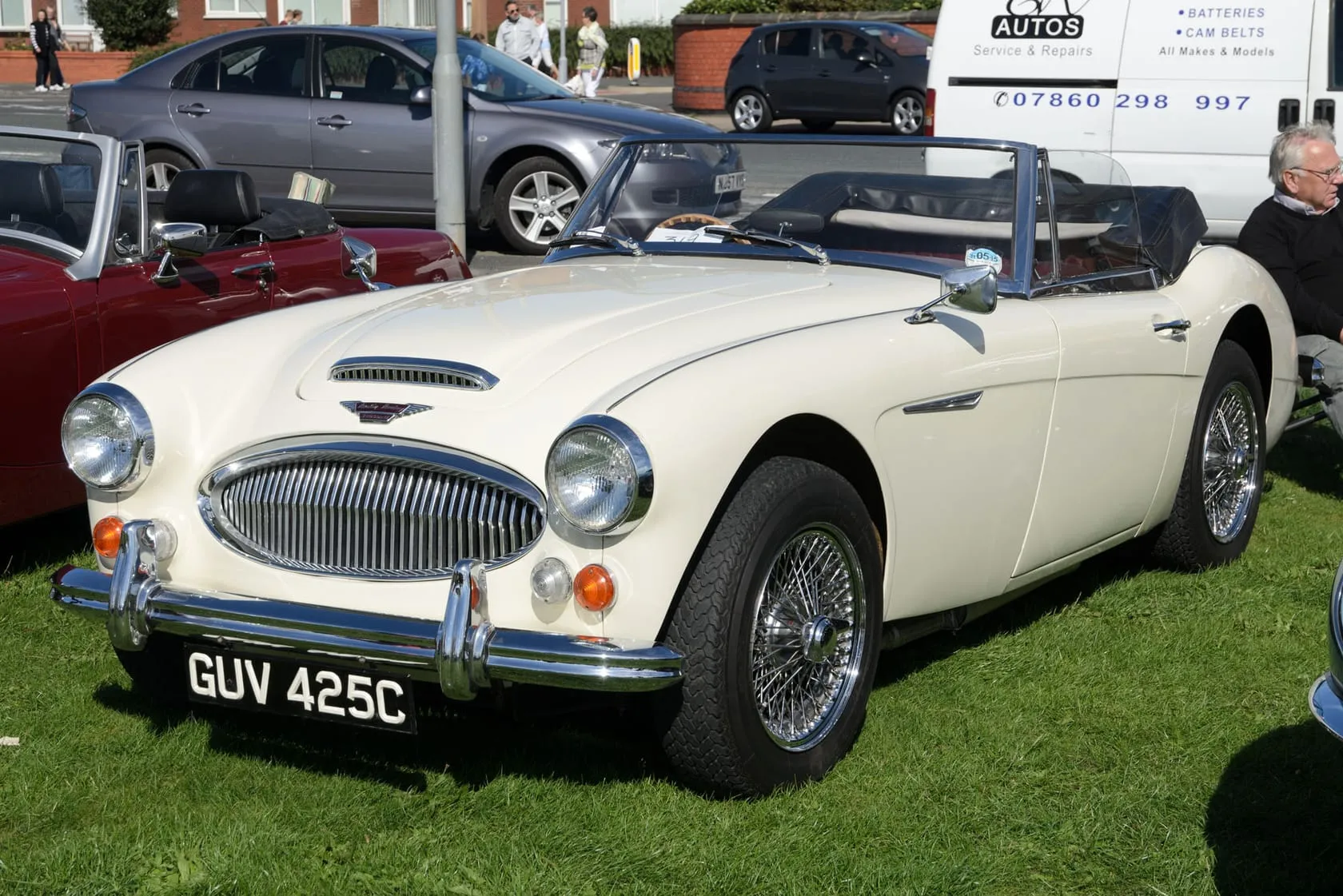
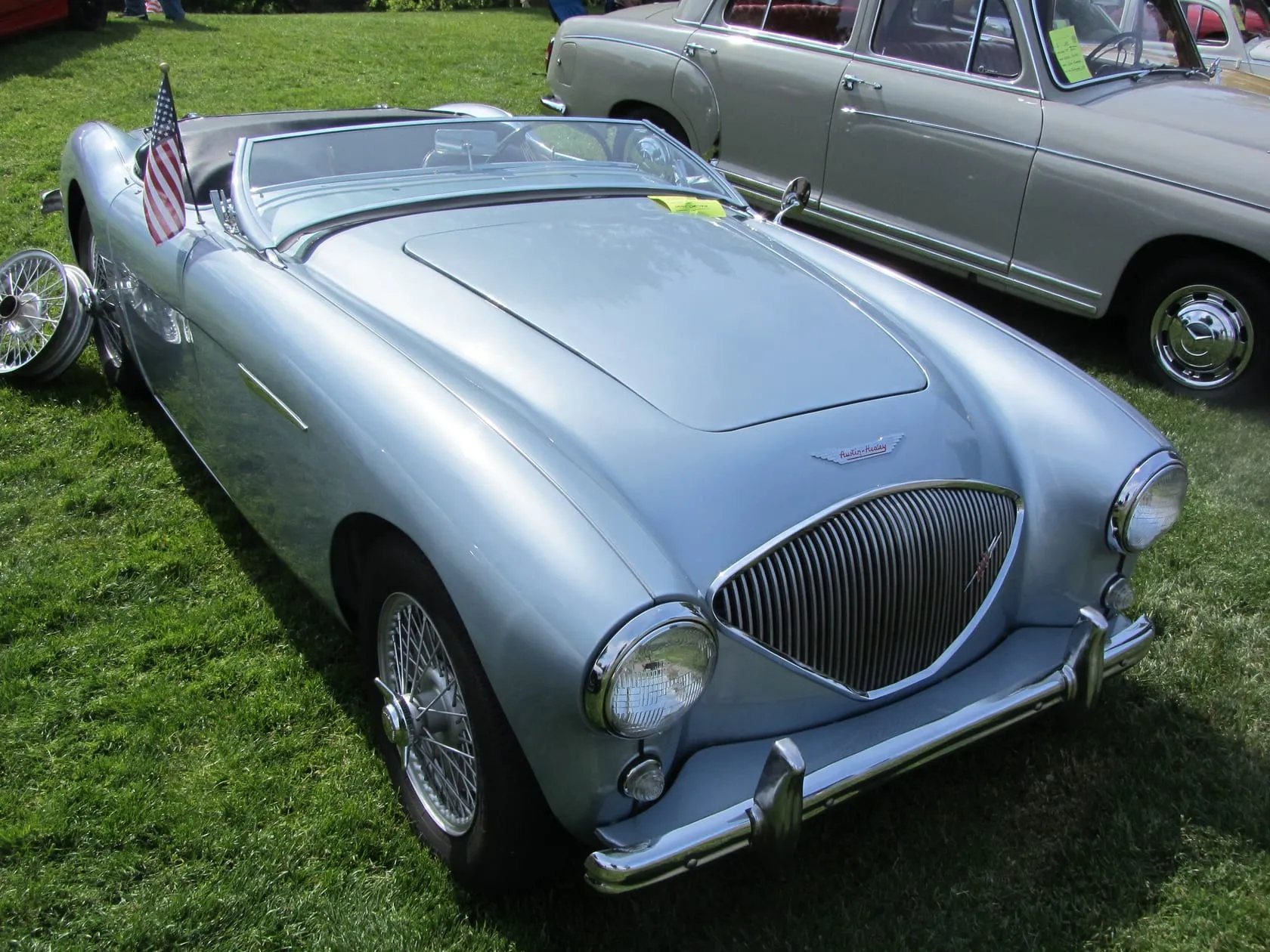
The variant table on this page runs in three tiers. The standard four-cylinder cars sit at the bottom: the BN1 of 1953 to 1955, with the three-speed gearbox, at a median of £40,300 across 100 recorded sales (and £45,700 across the 29 the source listed without the “100/4” prefix), and the BN2 of 1955 to 1956, with the four-speed box and overdrive, at £49,500 across 73, about a quarter more. The Le Mans cars, standard 100s fitted with the factory’s performance kit, sit above them at £56,000 to £64,000 across 37 sales, a clear step for the louvred bonnet and the extra carburation but far from the next tier.
That tier is the 100M: the 640 cars the factory built to Le Mans specification in 1955 and 1956, with the louvred bonnet, the leather strap, the high-compression engine and the cold-air box, which have a median of £94,500 across 64 sales, more than double a standard BN2, and reach £150,000 and beyond at the top. The premium belongs only to a car whose chassis number appears on the factory list; a standard car with the kit fitted later is a Le Mans, however complete. Above everything is the 100S, the aluminium-bodied competition car of which around 50 were built, at a median of £497,000 across twelve sales, and the works Special Test cars that preceded it, one of which made £785,500 in 2013.
At the other end is the six-cylinder 100/6 of 1956 to 1959, the Big Healey nobody wanted in period: the BN4 with its two occasional rear seats at £27,200 across 90 sales, the unprefixed 100/6 at £30,500 and the two-seat BN6 at £31,200. It sells for a third less than a four-cylinder car and a quarter less than the 3000 that replaced it.

What moves the price of a Healey 100
Identity first, because the premiums are so large. The chassis number, the engine number and the body checked against the heritage certificate and, for an M, the factory list are the start of any serious price, and the market treats every louvred bonnet as a claim to be proven; the same applies to the 100S, whose chassis numbers are all known. Then the steering wheel: the great majority of 100s were built left-hand drive for America, and a genuine home-market right-hand-drive car sells at a premium in Britain of perhaps ten to twenty per cent, with a converted car, declared, somewhere between.
Then the body and the chassis, which rust together: the sills, the floors, the outriggers and the chassis rails at the rear, where the aluminium outer panels hide the steel beneath. A body-off restoration at a specialist costs more than a standard car is worth, which is why the £55,000 restored BN2 is a car somebody else has paid for and the £15,000 project rarely the bargain it looks. Originality counts with the collectors: the three-speed gearbox on an early BN1, the correct engine, period colours and the original wheels all add, while the upgrades that make a 100 pleasanter, a five-speed gearbox, disc brakes and an alternator, are accepted by the users and marked down by the collectors. Mileage, on a car that has always been restored, means nothing.

Half the value it had in 2013
The chart shows a long plateau and a slow slide. The yearly median was around £25,000 to £30,000 through the late 2000s, jumped to £42,900 in 2010 and £47,000 in 2012, and sat between £45,000 and £50,700 from 2012 to 2019, peaking in 2019. It fell to £40,500 in 2020, recovered to £47,300 in 2022, and then dropped to £34,900 in 2023, £39,600 in 2024 and £33,400 in 2025, with the 2026 figure so far around £38,000. Restated in today’s money the 100 has lost about half its value since 2013 and since 2019.
The sample explains part of it, with the online auctions bringing more 100/6s and more projects into the record, and a median built on those is lower than one built on restored 100Ms. The rest is the cause the XK120 and the 3000 share: a 1950s sports car whose buyers are leaving the market while the buyers who follow want an E-Type. The 100M and the 100S have held their prices, because they are scarce and the collectors still want them; the standard cars and the 100/6, restored in the boom years and returning to the sale rooms now, have fallen hardest, and a single month in the summer of 2026 saw BN1s, BN2s and 100/6s sell between £19,700 and £26,200 on both sides of the Atlantic, figures that would have bought a project in 2015.

Where Healey 100s change hands
The record is split between Britain and America, where most of the cars were sold new, and the international auction houses, which sell the Ms and the Ss. The summer of 2026 shows the spread: a 100M at £102,400 at a French sale, a BN2 at £24,200 and a BN1 at £24,200 on the American online platforms, a 100/6 at £19,700 at a Norfolk sale room and a BN4 at £26,200 online. The best 100Ms and every 100S go through the catalogued international sales and the Healey specialists at prices above the recorded range. Whether a recorded price includes the buyer’s premium varies by sale, which is one more reason to read the usual range rather than any single result.

Insuring, restoring, selling
For an agreed-value policy a good standard car belongs around its version’s median and a restored one in the upper half of the range; a 100M is insured on its chassis number and a 100S on its history. On restoration the arithmetic is the XK’s: a body-off rebuild costs more than a standard car is worth, so the sensible buy is the finished car at today’s reduced prices, and only an M or a car with history recovers the cost. If you are selling, the spring is the season, the heritage certificate and the chassis number are what the buyer checks first, and the realistic expectation is the median for the version, not the figure the car was insured for in 2019.
Related
The 100 begat the 100/6 and then the 3000, which now sells for a little less than a four-cylinder 100 and a little more than a six; its rival in period was the Triumph TR3, which sells for about half as much, and its price today sits below the XK120’s. For the decade, see British classic cars of the 1950s. For how all the figures on this site are compiled, see what classic cars sell for.