The engines behind most British classics: A-series, B-series, Rover V8 and the Jaguar XK
The guides
Strip the badges off the British classics built between the late 1940s and the turn of the century and a surprisingly small number of engines remain. Four families, each descended from one design, powered a remarkable share of everything from the Morris Minor to the Range Rover.
Understanding them is the fastest way into understanding the cars, because an engine’s habits follow it from model to model. A fault that plagues an MGB is the same fault in a Marina, and the fix is the same too.
A note on sources before the detail. The production dates and applications below rest on a mix of heritage records, club literature and well-researched secondary histories. The famous weaknesses rest almost entirely on the accumulated experience of owners and rebuilders. Both are useful. They are not the same kind of fact, and where a claim is folklore rather than record we say so.
The A-series: the engine of the small British car
The BMC A-series arrived in the Austin A30 in 1951 as an 803cc overhead valve four, and it was still being built in 2000, when the last classic Mini left Longbridge. Nearly fifty years is an extraordinary run for any engine, and it happened because the design was simple, cheap to make, and easy to enlarge.
It grew in steps: 948cc for the Minor 1000 and the Sprite from 1956, 848cc for the original Mini in 1959, 998cc, 1,098cc for the 1100 and the Midget, and 1,275cc for the Cooper S and the later Sprites and Midgets. Applications read like a list of British motoring: the A30 and A35, the Morris Minor, the Mini in all its forms, the Austin-Healey Sprite and MG Midget, the 1100 and 1300, and the Metro, which received the revised A-Plus version from 1980 with a stronger block and an improved oil system.
The reputation for leaking oil and for timing chain rattle has one piece of hard corroboration: the A-Plus changes were made specifically to address oil leakage and to add a chain tensioner, which tells you the factory knew. The other famous fault, crankshaft thrust washers wearing or dropping out so that the crank walks forward under clutch load, is reported with complete consistency by owners and specialists and appears in no manufacturer document anywhere. The advice that follows from it is universal: check crankshaft end float, and do not sit at the lights with the clutch pedal held down.
The 1,275cc version, bored close to the limit of the block with little metal between the middle cylinders, is the one reputed to run hottest, which is enthusiast consensus rather than record but is repeated by everyone who has rebuilt one.
The B-series: the mid-sized four
If the A-series powered the small car, the B-series powered the one above it. It descended from the 1,200cc engine of the Austin A40 and appeared at 1,489cc in the MG Magnette in 1953 and the Morris Oxford the following year. It grew to 1,588cc for the MGA 1600, 1,622cc, and finally 1,798cc, the capacity that powered the MGB from 1962 and the Austin and Morris 1800.
The applications span the BMC and British Leyland saloon range: the Magnette, Oxford and Cambridge, the Wolseley 15/50 and Riley 1.5, the MGA and MGB, the 1800 and the Marina, and commercial derivatives into the 1980s. Its mainstream car production ran from 1954 to around 1980, with derivatives built later.
Two things about the B-series are worth knowing before buying a car with one. The early MGB engines of 1962 to 1964 had a three-bearing crankshaft, and the five-bearing unit that replaced it in 1964 is the one everybody prefers; this is well documented. The rear crankshaft seal on most B-series engines is a scroll rather than a lip seal, which is why a B-series that does not leave a small mark on the garage floor is regarded with suspicion. That one is workshop consensus, not a manufacturer note, but it is universal.
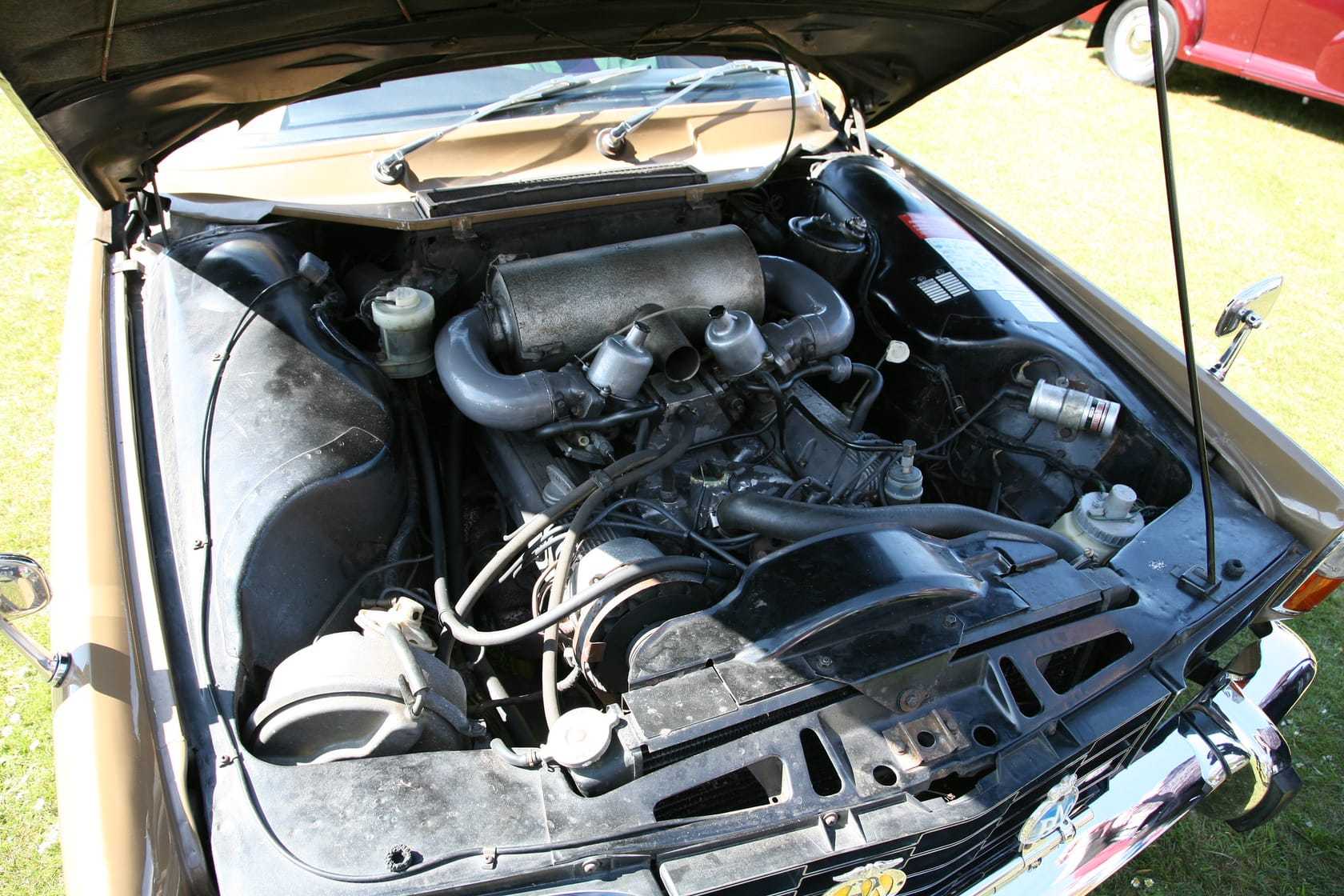
The Rover V8: Detroit, via Solihull
The most-travelled British engine was not British. General Motors designed and built the all-aluminium Buick 215, 215 cubic inches or 3,528cc, from 1961 to 1963, then abandoned it. The original American castings had porosity problems of their own, and the industry was not ready for aluminium.
In 1964 Rover’s managing director William Martin-Hurst saw one of the engines at a boat-engine company in Wisconsin, and began a campaign to buy the design. GM agreed in January 1965. Rover re-engineered the block for its own casting methods, with pressed-in iron cylinder liners in place of Buick’s cast-in ones, and launched it in the P5B in 1967.
From there it went almost everywhere: the P6 3500 from 1968, the Range Rover from 1970, the Morgan Plus 8, the MGB GT V8 from 1973, the Rover SD1, the TVRs, the Land Rover Discovery and the Defender. It grew from 3.5 litres through 3.9 and 4.2 to 4.6, and a confusing detail is worth untangling: the 4.0-litre of the 1990s is not a bigger engine than the 3.9, it is the same 3,946cc in a stronger block with cross-bolted main bearings. Land Rover’s own production ended in 2004 with the last Discovery 2, and a specialist continued licensed production for a short time afterwards, which is why the end date is sometimes given as 2006.
The famous weakness is liner movement on the later 4.0 and 4.6 engines of the P38 Range Rover and Discovery 2 era: the iron liner shifting in the aluminium block, or the block cracking behind it, with coolant and combustion finding each other. Specialists and forums report it exhaustively and the aftermarket has built a business around top-hat liner conversions. No manufacturer bulletin or recall documents it. It is the single most expensive thing that can happen to a Rover V8, it concentrates on the late castings rather than the early 3.5 and 3.9 blocks, and a buyer of a 1990s Land Rover product with this engine should assume the question needs answering.
The Triumph fours and sixes
Triumph’s small engine began in the Standard Eight in 1953 at 803cc, a curious parallel to the A-series, and grew through the Herald and Spitfire to nearly 1.5 litres. Its six-cylinder derivative, the same design with two more cylinders, arrived in the Standard Vanguard Six in 1960 at two litres and went on to power the Triumph 2000 and 2500 saloons, the GT6 and the TR6, where in fuel-injected form it made the car’s reputation. The Stag, it should be said, did not use this six; it had its own V8, with its own well-known story.
The Triumph six shares the A-series’ reputation for crankshaft thrust washer failure, with the same mechanism and the same forum-only evidence: washers found in the sump, end float growing until the rear main is wrecked, and the same advice about the clutch pedal. Pinned replacement washers are the aftermarket answer.
The Jaguar XK: the one with a museum date
Of the four families, the Jaguar XK six is the only one whose span is confirmed by a heritage body: the Jaguar Daimler Heritage Trust lists it as in production from 1948 to 1992. Designed under William Heynes with Walter Hassan and Claude Baily, it was shown in the XK120 at the 1948 motor show and powered the XK sports cars, the Mk1 and Mk2 saloons, the E-Type, the XJ6 and the Daimler derivatives, in capacities from 2.4 to 4.2 litres.
The last production car to carry it was a Daimler DS420 limousine built in 1992, forty-four years after the first. For an engine designed in the 1940s that is a remarkable record, and it is a large part of why the cars it powered, from the E-Type onward, remain so well supported.
Why this matters when buying
An engine family’s habits travel with it, and that makes the list above a buying tool. A B-series car will have the B-series seal. A late Rover V8 will have the liner question. An A-series or Triumph six will have the thrust washer question, answerable in a minute with a pry bar at the front pulley and a clutch pedal.
It also explains the parts situation, which for these four families is as good as it gets. The A-series alone was built in the millions over five decades, and the specialists, the clubs and the remanufacturers that grew up around it have no intention of stopping. Buying a classic with one of these engines means buying into that support, which is worth more over ten years of ownership than almost any other single factor. The practical side of looking after one, starting with the jobs a new owner can learn first, is in our guide to maintenance for beginners.