Ford Cortina 1600E: the executive Cortina everyone wanted (1967–1970)
The Ford Cortina 1600E dressed the Mk2 in lowered suspension, Rostyle wheels and a walnut-and-sports-seats cabin, inventing the affordable executive express and outliving its era as the most loved Cortina of all. A guide to the 1600E and the Mk2 family around it, buying checks and values.
Built 1966–1970 90 recorded sales

At a glance
- Years
- 1966–1970 (Mk2); 1967–1970 (1600E)
- Body styles
- Four-door saloon (1600E); two/four-door and estate across the Mk2 range
- Drivetrain
- Front engine, rear-wheel drive
- Engines
- 1599cc Kent crossflow GT-tune (1600E); 1.3-1.6 across the range
- Power
- 88 bhp (1600E)
- Top speed
- Around 98 mph
- Trim levels
- Base, De Luxe, Super, GT, 1600E; Crayford convertible conversions
- Production
- About 58,000 1600Es among over a million Mk2s
- Assembly
- Dagenham, Essex
- Designer
- Ford of Britain; 1600E package by the product planners' inspired afternoon
- Values
- Usable 1600Es from around £8,000; good cars £11,000-£16,000; the best beyond £20,000
- The formula
- GT running gear, Lotus-lowered suspension, Rostyles and a walnut dashboard
- The legacy
- The template for every sporting-executive trim Ford sold for decades after
The models
Some cars are engineered into legend; the Cortina 1600E was, gloriously and profitably, option-listed into it. In 1967 Ford’s product planners took the Mk2 Cortina GT, lowered it on Lotus-derived springs, bolted on Rostyle wheels and filled the cabin with walnut and reclining seats, and the resulting Ford Cortina 1600E invented the affordable executive express. Half a century later it remains the most loved Cortina of all, guarded by one of the most devoted single-model cults in British motoring.
The inspired afternoon
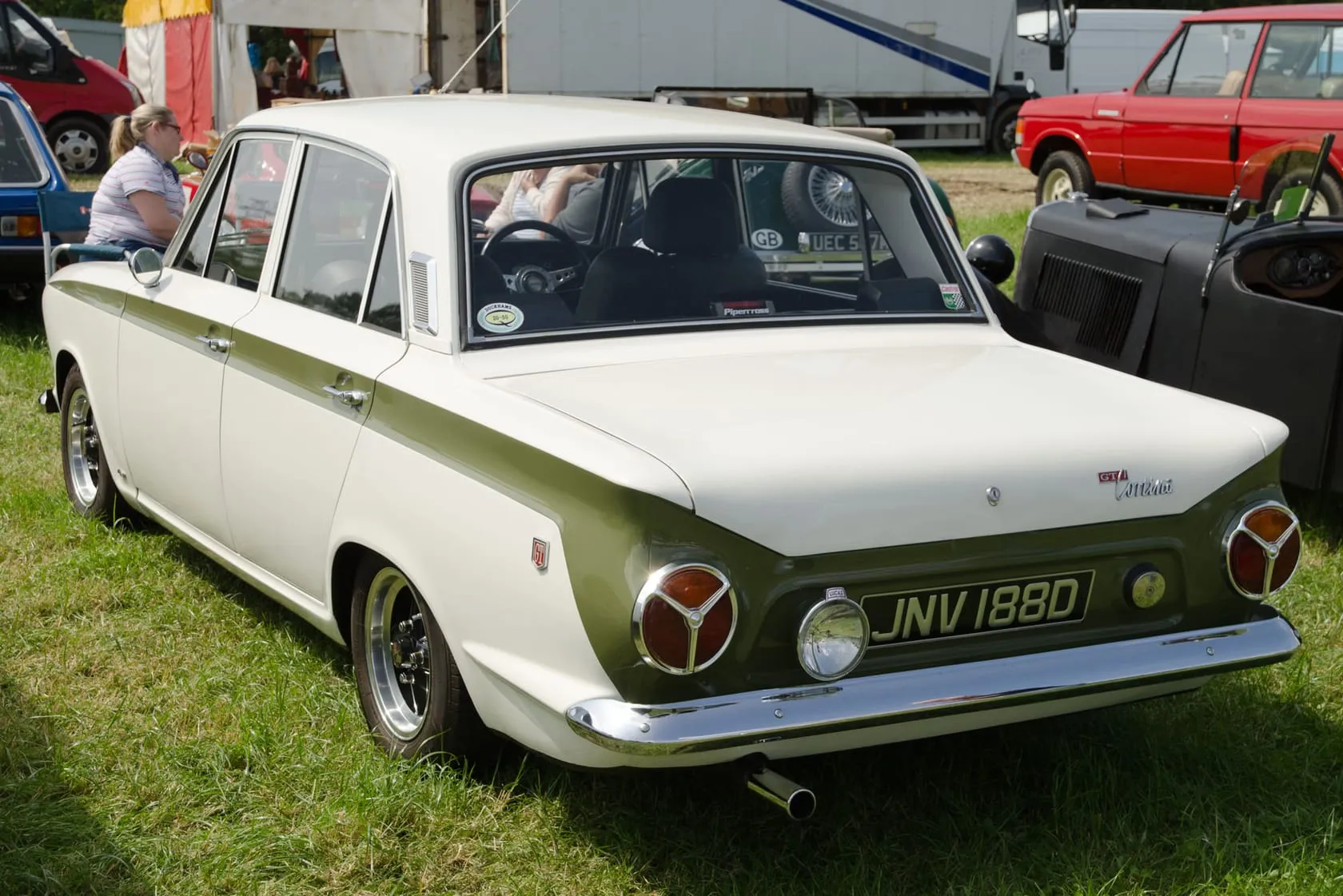
The 1600E cost Ford almost nothing to create and earned a fortune: GT mechanicals already existed, the Lotus Cortina had developed the lowered suspension, and the rest was trim-book genius, matt-black grille, driving lamps, Rostyles, veneer and those seats. Priced between GT and Lotus, it sold to young executives who wanted pace with polish, about 58,000 of them, and spawned every plush-sporting Ford trim that followed. Rivals took years to answer the formula; buyers never stopped answering it.

The Mk2 family around it
Beneath the flagship, the Mk2 Cortina (1966–70) was Britain’s default family car in its crispest form: clean-edged styling over proven mechanicals, 1.3 and 1.6 crossflow engines, base to Super trims, GT pace and cavernous estates, more than a million sold. Crayford’s convertible conversions added open-top glamour at the margin. The Mk2’s honest breadth is why this page’s auction statistics span the family: the 1600E leads a market in which even ordinary survivors now matter, scarcity having overtaken hierarchy.

The cult of the E
Few cars of any price sustain devotion like the 1600E. Its owners’ club has run continuously since 1971, its registers track individual cars across the decades, and the period colours, aubergine, amber gold, saluki bronze, are debated at club gatherings with genuinely scholarly seriousness. The E became shorthand for a certain late-sixties confidence, Carnaby-collared and ambitious, and its survivors are restored to standards the original line workers would disbelieve. The cult keeps values firm and knowledge deep, which makes buying well unusually straightforward for a fifty-year-old Ford.

Colours, details and the identity
Much of the E’s magic lives in its details, which is why the faithful defend them so fiercely. The launch palette leaned into late-sixties confidence, aubergine, amber gold, saluki bronze, jet black over red trim, and an original-colour car carries real weight in the club world. The gold-and-silver Rostyle wheels, the matt-black grille with twin driving lamps, the burr-walnut facia and centre console, and the badged boot lid together form a specification the cognoscenti can recite from memory, and correctness matters at sale time. Series 1 cars (to autumn 1968) differ from Series 2 in trim and detail, both have their partisans, and the club’s registers document which cars left Dagenham wearing what. Few classics this affordable reward originality so visibly, which keeps the hunt for correct parts a permanent club sport.

What a 1600E is like to drive
The blend still convinces: the crossflow’s eager 88 bhp in a light shell, close GT gearing through a gearchange Ford made better than anyone, the lowered stance tightening responses without ruining the ride, and that walnut-and-vinyl cabin making every journey feel promoted. The rear axle hops on bad surfaces as every live-axle Ford’s did, the brakes are adequate rather than heroic, and none of it matters. Ninety-eight flat out counted for less than how the whole car carried itself, and still does. Against its Lotus sibling the E trades final pace for civility, which in modern traffic makes it arguably the better companion, and certainly the cheaper one to feed.

Buying a 1600E today
Structure decides: sills, floors, chassis legs, arches and screen surrounds rot as on every Cortina of the era, and 1600E values now justify proper metalwork, so learn to distinguish real restoration from a smart top coat over filler. Verify authenticity next, genuine Es carry known identifiers and the club can confirm cars, because GT-to-E upgrades exist. Mechanical parts flow from the vast crossflow ecosystem; correct trim, veneer and Rostyles are the hunts. Crayford convertibles need register confirmation. A documented, club-known car carries a premium worth every pound.

Values: the flagship’s firm market
Ninety measured Mk2 sales at a £9,450 median show the family’s health, with the 1600E setting the pace: £8,000 usable, £11,000 to £16,000 good, past £20,000 for the best. That is serious money for a trim package, and entirely rational for what the E actually is, the 1960s executive dream in its most perfectly judged form, with a survivor community that treats every car as heritage. The inspired afternoon keeps paying out.

More photos


How the Mk2 / 1600E changed
- 1966The Mk2 Cortina arrives, clean-edged styling over proven mechanicals, and goes on to sell more than a million.
- 1967The 1600E launches between GT and Lotus, combining GT mechanicals with the Lotus Cortina's lowered suspension and a trim book of its own.
- Autumn 1968Series 2 cars bring changes in trim and detail; both series have their partisans.
- 1970Production ends after about 58,000 cars, having spawned every plush-sporting Ford trim that followed.
- 1971The owners' club forms, and has run continuously ever since.
Mk2 / 1600E: what to check before you buy
Structure decides
- Sills, floors, chassis legs, arches and screen surrounds
- Values now justify proper metalwork, so learn to tell real restoration from a smart top coat over filler
Proving it is an E
- Genuine cars carry known identifiers and the club can confirm them, because GT-to-E upgrades exist
- Crayford convertibles need register confirmation
- Series 1 cars run to autumn 1968 and differ from Series 2 in trim and detail
The specification the cognoscenti recite
- Gold-and-silver Rostyle wheels, matt-black grille and twin driving lamps
- Burr-walnut facia and centre console, and the badged boot lid
- An original launch colour, aubergine, amber gold or saluki bronze among them, carries real weight in the club world
What the Cortina 1600E sells for at auction
In 2025 the median Cortina 1600E sold for £7,776 across 14 sales, 33% down on 2024. In real terms, typical Cortina 1600E prices were up about 52% over the five years to 2025, once inflation is accounted for.
| Variant | Sold | Typical range | Median |
|---|---|---|---|
| Cortina Mk II 1600 E | 24 | £7,412 - £12,426 | £9,454 |
| Cortina Mk II 1500 | 8 | £6,442 - £13,181 | £8,350 |
| Cortina Mk II 1600 | 8 | £5,105 - £10,174 | £6,084 |
| Cortina Mk II 1600 GT | 8 | £5,044 - £11,580 | £7,728 |
| Cortina Mk II Savage | 6 | £25,470 - £37,240 | £31,180 |
| Cortina Mk II 1300 | 5 | £3,000 - £7,150 | £3,334 |
Show the year-by-year mediansHide the year-by-year medians
| Year | Sold | Median | In 2025 money |
|---|---|---|---|
| 2026 (so far) | 7 | £6,568 | |
| 2025 | 14 | £7,776 | £7,776 |
| 2024 | 14 | £11,630 | £12,076 |
| 2023 | 10 | £15,542 | £16,678 |
| 2022 | 8 | £12,248 | £14,027 |
| 2021 | 15 | £13,724 | £16,971 |
| 2020 | 4 | £4,031 | £5,108 |
| 2019 | 6 | £18,330 | £23,464 |
| 2017 | 3 | £10,500 | £13,986 |
| 2016 | 3 | £3,203 | £4,376 |
- £6,568Cortina Mk II 1600
- £1,250Cortina Mk II 1600 E
- £12,937Cortina Mk II 1600 E
- £9,000Cortina Mk II 1600 E
- £9,225Cortina Mk II 1500
Reasonable evidence. 90 recorded sales: enough for the range to mean something, though a few unusual cars can still move a single year's median. Based on 90 sold results from public classic car auctions (2011 to 10 August 2026). Sold prices, not asking prices, and not a valuation: condition, history and specification vary from car to car. Inflation-adjusted figures use the ONS CPIH index, in 2025 money.