Ford Escort Mk5 (1990–1995): the car Ford had to fix, and the Cosworth that saved it
The front-drive Escort Mk5 of 1990 launched to some of the harshest reviews Ford had ever received, and the company spent the next two years putting it right. At the top of the range, the rally-homologation Escort RS Cosworth turned the unloved Escort into an icon. The development story and the survivors.
Built 1990–1995 329 recorded sales

At a glance
- Years
- 1990–1995
- Body styles
- Three- and five-door hatchback, estate
- Drivetrain
- Front-wheel drive (RS Cosworth: four-wheel drive)
- Engines
- 1.4-1.8 CVH/Zetec fours, diesel; 2.0 16v (RS2000); 2.0 turbo Cosworth YB (RS Cosworth)
- Power
- Up to 148 bhp (RS2000); around 224 bhp (RS Cosworth)
- Trim levels
- L, LX, GLX, Ghia; XR3i, RS2000, RS Cosworth
- Production
- RS Cosworth: 7,145 built (1992–1996)
- Assembly
- RS Cosworth built by Karmann, Germany
- UK survivors
- Ordinary Mk5s now genuinely rare
- Values
- Ordinary cars minimal; RS Cosworth low £20,000s to over £100,000 (2026 median around £50,000, record £202,500)
The models
The Escort Mk5 is the cautionary tale of the range, and its redemption. Launched in 1990 to reviews that ran from lukewarm to brutal, it was seen as a car built down to a cost at exactly the wrong moment. Ford reacted hard, reworked it within two years, and crowned the range with a homologation special, the RS Cosworth, that remains one of the most desirable fast Fords ever made. The same model name covers the company’s biggest 1990s embarrassment and one of its greatest 1990s heroes.
A difficult launch
The Mk5 arrived in the autumn of 1990 as an all-new bodyshell, the product of a roughly £1 billion programme codenamed CE14 and around five years of development at Ford’s Cologne design centre. For all that investment, the press savaged it. Autocar handed the new Escort a two-out-of-ten star rating and later kept the road test in its hall of fame not as praise but as a lesson in what happens when a maker grows complacent about its customers.
The criticism was specific. The carryover CVH engines were coarse and noisy, the unassisted steering was vague around the straight-ahead, the chassis understeered and felt a generation behind, the seats and interior plastics looked cheap, and the styling played it so safe that it disappeared. Tested against the Volkswagen Golf, the Vauxhall Astra and the Fiat Tipo, the Escort came last, and for a car as central to Ford’s business as the Escort, that was a serious public stumble.

Putting it right: the 1992 rework
Ford did not let it stand. A major revision in the autumn of 1992 brought a new oval grille, a new bonnet and revised rear styling, but the important changes were under the skin: reworked suspension and steering, and a pair of new 16-valve twin-cam Zetec engines in 1.6 and 1.8 forms, built at Bridgend. The Zetec name, incidentally, started as Zeta and was changed because Lancia owned the trademark.
The reworked car was a genuine and marked improvement, competitive in its class at last, even if first impressions proved hard to shift. Enthusiasts call the 1992 car the Mk5b and the further 1995 facelift the Mk6, but neither was an official change of designation: all of them are the same CE14 Escort, heavily updated. The story of the Mk5 is really the story of a car that was fixed in public, one revision at a time.
The range and the hot Escorts
Below the headline cars the Mk5 covered the usual broad family range, in the familiar L, LX, GLX and Ghia trims, with the 1.3, 1.4 and 1.6i CVH and later Zetec petrol engines and a diesel for the high-mileage buyer. The sporting line ran up through the XR3i to the RS2000, launched in 1991 with a 2.0-litre 16-valve engine making 148 brake horsepower, which is the same figure as the 150 metric horsepower you sometimes see quoted, not a different engine. The RS2000 was a genuinely quick, well-sorted car, later offered with four-wheel drive, and it sits today as the affordable hot Escort of the era.

The Escort RS Cosworth
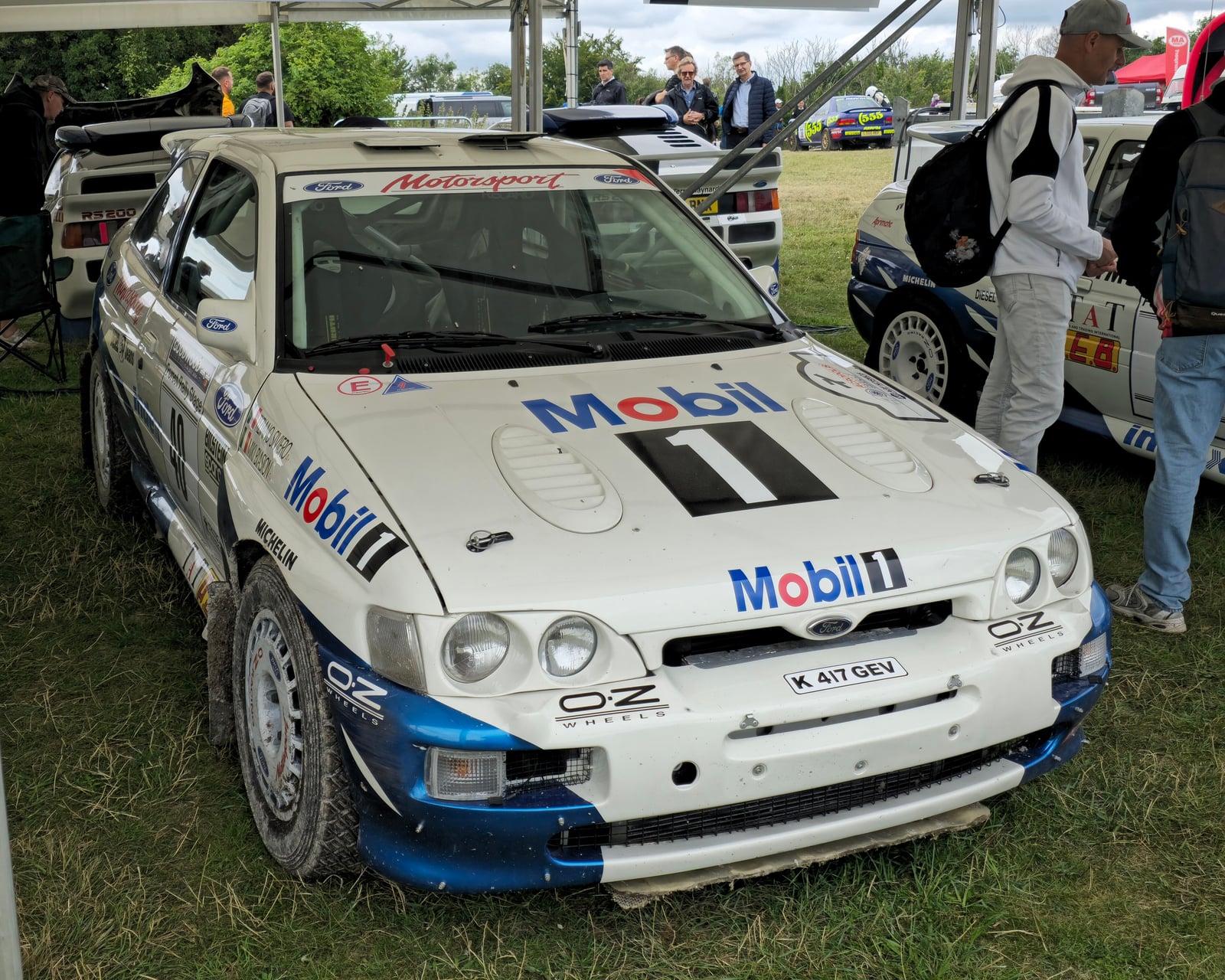
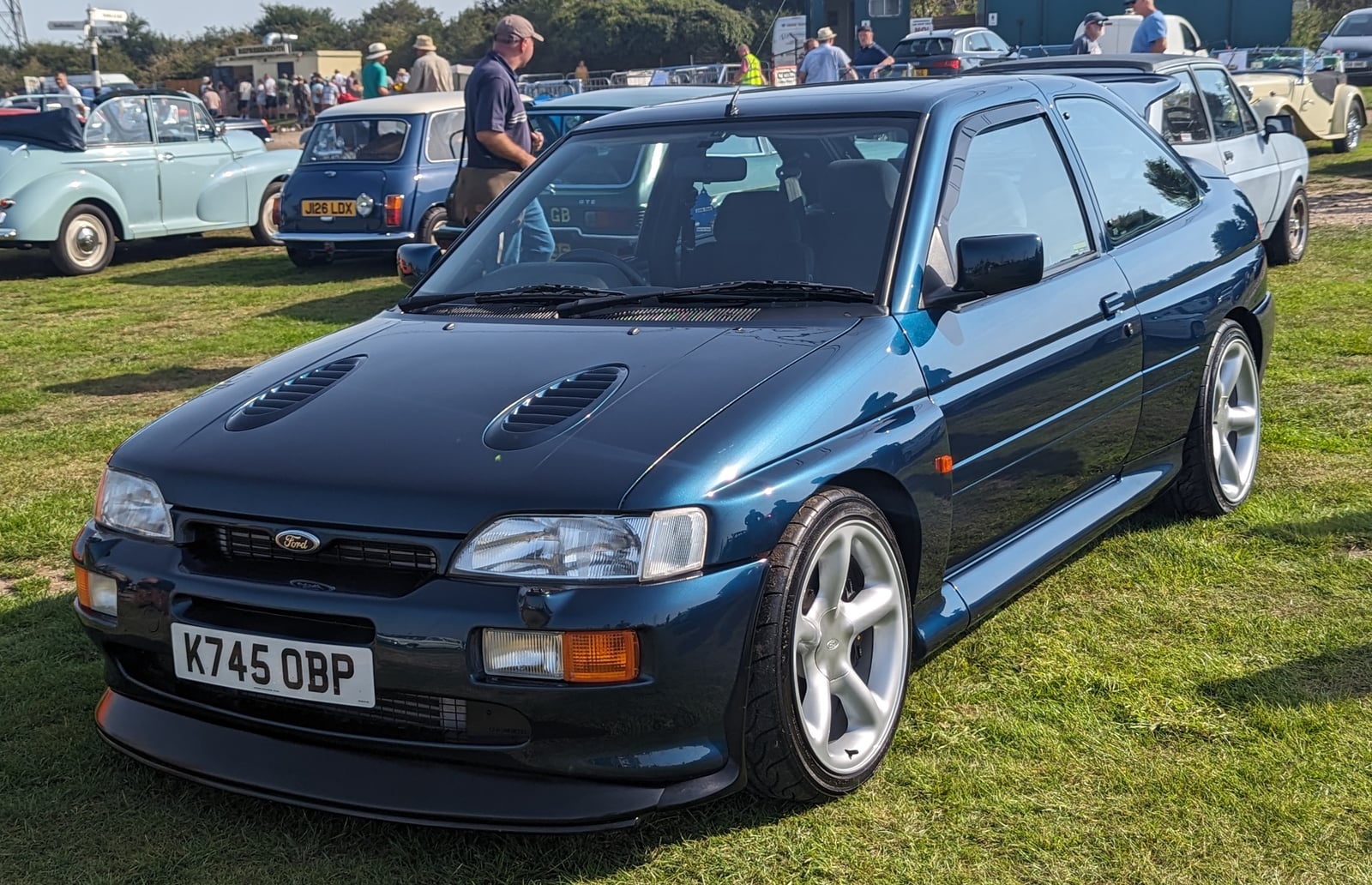
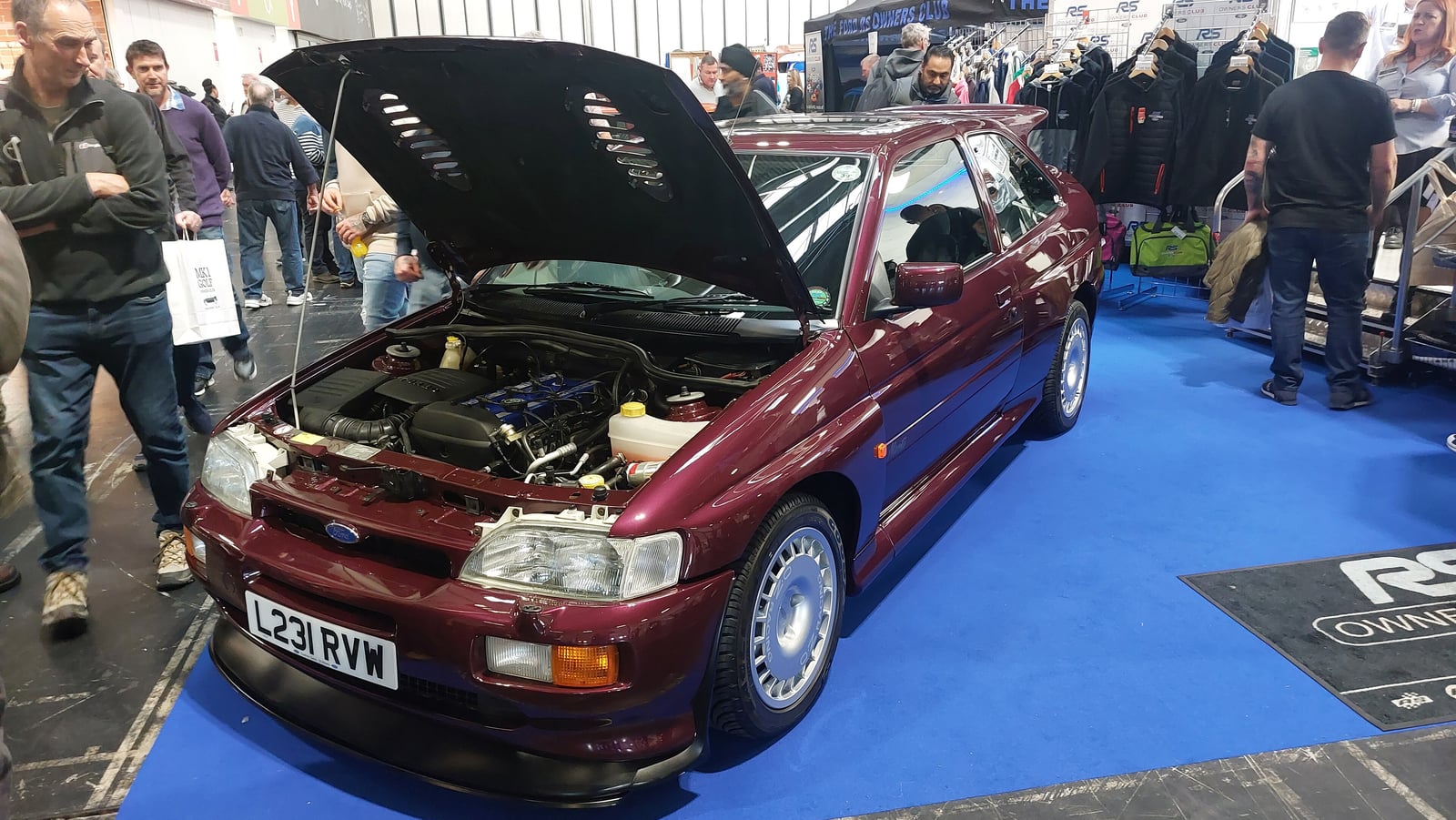
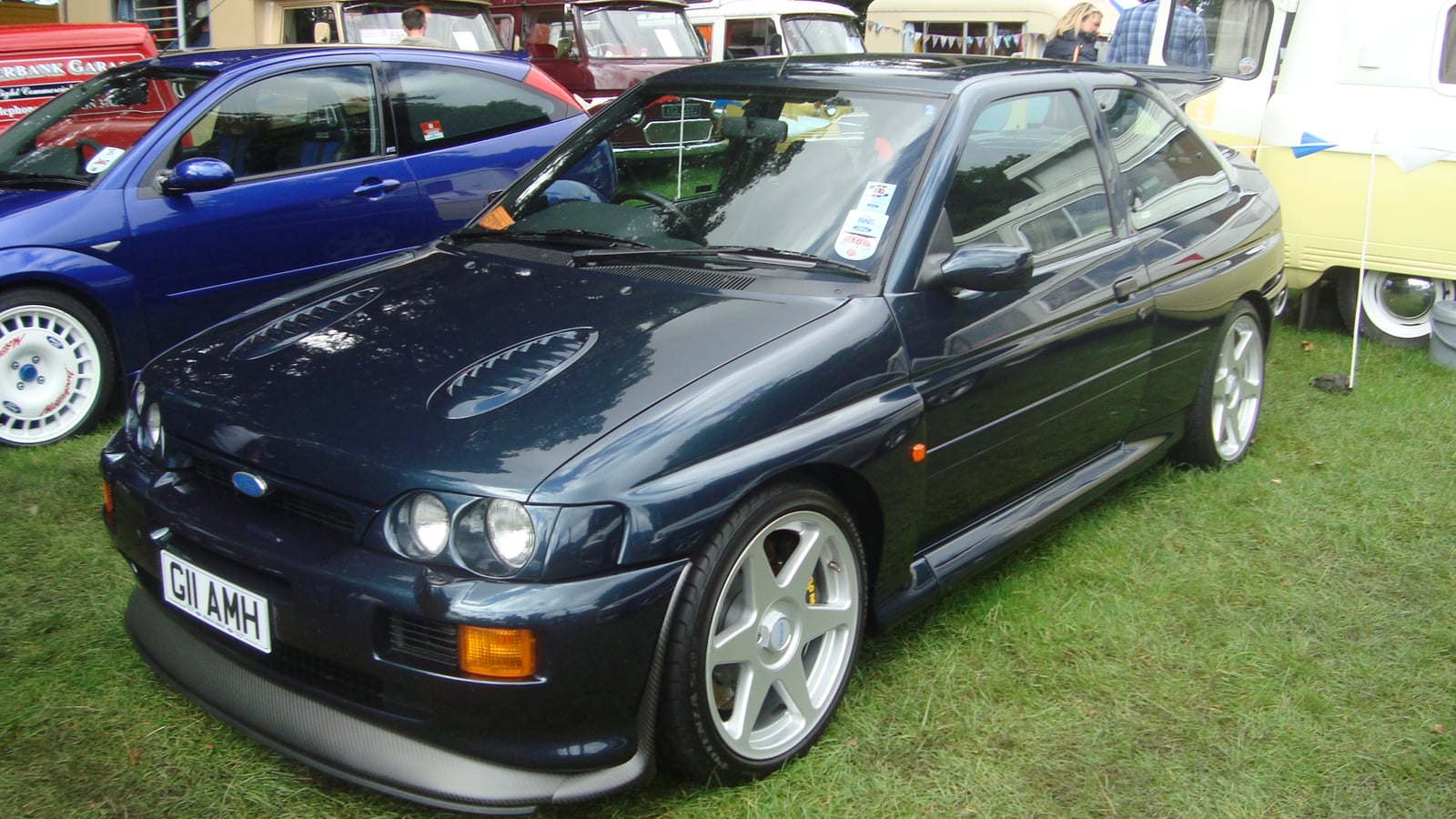
And then there is the car that rescued the whole generation’s reputation. The Escort RS Cosworth, built from 1992, looks like a winged Mk5 Escort and is almost nothing of the sort underneath. Ford built it on shortened Sierra Cosworth four-wheel-drive running gear, clothed in Escort-shaped panels to resemble the family car, with the bodywork shaped by Stephen Harper at MGA Developments. It had permanent four-wheel drive with a roughly one-third front, two-thirds rear torque split, a Ferguson MT-75 gearbox, and the turbocharged 2.0-litre Cosworth YB engine making 227 metric horsepower, about 224 brake horsepower. The huge twin-plane “whale-tail” rear wing is the car’s signature, and it was there to work, not to pose.
It existed to homologate a Group A rally car, so the first 2,500 cars were homologation specials, and total production over the 1992-to-1996 run came to 7,145. Road cars came in standard (Motorsport-leaning) and better-equipped Lux forms, the Lux with electric windows, sunroof and Recaro seats, and it is the Lux that dominates the survivors at auction. Early cars used a large Garrett turbo for top-end punch; from June 1994 Ford fitted a smaller turbo for less lag and more road-friendly response, which is the “big turbo versus small turbo” distinction the values now turn on. The whole run was built not on the Escort lines but by Karmann in Germany, which is one of the ways a genuine car is told from a fake.

Reception, legacy and the turnaround
Few Fords have been as maligned as the early Mk5, and few have been so thoroughly rehabilitated. One fair summary: brutalised by the press, rapidly and comprehensively updated, then quietly forgotten once the Focus arrived in 1998. But the 1992 chassis and Zetec changes made the ordinary car genuinely competent, and the RS Cosworth functioned as the halo that pulled the whole model’s image back up. Today the Cosworth is an icon of 1990s fast Fords and Group A rallying, and the ordinary Mk5 is a period curiosity that almost nobody kept, which is starting to make the survivors interesting in their own right.
Buying an Escort Mk5 now
This is two completely different buying propositions. Ordinary Mk5s are now genuinely rare, having had little sentiment attached to them when they were cheap, and they remain a budget classic. The RS Cosworth sits at the very top of the fast-Ford market and demands careful provenance checks. Unlike the earlier cars in this guide, the Mk5 has not yet reached historic vehicle status: the rolling 40-year rule reaches the first 1990 cars only at the end of this decade.
On an ordinary car, look at the bulkhead, around the rear window, the rear chassis rails and the fuseboxes, and be wary of the weaker pre-1995 rear suspension. On a Cosworth, the rust list is longer, sills, arches, behind the body kit, boot floor, tailgate, door bottoms, chassis legs, battery tray and floor pans, and the stakes are far higher.
The Cosworth’s real risk is provenance. Genuine cars were stolen, crashed and modified in large numbers, and front-drive Escort shells get converted onto Cosworth floorpans to fake them. Check that the car was Karmann-built, that the V5 shows it registered as four-wheel drive from the start, and look hard for non-factory welding and paint. A car rebuilt from a motorsport bodyshell will wear a Q-plate, which is a flag rather than a fault but must match the story you are being told.
The values tell you why the checks matter. Ordinary Mk5s are still pocket money. The RS Cosworth, by contrast, runs from the low twenties to well over £100,000, with a 2026 auction median around £50,000, and a low-mileage 1992 big-turbo car set a live-auction record of £202,500 at the NEC in November 2024. Big-turbo, low-mileage and well-documented cars lead; the small-turbo cars are more usable and generally cheaper. Either way, the lesson of the Mk5 holds at both ends of the range: the car that the press destroyed at launch produced, three years later, one of the most collectable Fords of its decade.
How the Escort Mk5 changed
- 1990The Mk5 launches to a hostile press reception.
- 1992A substantial rework puts right most of the launch criticism.
- 1992The Escort RS Cosworth arrives, Karmann-built on a shortened Sierra 4x4 platform.
- 1994The Cosworth switches to the smaller T25 turbo and the friendlier YBP engine.
- 1995Mk5 production ends.
- Nov 2024A low-mileage 1992 big-turbo RS Cosworth sets a live-auction record of £202,500 at the NEC.
Before you buy an Escort Mk5
On an ordinary Mk5
- Bulkhead and around the rear window
- Rear chassis rails and the fuseboxes
- Be wary of the weaker pre-1995 rear suspension
On a Cosworth the rust list is longer
- Sills, arches and behind the body kit
- Boot floor, tailgate and door bottoms
- Chassis legs, battery tray and floor pans
Cosworth provenance
- Check the car was Karmann-built and that the V5 shows it registered as four-wheel drive from the start
- Look hard for non-factory welding and paint, because front-drive shells get converted onto Cosworth floorpans
- A Q-plate means a rebuild from a motorsport bodyshell, a flag rather than a fault, but it must match the story you are told
What the Escort Mk5 sells for at auction
In 2025 the median Escort Mk5 sold for £9,632 across 54 sales, 39% up on 2024. In real terms, typical Escort Mk5 prices were down about 59% over the five years to 2025, once inflation is accounted for.
| Variant | Sold | Typical range | Median |
|---|---|---|---|
| Escort RS Cosworth | 85 | £39,375 - £63,248 | £47,972 |
| Escort | 81 | £1,195 - £5,376 | £2,366 |
| Escort XR3i | 49 | £3,094 - £9,180 | £5,200 |
| Escort RS2000 | 33 | £2,260 - £5,824 | £3,850 |
| Escort RS Cosworth Lux | 32 | £50,906 - £67,078 | £56,816 |
| Escort RS Turbo | 20 | £11,439 - £20,836 | £17,958 |
| Escort 1.6i | 6 | £2,277 - £4,320 | £2,673 |
Show the year-by-year mediansHide the year-by-year medians
| Year | Sold | Median | In 2025 money |
|---|---|---|---|
| 2026 (so far) | 37 | £6,292 | |
| 2025 | 54 | £9,632 | £9,632 |
| 2024 | 43 | £6,907 | £7,172 |
| 2023 | 43 | £31,167 | £33,445 |
| 2022 | 38 | £4,991 | £5,716 |
| 2021 | 35 | £7,526 | £9,306 |
| 2020 | 21 | £18,480 | £23,418 |
| 2019 | 9 | £45,000 | £57,607 |
| 2018 | 10 | £23,941 | £31,168 |
| 2017 | 6 | £38,380 | £51,123 |
| 2016 | 11 | £32,437 | £44,320 |
| 2015 | 3 | £15,833 | £21,850 |
| 2014 | 3 | £2,464 | £3,414 |
| 2013 | 3 | £11,250 | £15,810 |
| 2007 | 3 | £1,100 | £1,822 |
| 2006 | 3 | £2,700 | £4,577 |
- £5,824Escort RS2000
- £2,464Escort
- £2,268Escort
- £11,500Escort RS Turbo
- £2,820Escort XR3i
Strong evidence. 329 recorded sales and a dozen or more a year: the median and the range are well founded. Based on 329 sold results from public classic car auctions (2004 to 10 August 2026). Sold prices, not asking prices, and not a valuation: condition, history and specification vary from car to car. Inflation-adjusted figures use the ONS CPIH index, in 2025 money.
Related
The Escort Mk5 is part of the classic Ford story and of British classic cars of the 1990s. For the rear-drive rally Escort that set the badge’s reputation, see the Escort Mk2; it is one generation of the wider Ford Escort story.
More photos