Triumph Spitfire values: Mk1 and Mk2 at nearly double the 1500, the Mk3 between, and the cheapest open Triumph there is
The early Mk1 and Mk2 sell for nearly double the 1500, and the Mk4 for least of all. Triumph Spitfire values across 487 recorded auction sales, how it compares with the MG Midget and the Sprite, what moves a Spitfire price, and why the cheapest open Triumph has slipped by a third in real terms since 2022.
Built 1962–1980
What the Spitfire sells for at auction
In 2025 the median Spitfire sold for £4,161 across 70 sales, 36% down on 2024. In real terms, typical Spitfire prices were down about 61% over the five years to 2025, once inflation is accounted for.
| Variant | Sold | Typical range | Median |
|---|---|---|---|
| Spitfire 1500 | 229 | £3,402 - £7,590 | £5,267 |
| Spitfire Mk IV | 94 | £3,000 - £7,237 | £4,735 |
| Spitfire Mk III | 70 | £4,975 - £11,188 | £7,445 |
| Spitfire Mk II | 37 | £7,460 - £11,850 | £8,789 |
| Spitfire Mk I | 26 | £6,321 - £14,500 | £8,816 |
Show the year-by-year mediansHide the year-by-year medians
| Year | Sold | Median | In 2025 money |
|---|---|---|---|
| 2026 (so far) | 36 | £6,825 | |
| 2025 | 70 | £4,161 | £4,161 |
| 2024 | 62 | £6,462 | £6,710 |
| 2023 | 56 | £5,971 | £6,407 |
| 2022 | 57 | £7,316 | £8,378 |
| 2021 | 51 | £6,600 | £8,161 |
| 2020 | 22 | £8,480 | £10,747 |
| 2019 | 20 | £6,158 | £7,883 |
| 2018 | 29 | £5,595 | £7,284 |
| 2017 | 26 | £6,273 | £8,356 |
| 2016 | 13 | £4,200 | £5,739 |
| 2015 | 11 | £4,500 | £6,210 |
| 2014 | 4 | £4,452 | £6,168 |
| 2013 | 6 | £9,807 | £13,782 |
| 2012 | 4 | £2,885 | £4,147 |
| 2010 | 3 | £4,135 | £6,333 |
| 2009 | 3 | £6,776 | £10,638 |
| 2008 | 6 | £2,802 | £4,485 |
| 2006 | 3 | £2,812 | £4,767 |
- £2,600Spitfire 1500
- £2,900Spitfire 1500
- £7,594Spitfire 1500
- £22,500Spitfire Mk I
- £3,000Spitfire Mk IV
Strong evidence. 487 recorded sales and a dozen or more a year: the median and the range are well founded. Based on 487 sold results from public classic car auctions (1996 to 10 August 2026). Sold prices, not asking prices, and not a valuation: condition, history and specification vary from car to car. Inflation-adjusted figures use the ONS CPIH index, in 2025 money.
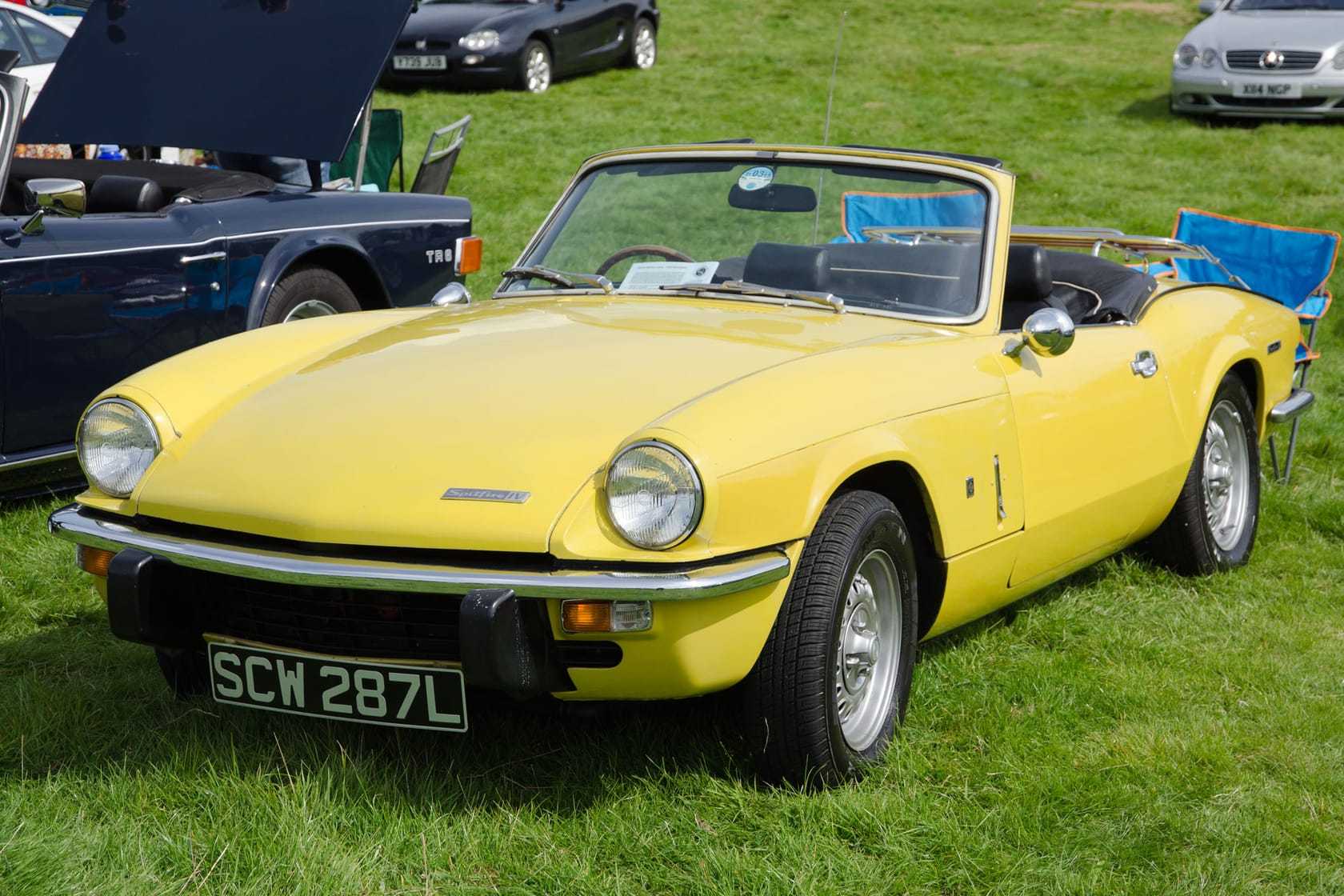
The Spitfire is the people’s sports car, the open Triumph that put the roadster within reach, and Triumph Spitfire values are among the lowest for any sports car on this site: 487 recorded sales since 1996, nearly 60 a year lately, at a median of £6,000, with the middle half between £3,800 and £8,850. Four in five of the cars offered find a buyer, the highest rate of any Triumph in the database, because a Spitfire is estimated honestly and bought for what it is. The spread runs from a £250 project to £70,400 for one car at an American sale, and most of the record is a 1500 or a Mk4, sold in Britain to someone who wants an open car for the price of a used hatchback.
The Triumph Spitfire model guide covers the five marks, the saloon chassis underneath, the swing-axle handling and what to check. This page is about the money, and about a market that has slipped back from its pandemic peak.
Mk1 and Mk2 over the rest, and the Mk4 last
The variant table on this page runs against the calendar. The early cars lead: the Mk1 of 1962 to 1965 and the Mk2 of 1965 to 1967 both sit at a median of £8,800, on 26 and 37 recorded sales, with the original Michelotti shape, the low bumper and the rarity of cars that were the first to rust away. The Mk3 of 1967 to 1970, with the 1,296cc engine and the raised bumper, follows at £7,400 across 70 sales. Then the late cars: the 1500 of 1974 to 1980, the most numerous Spitfire and nearly half the record at 229 sales, at £5,300, and the Mk4 of 1970 to 1974 last at £4,700 across 94, because it has the Mk3’s smaller engine in the 1500’s later body and is neither the early car the collectors want nor the late one the users prefer.
The gap from top to bottom is nearly double at the median and wider at the top, where the best restored Mk1s and Mk2s reach £15,000 to £20,000 and a 1500 rarely passes £10,000. The £70,400 that tops the record, for a Mk3 at an American auction in 2023, describes one car and nothing else; the Spitfire’s real ceiling is around £20,000, and most of the record sits far below it.

What moves the price of a Spitfire
The chassis and the body, because the mechanical parts are cheap, plentiful and shared with the Herald and the Vitesse, and the shell is where the money goes. The separate chassis rusts at the outriggers and towards the rear, the sills and floors rot, the rear wings go at the arches and the seams, and the fold-flat bonnet, the Spitfire’s best feature, is expensive to replace and often damaged at its hinges and its front edge; a car with a sound chassis, solid sills and a straight bonnet, with the receipts, sits in the upper half of its range whatever the paint, and a car with filler in its sills is a project at any price.
Then what the car is. A Mk1 or Mk2 with its correct engine and its early features carries the collectors’ premium; overdrive on any mark adds clearly, as do the factory hardtop, wire wheels, a period colour and an interior in good order; a long history file with the club’s involvement adds more. The swing-axle rear suspension on the early cars, and the fixes for it, are a driving matter rather than a value one, and a well-done rear-suspension conversion loses nothing. Mileage means little on a car that has usually been restored at least once.

A third off since 2022
The chart shows a car that rose late and has been volatile since. The yearly median was around £4,200 to £4,500 in the mid-2010s, rose to £6,300 in 2017 and £8,500 in 2020, the pandemic peak, and has settled since at £6,600 in 2021, £7,300 in 2022, £6,000 in 2023 and £6,500 in 2024, before dropping to £4,200 in 2025, the lowest figure in a decade, with the 2026 figure so far back at about £6,800. Restated in today’s money the Spitfire is about a third cheaper than in 2022 and well below its 2020 peak.
Two causes, as usual. The online auctions have brought the tired 1500s, the Mk4s and the projects into a record that the catalogued sales filled with restored early cars, and a median built on those is a lower figure for the same cars; the 2025 dip, 70 sales at £4,200, is what that looks like in a year when the ordinary cars outnumbered the good ones. And the market for small 1970s sports cars has softened as its buyers have aged, as it has for the Midget, which sits a little below the Spitfire, and the Sprite, which sits above it on the Frogeye’s account. The early cars have held up; the 1500 and the Mk4 have fallen, and a sound 1500 is now the cheapest open Triumph there is.

Where Spitfires change hands
The Spitfire is a British car in a British record. The regional sale rooms, from Yorkshire to the south, the Triumph specialists and the online platforms all trade them, and a single fortnight in late July 2026 shows the whole range: 1500s at £2,600 and £2,900 at a Yorkshire sale, another at £7,600 at a specialist auction, a Mk4 at £3,000 at a northern sale, and a Mk1 at £22,500 at a catalogued sale, the kind of early car that sets the top of the market. Whether a recorded price includes the buyer’s premium varies by sale, which is one more reason to read the usual range rather than any single result.

Insuring, restoring, selling
For an agreed-value policy a good 1500 belongs around its median and a restored early car in the upper half of the range; a Mk1 with its original features is insured on the car. On restoration the arithmetic is blunt: a chassis and body restoration costs more than any Spitfire short of a concours Mk1 is worth, so the project is for the owner who wants the doing of it, and the sensible buy is the car someone else has finished, which at today’s prices costs less than the parts. If you are selling, the spring is the season, the photographs that sell a Spitfire are of the chassis outriggers and the bonnet hinges, and the honest expectation for an ordinary 1500 is its median, not the figure a restored Mk2 fetched in 2020.
Related
The Spitfire shares its chassis with the GT6, which sells for about double, and its market with the Midget, which sells for a little less; above it in the Triumph range sit the TR6, at more than double, and the Stag, at about half as much again. For the decade, see British classic cars of the 1960s. For how all the figures on this site are compiled, see what classic cars sell for.