Triumph TR7 values: the cheapest TR, and the TR8 at twice the money
The record disagrees with the folklore on coupe against convertible. Triumph TR7 prices across 309 recorded auction sales, why the V8 TR8 sells for well over twice a four-cylinder car, and why five flat years have quietly cost the wedge a quarter of its money.
Built 1975–1981
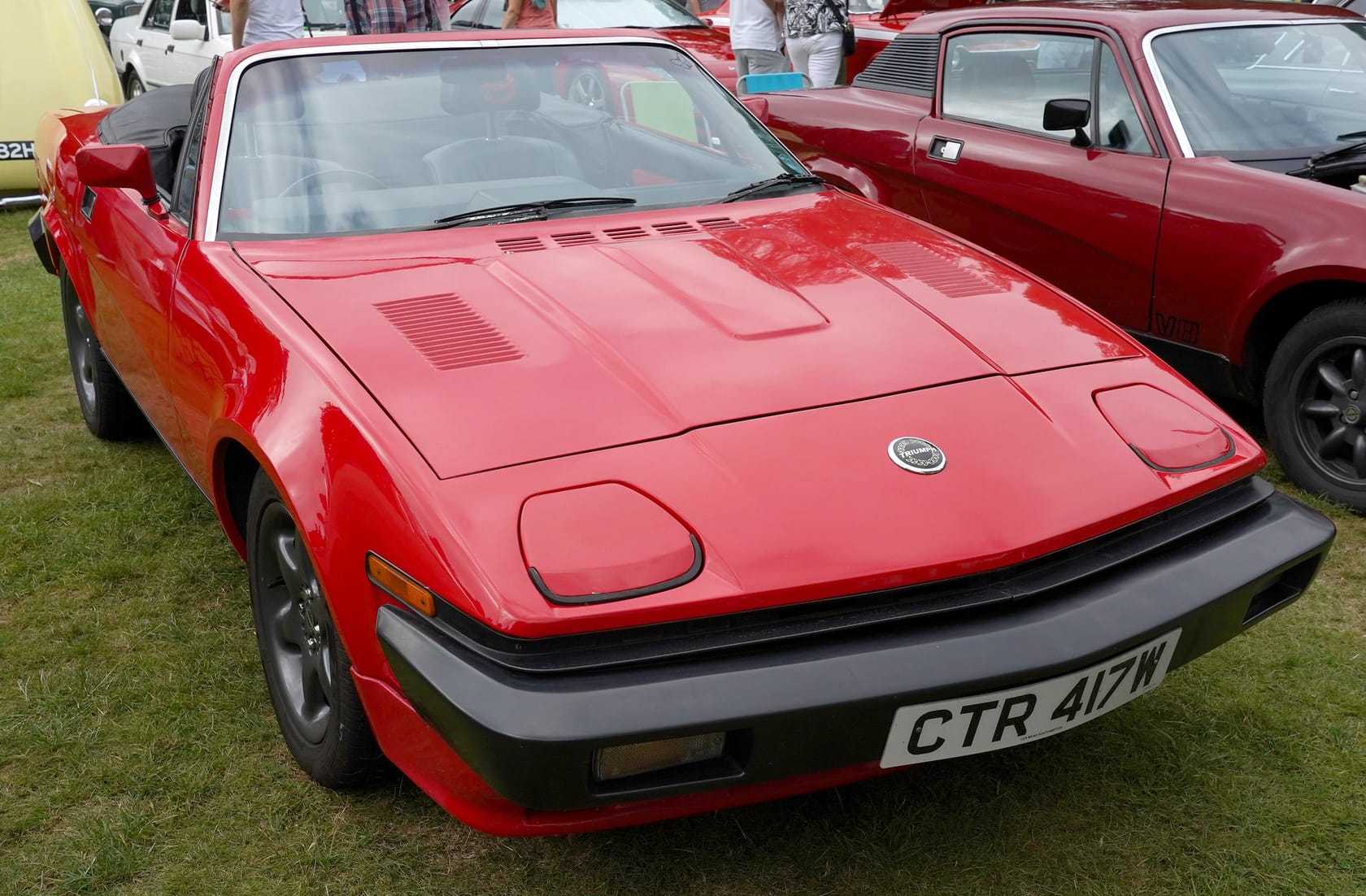
What the Triumph TR7 & TR8 sells for at auction
In 2025 the median Triumph TR7 & TR8 sold for £6,227 across 37 sales, much where it was in 2024. In real terms, typical Triumph TR7 & TR8 prices were down about 57% over the five years to 2025, once inflation is accounted for.
| Variant | Sold | Typical range | Median |
|---|---|---|---|
| TR7 Convertible | 113 | £3,000 - £6,496 | £4,860 |
| TR7 | 105 | £3,565 - £8,700 | £5,300 |
| TR8 | 91 | £8,788 - £16,234 | £12,508 |
Show the year-by-year mediansHide the year-by-year medians
| Year | Sold | Median | In 2025 money |
|---|---|---|---|
| 2026 (so far) | 25 | £7,100 | |
| 2025 | 37 | £6,227 | £6,227 |
| 2024 | 51 | £6,300 | £6,542 |
| 2023 | 49 | £6,259 | £6,717 |
| 2022 | 34 | £7,748 | £8,873 |
| 2021 | 34 | £7,280 | £9,002 |
| 2020 | 17 | £11,350 | £14,383 |
| 2019 | 10 | £6,746 | £8,635 |
| 2018 | 10 | £3,879 | £5,050 |
| 2017 | 14 | £5,902 | £7,861 |
| 2016 | 10 | £3,927 | £5,366 |
| 2011 | 4 | £3,392 | £5,002 |
- £4,000TR7
- £1,800TR7
- £5,707TR7 Convertible
- £2,760TR7
- £12,800TR7
Strong evidence. 309 recorded sales and a dozen or more a year: the median and the range are well founded. Based on 309 sold results from public classic car auctions (2005 to 10 August 2026). Sold prices, not asking prices, and not a valuation: condition, history and specification vary from car to car. Inflation-adjusted figures use the ONS CPIH index, in 2025 money.
The TR7 is the cheapest way into a Triumph sports car and has been for forty years. Triumph TR7 values sit at a median of £6,264 across 309 recorded sales since 2005, with the middle half between £4,033 and £11,333, and four in five cars offered find a buyer, the sort of clearance rate that belongs to a car nobody is speculating on. The spread runs from a £210 project to £43,572 for the best TR8 in the record, and almost all of that spread is one question: how many cylinders.
The Triumph TR7 and TR8 guide covers the wedge shape, the build-quality story and what to check before buying one. This page is about the money, and about a market that has stood still long enough for standing still to cost something.
The TR8 is the one the market pays for
The record splits into three rows and the V8 takes the top one on its own. The TR8 sits at £12,508 at the median across 91 recorded sales, with a middle half of £8,788 to £16,234; the four-cylinder fixed-head coupe at £5,300 across 105 sales; the convertible at £4,860 across 113. That makes a genuine TR8 worth roughly two and a half times a TR7 in the same condition, and every sale at the top of the data wears the V8 badge, including the £43,572 record.
The premium is not for the performance so much as for the paperwork. A Rover V8 drops into a TR7 engine bay without drama and a well-engineered conversion is a genuinely good car, but it is not a TR8 and the sale rooms price it much nearer a TR7. Factory build records are what separate the two, they are checkable, and on a car where the difference is several thousand pounds they are the first thing to ask for and the last thing to take on trust.

Coupe or convertible, and where the folklore is wrong
The received wisdom on the wedge is that the convertible is the one to have and the closed car is the compromise. The recorded sales do not agree. The fixed-head coupe’s median is £5,300 against the convertible’s £4,860, and the coupe’s upper quartile is £8,700 against £6,496, so the closed car both sits slightly higher and reaches further.
The honest reading is not that the coupe is the better buy. The gap is a few hundred pounds on a car that costs several thousand, the two ranges overlap almost completely, and a good convertible will always outsell a tired coupe. What the numbers do say is that the convertible premium most buyers expect to pay is not in the data, so paying it is a choice about what you want to drive rather than a decision about money. Buy the body you prefer and spend the difference on condition.

Five flat years, and what they cost
The chart looks like a car that had one good year and then stopped. The yearly median ran £7,280 in 2021, £7,748 in 2022, £6,259 in 2023, £6,300 in 2024 and £6,227 in 2025, with 2026 at about £7,100 so far. In cash that is a flat market, and flat is how most owners would describe it.
Restated in today’s money it is not flat at all. The same run reads £9,002, £8,873, £6,717, £6,542 and £6,227, so the wedge has quietly given up about a third of its real value since 2021 while its price tag barely moved. That is the ordinary fate of a cheap classic in an inflationary stretch, and it is worth knowing before treating a TR7 as a store of value. One figure to discount along the way: the £11,350 median for 2020, which some guides still quote, rests on 17 sales in a thin year and is not a level this market has revisited.

Where TR7s change hands
The TR7 is a British car sold in British sale rooms, and the record reads like it. The regional rooms carry the volume and the bottom of the range, and the summer of 2026 is typical: a TR7 at £1,800, another at £2,760, a third at £4,000, and one good one at £12,800, all within six weeks. The American online platforms take the restored cars and most of the TR8s, which is where the £12,508 V8 median comes from and why the dollar market matters more to a TR8 owner than to a TR7 one. Whether a recorded price includes the buyer’s premium varies by sale, which is one more reason to read the usual range rather than any single result.

Insuring, buying, selling
For an agreed-value policy a sound four-cylinder car belongs in the upper half of its range rather than at the median, because the median is dragged down by projects, and a documented TR8 needs its own figure entirely. On buying, the wedge’s economics are unforgiving in one direction only: mechanical parts are cheap and available, bodywork is not, and a full restoration costs several times what a finished TR7 makes. That makes the sorted £6,000 car better value than the £2,500 one in nearly every case. If you are selling, a TR8 sells on its build records, a TR7 sells on its sills and its history file, and the photograph that does the work is of the underside.
Related
The TR7 is the last of the line that runs back through the TR6, which sells for around three times as much, and the TR4 before it; its closest rival for the money is the MGB. For the period it belongs to, see British classic cars of the 1970s and 1980s. For how all the figures on this site are compiled, see what classic cars sell for.
Frequently asked questions
How much is a Triumph TR7 worth?
What is a Triumph TR8 worth?
Is a TR7 convertible worth more than the coupe?
Are Triumph TR7 prices going up?
What should I pay for a Triumph TR7?
What is the most expensive Triumph TR7 & TR8 ever sold at auction?
How often does a Triumph TR7 & TR8 come up for sale?
Related across themes
More Triumph values

Triumph Spitfire values: Mk1 and Mk2 at nearly double the 1500, the Mk3 between, and the cheapest open Triumph there is

Triumph Stag values: Mk2 over Mk1, manual level with automatic, the original-engine premium, and a market down by half

Triumph TR3 values: TR3B over TR3A over TR3, the works cars apart, and a market back to 2010 prices


