Messerschmitt KR200: tandem seats, a bubble canopy and the fighter-plane school of motoring (1955–1964)
The Messerschmitt KR200 sat its two occupants in tandem under an aircraft-style bubble canopy, steered by handlebars and reversed by running its engine backwards. A guide to the Kabinenroller's story, the KR175 before it and the Tg500 Tiger above it, what to check when buying, and what one costs today.
Built 1953–1964 172 recorded sales
At a glance
- Years
- 1955–1964; KR175 1953–1955
- Body styles
- Three-wheel tandem two-seater with bubble canopy
- Drivetrain
- Rear engine, rear-wheel drive
- Engines
- 191cc Fichtel & Sachs two-stroke single
- Power
- Around 10 bhp
- Trim levels
- KR200 saloon, Kabrio, Roadster; Tg500 four-wheeler above
- Production
- Around 40,000 KR200s
- Assembly
- Regensburg, Germany
- Designer
- Fritz Fend
- Values
- Usable from around £18,000; good cars £25,000-£40,000; Tg500s far beyond
- The party trick
- No reverse gear: the two-stroke runs backwards, giving four reverse speeds
- The layout
- Tandem seating under a sideways-hinged bubble canopy, pure fighter cockpit
The cars
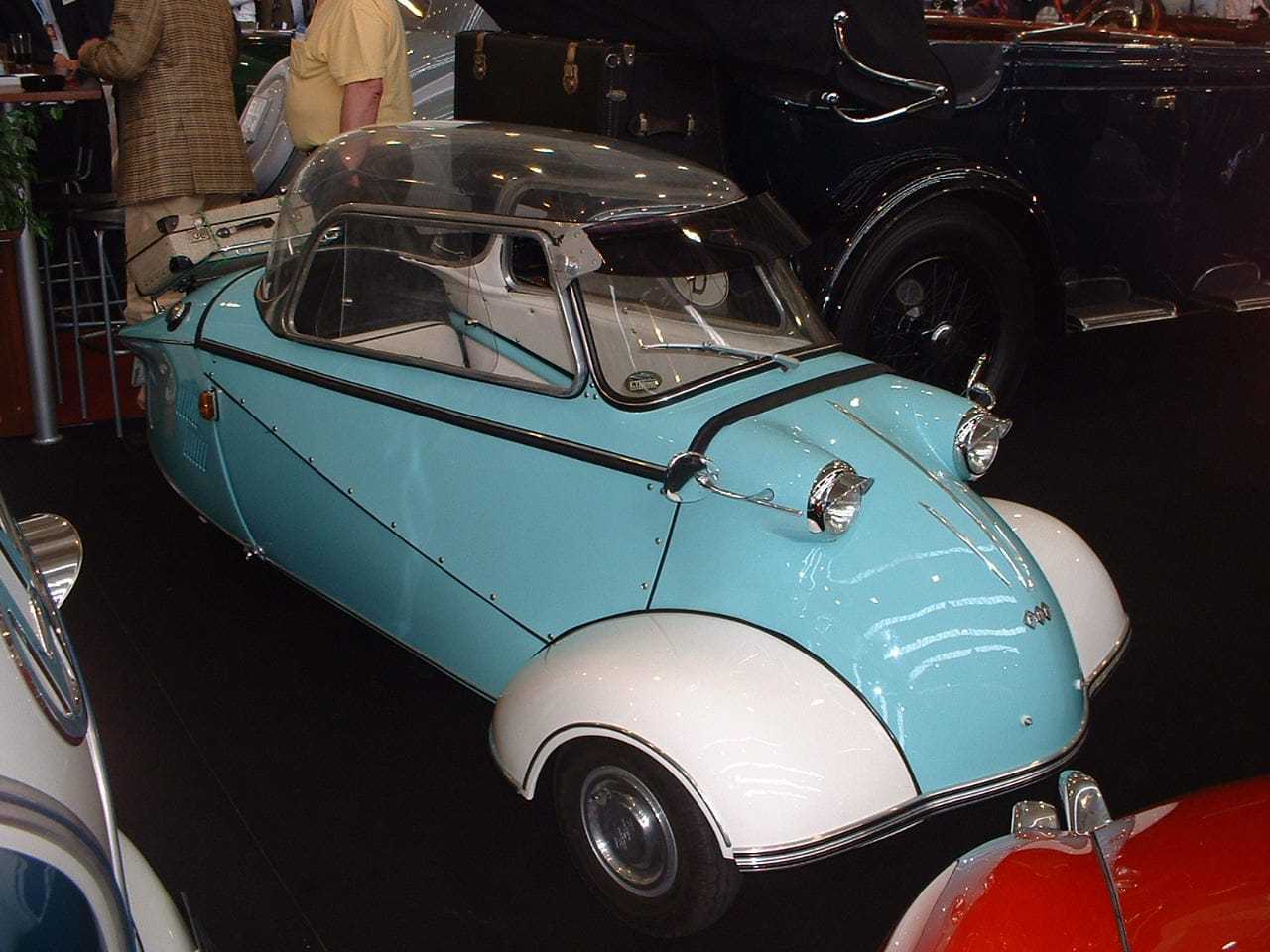
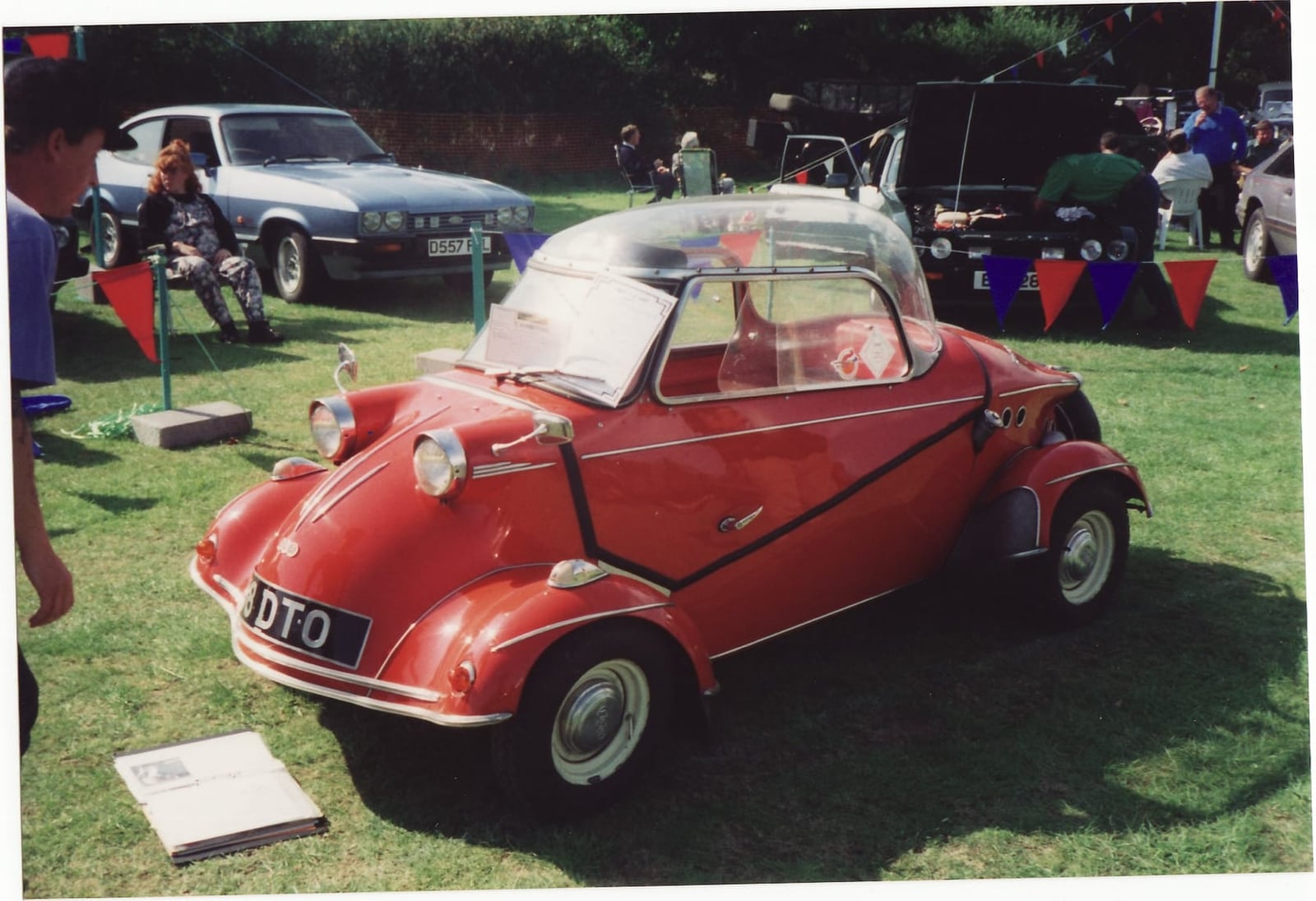
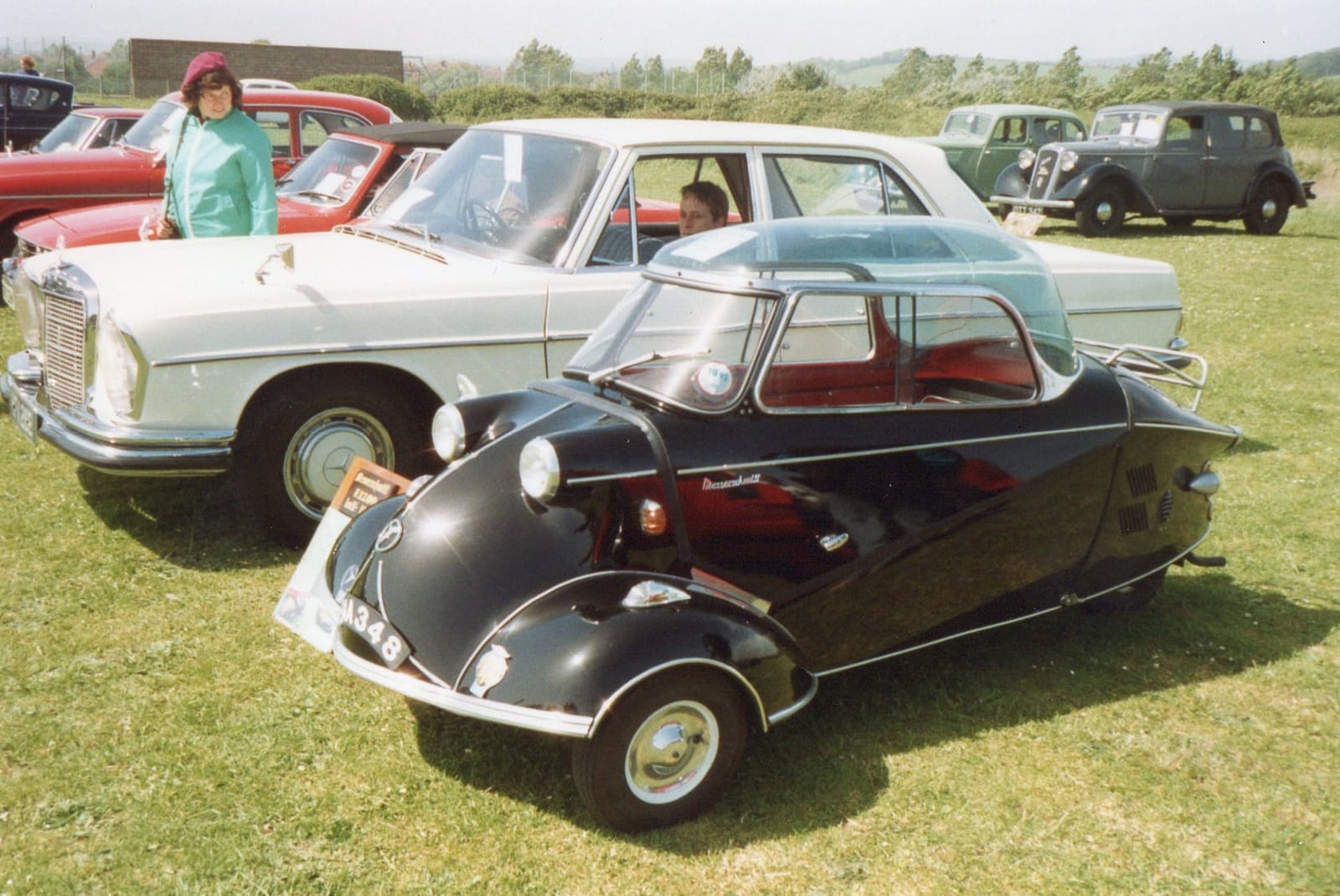
Lower the sideways-hinged canopy of a Messerschmitt KR200, settle into the front of two tandem seats, take hold of the handlebars, and the fighter-plane fantasy is complete before the two-stroke has even fired. The Kabinenroller, cabin scooter, was what happened when a banned aircraft industry turned its obsessions to the school run, and it became the most distinctive of all the microcars, forty thousand times over.
Fritz Fend and the grounded aircraft works
The KR200’s father was Fritz Fend, an aircraft engineer who began with invalid carriages and scaled his ideas up to a proper enclosed runabout. Messerschmitt, forbidden aircraft production after the war, offered its Regensburg works, and from 1953 the KR175 and then the definitive KR200 of 1955 carried the great aviation name on three small wheels. The layout owed nothing to car convention: occupants in tandem for minimal frontal area, a perspex bubble overhead, handlebar steering with direct, dartlike responses, and weight pared in a way only aircraft people think to do.


The backwards-running party trick
The KR200’s engineering delight is its reverse. Rather than carry a reverse gear, the two-stroke Sachs engine simply runs in either direction: stop, twist the key to the second position, and the engine restarts backwards, offering the full four-speed gearbox in reverse. The famous consequence, a Messerschmitt can theoretically reverse at motorway speed, has been terrifying volunteers at shows for seventy years. In 1955 a specially streamlined KR200 ran for a full 24 hours around Hockenheim and averaged better than 64 mph, taking a stack of class records that Messerschmitt advertised with entirely pardonable pride.

KR175, KR200 and the Tiger
The family runs from crude to cult. The KR175 opened the line in 1953, minimal even by microcar standards; the KR200 civilised it with better suspension, more power and weather protection worth the name, in closed, Kabrio and roadster forms; and in 1958 came the Tg500 Tiger, a four-wheeled, 494cc twin-engined evolution good for over 75 mph and built in tiny numbers. The Tiger is now among the most valuable microcars in the world, and the KR200 remains the accessible heart of the legend.

Driving position, controls and the learning curve
Nothing about KR200 driving is quite like car driving, and that is the appeal. The handlebar-style bar steers with direct, unassisted immediacy, more aircraft yoke than steering wheel, and needs gentle inputs at speed; the sequential gear lever works a motorcycle-pattern box; and the tandem seating puts the driver on the centreline with a fighter pilot’s view over the road. Most newcomers to a Messerschmitt report the controls feel natural within ten minutes and quietly addictive within twenty, and the little machine holds forty-five miles an hour all day with a willingness that thoroughly shames its ten stated horsepower.

The Kabinenroller in Britain
Britain took to the Messerschmitt KR200 with particular enthusiasm, and the Suez crisis of 1956 explains why: with petrol rationed, a machine returning far better economy than any real car while keeping the weather out sold itself, and the bubble-car boom peaked in the crisis years. Right-hand-drive imports built a healthy British population, a devoted owners’ club scene took root early and never let go, and surviving UK-registered cars now anchor the microcar displays at every major show. The marque’s British following also keeps the parts pipeline alive, remanufacturing the perishables that sixty-year-old German microcars inevitably need.
When the boom died, killed within a few years by a proper small car called the Mini, the Kabinenroller’s fate was sealed, and production ended in 1964. The joke of history is that the executioner’s own descendants now share show fields with their victim, and the crowds gather at the Messerschmitt.

What a KR200 is like to own
Messerschmitt ownership is happily practical by microcar standards. The Sachs engine is simple and well supported through the marque’s devoted international club scene, the controls reward a short learning curve with genuinely engaging handling, and the canopy turns every journey into an event and every fuel stop into a press conference. The buying checks are the breed’s usual ones: canopy and perspex condition first, since replacements are costly and their fit defines the car, completeness of the tandem interior and trim, frame and floor corrosion, and documented evidence of care for the two-stroke’s crank seals. Prices have long since left toy territory: usable cars from around £18,000, the best beyond £40,000, and Tigers in another postcode altogether, with the open Roadster versions carrying their own premium over the closed cars. Like its Heinkel contemporary, the KR200 proves the bubble era’s enduring lesson: nothing on four wheels or three draws a warmer crowd than brave engineering executed at very small scale.


More photos
KR200: what changed and when
- 1953Fritz Fend's KR175 puts the invalid-carriage idea under a fighter-style canopy at Messerschmitt's grounded Regensburg works.
- 1955The KR200 refines it: 191cc Fichtel and Sachs two-stroke, tandem seats, handlebar steering and around 10 bhp.
- 1957Kabrio and Roadster versions open the top; the four-wheeled Tg500 Tiger sits above the range.
- 1964Production ends at around 40,000 KR200s.
What to check on a KR200
The canopy, first
- Perspex condition, since replacements are costly
- The fit of the canopy defines the car
- Hinges and seals on a part that is both door and roof
- Open Kabrio and Roadster versions carry their own premium over the closed cars
Interior and structure
- Completeness of the tandem interior and trim
- Frame and floor corrosion
- Handlebar steering and its linkages
- The direct steering asks a short learning curve, not strength
The two-stroke
- Documented evidence of care for the crank seals
- The backwards-running reverse trick should actually work
- The Sachs single is simple, and the club scene supports it internationally
- A Tg500 Tiger is a different market entirely and needs its identity proved
What the Messerschmitt KR200 sells for at auction
In real terms, typical Messerschmitt KR200 prices were down about 66% over the five years to 2025, once inflation is accounted for.
| Variant | Sold | Typical range | Median |
|---|---|---|---|
| KR200 | 133 | £16,100 - £29,702 | £23,907 |
| KR201 | 13 | £21,198 - £28,911 | £25,833 |
| KR175 | 11 | £18,458 - £28,870 | £24,133 |
| TG 500 | 6 | £76,598 - £100,756 | £83,682 |
Show the year-by-year mediansHide the year-by-year medians
| Year | Sold | Median | In 2025 money |
|---|---|---|---|
| 2026 (so far) | 8 | £24,048 | |
| 2025 | 16 | £17,780 | £17,780 |
| 2024 | 5 | £31,212 | £32,410 |
| 2023 | 7 | £22,946 | £24,623 |
| 2021 | 16 | £26,500 | £32,769 |
| 2020 | 6 | £41,738 | £52,892 |
| 2019 | 10 | £26,256 | £33,612 |
| 2018 | 6 | £23,322 | £30,362 |
| 2017 | 3 | £25,017 | £33,324 |
| 2016 | 13 | £22,492 | £30,732 |
| 2015 | 4 | £42,251 | £58,306 |
| 2014 | 20 | £14,775 | £20,471 |
| 2013 | 34 | £24,150 | £33,938 |
| 2012 | 5 | £26,913 | £38,687 |
| 2010 | 3 | £20,324 | £31,129 |
| 2005 | 5 | £7,050 | £12,253 |
- £22,624KR200
- £13,800KR201
- £24,941KR200
- £30,000KR201
- £15,680KR200
Reasonable evidence. 172 recorded sales: enough for the range to mean something, though a few unusual cars can still move a single year's median. Based on 172 sold results from public classic car auctions (2001 to 10 August 2026). Sold prices, not asking prices, and not a valuation: condition, history and specification vary from car to car. Inflation-adjusted figures use the ONS CPIH index, in 2025 money.
Frequently asked questions
Why is the Messerschmitt KR200 shaped like a plane?
How does the Messerschmitt KR200 reverse?
How fast is a Messerschmitt KR200?
What is the difference between the KR175 and KR200?
How much is a Messerschmitt KR200 worth?
What is the most expensive Messerschmitt KR200 ever sold at auction?
How often does a Messerschmitt KR200 come up for sale?
Related across themes
More from Microcars


Recently added

Bentley S-series: the quiet twin with the beautiful secrets (1955–1965)

Rolls-Royce Silver Spirit and Silver Spur: the last Crewe bargain (1980–1999)

Rolls-Royce Corniche: the coachbuilt survivor that outlived its makers (1971–1995)
