Vauxhall Carlton: Luton's last big saloon, the Car of the Year and the GSi 3000 (1978–1994)
The Vauxhall Carlton was the marque's big saloon and estate for sixteen years, the Luton-assembled Mk1 of 1978 and the Rüsselsheim-built Mk2 of 1986 that won European Car of the Year and gave Britain the GSi 3000 24v and the Lotus Carlton. A guide to both generations, the engines, the Diplomat and CDX trims, what to check, and what the few survivors are worth.
Built 1978–1994

At a glance
- Years
- 1978–1994
- Body styles
- Four-door saloon; five-door estate
- Drivetrain
- Front engine, rear-wheel drive
- Engines
- Mk1: 2.0 carburettor and injection, 1.8, 2.2 injection, 2.3 diesel. Mk2: 1.8 and 2.0 four-cylinder, 2.6 and 3.0 straight-six (12v and 24v), 2.3 diesel and turbodiesel
- Power
- Mk1 2.0: 100 bhp; Mk2 2.0i: 122 bhp; GSi 3000: 177 bhp; GSi 3000 24v: 204 bhp
- Top speed
- GSi 3000: 134 mph; GSi 3000 24v: 149 mph
- Trim levels
- Mk1: L, GL, CD. Mk2: L, GL, CD, CDX, GSi, Diplomat, Diamond
- Production
- Mk1 assembled at Luton from Rüsselsheim-made parts until the 1982 facelift, then built in Germany; every Mk2 built at Rüsselsheim
- Assembly
- Luton, Bedfordshire (1978–1982); Rüsselsheim, Germany
- Values
- Ordinary Mk2 saloons and estates £1,500-£4,500; sound Mk1 survivors £3,000-£6,000; GSi 3000 and 24v £8,000-£15,000, with the best beyond
- The accolade
- The Mk2, as the Opel Omega, was European Car of the Year for 1987
- The offspring
- The GSi 3000 shell and straight-six became the Lotus Carlton of 1990, the 176 mph saloon they tried to ban
The models
For sixteen years the Vauxhall Carlton was the big car in the Vauxhall range, the saloon and estate above the Cavalier that carried company directors, motorway police, taxi ranks and families with caravans, and it was built in two generations that could hardly have been more different in fortune. The Mk1 of 1978 was the last big Vauxhall saloon assembled at Luton, a Vauxhall-nosed version of the Opel Rekord that sold steadily and rusted faster. The Mk2 of 1986 was a new car from Rüsselsheim, the Opel Omega with a griffin on the grille, and it won European Car of the Year, spawned the GSi 3000 and the 24v, and became the basis of the Lotus Carlton, the fastest saloon in the world.
Nearly all of them are gone. The Carlton was a cheap secondhand car through the 1990s and a banger through the 2000s, and both generations rusted; the survivors, a few hundred at most, are mostly estates, GSis and the cars the Vauxhall clubs saved. This page covers both generations, the engines and trims, what to check, and what the survivors are worth.
The Luton years: Mk1, 1978 to 1982
The Carlton arrived in September 1978 to replace the Victor-derived VX1800 and VX2300, and it marked the moment Vauxhall stopped designing its own big cars. Under the skin it was the Opel Rekord E, a rear-wheel-drive saloon and estate with Opel’s two-litre overhead-cam four-cylinder engine and 100 bhp, but Vauxhall gave it a face of its own, the sloping “droop snoot” nose first seen on the Firenza and the Chevette, and assembled it at Luton from components shipped from Rüsselsheim. There was one trim, the L, and one engine, and the car sold to exactly the buyers the Victor had: the fleet, the police, the taxi trade and the family that needed the estate.
Above it, on the longer Opel Senator floorpan, sat the Vauxhall Royale saloon and coupé; below it, the Cavalier. The Carlton’s job was to be the large, plain, reliable Vauxhall, and for four years it was built in Bedfordshire to do it.

The 1982 facelift and the German-built Mk1
In 1982 the Mk1 was facelifted into the Rekord E2’s flat, chromed nose, the sloping Vauxhall front went, and so did Luton: from the facelift on every Carlton was built in Rüsselsheim beside its Opel twin. The range widened to L, GL and CD, and the engines multiplied: the 1.8 Family II four-cylinder came in at the bottom, the two-litre gained fuel injection, a 2.2 injection replaced it in 1985, and a 2.3 diesel served the taxi ranks. The estate, one of the largest on sale in Britain, became the car’s best-remembered body, and the CD saloon, with velour, electric windows and a five-speed gearbox or an automatic, was the first Carlton anyone bought for pleasure.
The facelifted Mk1 ran to 1986, and it is the Carlton that survives in the smallest numbers: a plain, rust-prone saloon that nobody thought to keep. A sound one at a show now draws a larger crowd than the cars it parks beside.

Mk2: Car of the Year, 1986 to 1994
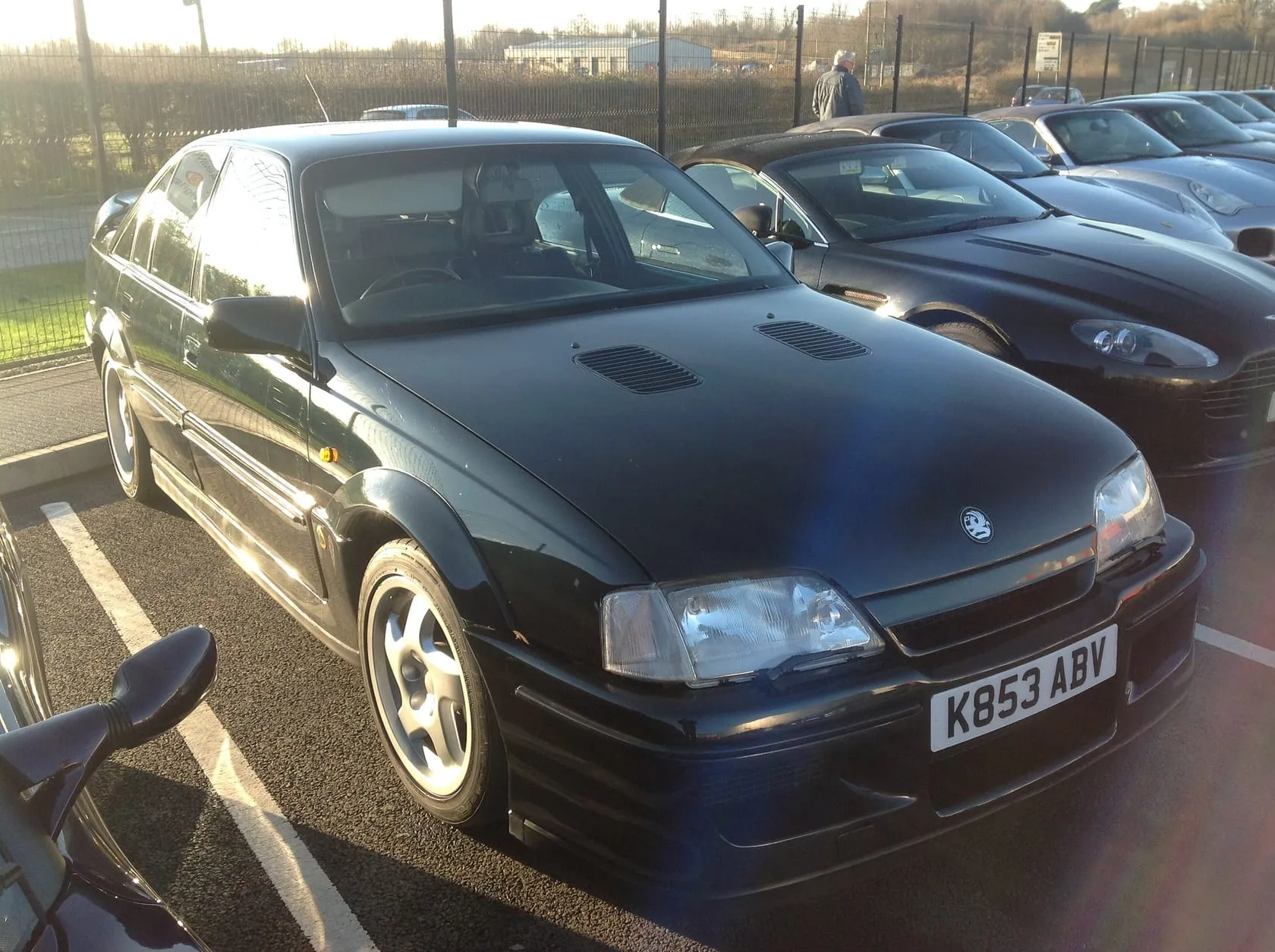
The Mk2 Carlton of November 1986 was the Opel Omega A, a new car on a new platform, and it was very good. The body was smooth where the Mk1 had been square, with a drag coefficient a quarter lower, and under it was a rear-wheel-drive chassis with independent suspension all round that the motoring press rated above the Ford Granada and close to the BMW 5 Series. The Opel version was voted European Car of the Year for 1987, and the Carlton inherited the honour with the badge. The engines were the 1.8 and 2.0 Family II fours, a 2.3 diesel and later a turbodiesel, and, for the first time in a Carlton, straight-sixes: the 2.6 and the 3.0 from the Senator, with twelve valves and, from 1990, twenty-four.
Trims ran from the L through the GL and CD to the CDX at the top, with a mild facelift in 1990 that changed the grille, the lights and the interior. The Mk2 sold well to the fleets and very well to the police, whose 3.0 24v patrol cars became the Carlton most people remember seeing in the mirror. Production ended in 1994 when the Omega, the Vauxhall version of the next Opel, replaced it.

GSi 3000 and the 24v
The GSi 3000 of 1987 was the first fast Carlton: the 177 bhp twelve-valve three-litre six, a five-speed manual gearbox, a limited-slip differential, lowered suspension, a body kit and 134 mph, a rival to the Ford Sierra XR4x4 and the BMW 525i at a Vauxhall price. In 1990 it became the GSi 3000 24v, with a four-valve head designed with Irmscher, 204 bhp, 149 mph and 0 to 62 mph in 7.6 seconds, and it was the fastest production Vauxhall there had been. It was also the car General Motors handed to Lotus, whose Type 104 programme bored and stroked the six to 3.6 litres, added two turbochargers and a Corvette gearbox, and produced the 377 bhp Lotus Carlton that Parliament wanted banned; that car has its own page.
The GSi is the Carlton the enthusiasts want. It is rare, it is quick enough to be interesting, the straight-six is durable, and the Vauxhall clubs keep the survivors running; the 24v is the one to have and the most expensive to keep, because its camshaft drive and its cooling system need a specialist’s attention.

Diplomat, CDX and the estates
Two run-out trims close the story. The Diplomat of 1992 to 1994, with a 2.0i four or a 2.6i six, paired most of the CDX’s equipment with a lower price, and the 2.6i Diplomat, with the smaller straight-six and the softer suspension, is the sweetest ordinary Carlton to drive. The Diamond, a 3.0 24v estate with CDX trim from the last years, was built in tiny numbers and is the rarest Carlton short of the Lotus.
The estate is the body that survived. The Mk2 Carlton estate was one of the largest cars on sale in Britain, with a flat floor and a self-levelling rear suspension on the better trims, and it towed caravans and carried antiques dealers for twenty years; estates were kept for their usefulness when saloons were scrapped, and they make up most of the Carltons at any show today.

What it is like to drive and own
A Mk1 drives like a 1970s Opel, which is to say better than a 1970s Vauxhall: the steering is light, the ride soft, the two-litre engine adequate and the whole car honest and unhurried. A Mk2 is a different proposition, quiet, stable and composed at speed in the way the Omega’s Car of the Year citation said it was, and a 2.6 or 3.0 six with an automatic gearbox is still a comfortable long-distance car; the GSi 24v is properly quick, with the rear-wheel-drive balance that the Cavalier and Astra of the same years never had.
Ownership is cheap on the mechanical side and hard on everything else. The Opel engines and gearboxes are durable and well understood, service parts are easy, and the Omega shares its running gear with a decade of Opels and Holdens; but body panels, trim and many electrical parts have been out of production for years, and the clubs and the breakers are the only source. Fuel economy is around 30 mpg for a four-cylinder and the low twenties for a six. Every Carlton pays tax by engine size; the earliest Mk1s are already in the historic vehicle class, a 1986 car joins it in April 2027, and a Mk2 follows from 2027 onwards. None of them clears the London ULEZ.

Buying guide: what to look for
Rust first, on both generations. On a Mk1 look at the sills, the front wings, the rear arches, the boot floor and the bottoms of the doors, and at the front valance, which holds water; the cars that survived are the cars that were garaged. On a Mk2 the rear arches and the sills go first, then the jacking points, the front subframe, the fuel tank straps and the bottoms of the tailgate and doors, and a car with its arches filled is a car with more to come. Check the windscreen surround and the sunroof aperture on both.
Then completeness. A Carlton with all its trim, its original wheels and a working set of electrics is worth far more than one with a good engine and a tired cabin, because the cabin cannot be replaced. On a GSi look for the genuine car rather than a dressed-up CD: the limited-slip differential, the Recaro seats, the correct wheels and the chassis number. On a 24v listen for the camshaft drive and check the cooling system and the head gasket. On any six check for oil leaks and for the automatic gearbox’s condition, and on a diesel expect the car to have worked hard. A long history file and a low mileage are worth more on a Carlton than on most classics, because so few cars have either.

Current value and where it sits
The sale-room record is thin, which is itself the story: fifteen recorded auction sales on this site, at a median of about £2,700, with the middle half between £1,500 and £4,200 and the best result under £10,000. At the time of writing an ordinary Mk2 saloon or estate sells for £1,500 to £4,500, a sound Mk1 for £3,000 to £6,000 because so few are left, and a GSi 3000 or 24v for £8,000 to £15,000, with the best low-mileage cars above that and the Lotus Carlton in a market of its own. Most Carltons change hands through the clubs and the classifieds rather than the auctions, which is why the record understates what a complete car is worth.
In the Vauxhall range the Carlton sits where it always did: above the Cavalier and below the Lotus, a rare car now that was never meant to be one. For the marque as a whole, see the Vauxhall guide.

The Carlton timeline
- Sept 1978Launched to replace the VX1800 and VX2300: an Opel Rekord E with a Vauxhall droop-snoot nose, assembled at Luton from parts shipped from Germany.
- 1982Facelift brings the Rekord E2's flat nose and ends Luton assembly; every Carlton after this is built in Germany.
- Nov 1986The Mk2 arrives as the Opel Omega A: a new platform, independent suspension all round, and a drag coefficient a quarter lower.
- 1987The Omega is voted European Car of the Year and the Carlton inherits the honour; the 177 bhp GSi 3000 becomes the first fast Carlton.
- 1990The GSi 3000 24v arrives with an Irmscher-designed four-valve head, 204 bhp and 149 mph; General Motors hands the same car to Lotus.
- 1992The Diplomat run-out trim pairs CDX equipment with a lower price; the 3.0 24v Diamond estate is built in tiny numbers.
- 1994Production ends and the Vauxhall Omega replaces it.
Buying checklist: the Carlton in front of you
Rust, on both generations
- Mk1: sills, front wings, rear arches, boot floor, door bottoms and the water-holding front valance
- Mk2: rear arches and sills first, then jacking points, front subframe, fuel tank straps and the tailgate bottom
- Windscreen surround and sunroof aperture on both
- Filled arches mean more to come; the cars that survived are the cars that were garaged
Completeness, which sets the price
- All its trim, original wheels and a working set of electrics beat a good engine and a tired cabin
- The cabin is the part that cannot be replaced, so judge it first
- A long history file and a low mileage count for more here than on most classics, because so few cars have either
- Most Carltons change hands through the clubs rather than the auctions, which is why the sale record understates them
Engine and specification
- GSi: look for the limited-slip differential, Recaro seats, correct wheels and chassis number, not a dressed-up CD
- 24v: listen to the camshaft drive, and check the cooling system and head gasket
- Any six: oil leaks, and the automatic gearbox's condition
- A diesel has worked hard by definition; the taxi trade bought them
Related
The Carlton was the rear-wheel-drive Vauxhall that outlived the Chevette and ran alongside the front-wheel-drive Cavalier and Astra; its rivals in period were the Ford Granada and the Rover 800. For the decade that produced the Mk2, see British classic cars of the 1980s.
More photos


Frequently asked questions
Is the Vauxhall Carlton a classic?
What is the difference between the Carlton Mk1 and Mk2?
Was the Vauxhall Carlton built in Britain?
How fast is the Vauxhall Carlton GSi 3000?
What are the common problems with a Vauxhall Carlton?
How much is a Vauxhall Carlton worth?
Related across themes

More from Vauxhall

Vauxhall Astra GTE: Ellesmere Port's hot hatchback, from the Mk1 to the 16v red-top (1983–1991)

Vauxhall Chevette: the shovel-nose hatchback that beat Ford to it (1975–1984)

Vauxhall Viva: three generations of Britain's other small car (1963–1979)


