Morris Minor values: the Traveller premium, the £350 saloon, and 948 sold prices
The one classic whose value has hardly moved in twenty years. Morris Minor prices across 948 recorded auction sales, why a Traveller sells for double a saloon, what the convertibles and the Minor Million make, and what the sills and the wood do to the figure.
Built 1948–1972

What the Morris Minor sells for at auction
In 2025 the median Morris Minor sold for £4,448 across 123 sales, 12% down on 2024. In real terms, typical Morris Minor prices were down about 55% over the five years to 2025, once inflation is accounted for.
| Variant | Sold | Typical range | Median |
|---|---|---|---|
| Minor 1000 Traveller | 261 | £4,644 - £11,016 | £7,398 |
| Minor 1000 Saloon | 162 | £1,691 - £5,313 | £3,582 |
| Minor 1000 Convertible | 132 | £3,731 - £8,054 | £5,800 |
| Minor Series II Saloon | 31 | £2,376 - £4,268 | £3,500 |
| Minor Series II Convertible | 16 | £3,018 - £6,575 | £3,425 |
| Minor MM Saloon | 8 | £4,556 - £12,169 | £7,541 |
| Minor Series II Traveller | 6 | £4,342 - £10,417 | £7,756 |
| Minor ‘The One Millionth Car’ | 5 | £12,600 - £19,936 | £15,318 |
Show the year-by-year mediansHide the year-by-year medians
| Year | Sold | Median | In 2025 money |
|---|---|---|---|
| 2026 (so far) | 96 | £4,490 | |
| 2025 | 123 | £4,448 | £4,448 |
| 2024 | 94 | £5,069 | £5,264 |
| 2023 | 106 | £6,106 | £6,552 |
| 2022 | 87 | £5,934 | £6,796 |
| 2021 | 92 | £4,490 | £5,552 |
| 2020 | 44 | £7,800 | £9,884 |
| 2019 | 44 | £5,389 | £6,899 |
| 2018 | 41 | £5,500 | £7,160 |
| 2017 | 50 | £4,976 | £6,628 |
| 2016 | 30 | £3,468 | £4,738 |
| 2015 | 32 | £4,595 | £6,341 |
| 2014 | 19 | £5,825 | £8,071 |
| 2013 | 22 | £4,550 | £6,394 |
| 2012 | 16 | £1,913 | £2,750 |
| 2011 | 14 | £2,046 | £3,017 |
| 2010 | 4 | £7,596 | £11,634 |
| 2009 | 8 | £3,600 | £5,652 |
| 2008 | 8 | £2,392 | £3,829 |
| 2006 | 5 | £2,250 | £3,814 |
| 2005 | 4 | £6,699 | £11,643 |
| 2004 | 6 | £1,708 | £3,029 |
- £6,622Minor 1000 Convertible
- £510Minor 1000 Traveller
- £351Minor 1000 Saloon
- £4,480Minor 1000 Saloon
- £4,100Minor 1000 Saloon
Strong evidence. 948 recorded sales and a dozen or more a year: the median and the range are well founded. Based on 948 sold results from public classic car auctions (1996 to 10 August 2026). Sold prices, not asking prices, and not a valuation: condition, history and specification vary from car to car. Inflation-adjusted figures use the ONS CPIH index, in 2025 money.
The Minor is the cheapest classic in the database with a proper market of its own, and Morris Minor values are the steadiest: 948 recorded sales since 1996, about 100 a year lately, at a median of £5,060, with the middle half between £3,000 and £8,000. Eight in ten of the cars offered find a buyer, the highest rate of any model on this site, because a Minor is always worth something to someone. The spread runs from £112 for a rolling shell to £37,000 for an exceptional Traveller, and a single week in August 2026 produced a £351 saloon and a £510 Traveller at the same sale room as a £4,480 saloon, which is the Minor market in miniature: the bottom is near zero and the top is modest, and condition decides everything between.
The Morris Minor model guide covers the three series, the bodies and what to check. This page is about the money, and about a car whose value has hardly moved in twenty years.
Traveller over convertible over saloon
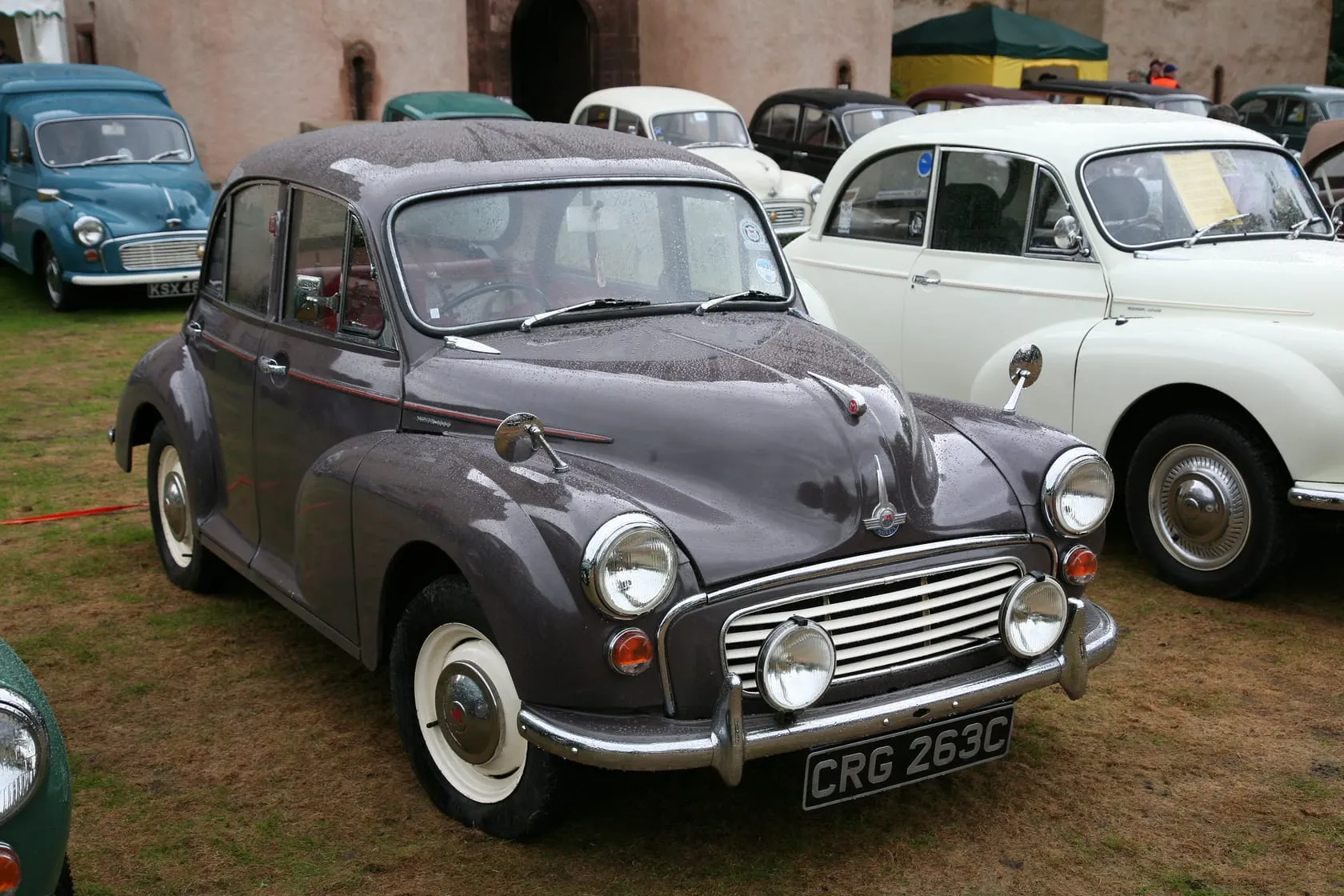
The body sets the order, and the variant table on this page puts numbers on it. The Minor 1000 saloon, the car most people picture, has a median of £3,600 across 162 sales. The convertible sits at £5,800 across 132. The Traveller, the ash-framed estate, leads at £7,400 across 261 sales, the largest group in the record, and the best restored Travellers and convertibles reach £12,000 to £18,000. The early cars, the split-screen Series MM of 1948 to 1953 and the Series II of 1952 to 1956, sell for about the same as the later Minor 1000 body for body, with the very earliest low-headlamp MMs the exception when one appears.
The one Minor with a collector’s premium is the Minor Million, the run of 350 lilac two-door saloons built in 1961 to mark the millionth car, which averages £15,300 across the five in the record and is the top of the standard-car market. Above it are only the oddities: the vans and pick-ups, which have their own commercial market, and the occasional competition or celebrity car.

What moves the price of a Minor
Rust, and on a Traveller, rot. The Minor’s monocoque rusts at the sills, the floors, the chassis legs, the rear spring hangers and the boot floor, and because every one of those panels is available new and the car is simple to work on, a rotten Minor is a cheap project rather than a write-off, which is why the bottom of the market is a few hundred pounds rather than nothing. The Traveller’s ash frame is different: it is structural, it rots at the joints and the bottom rails, and replacing it properly costs several thousand pounds, so a Traveller with sound, varnished wood is worth far more than one with soft corners, and the gap between them is most of the Traveller premium.
After the body comes originality, which the Minor market treats gently. Period upgrades (a 1275 engine, disc brakes, a five-speed gearbox, telescopic dampers) are common and accepted, and a sensibly improved car that drives well sells for as much as a standard one to most buyers, though the concours judges disagree. A saloon converted to a convertible, of which there are many, is worth less than a factory tourer and should be described as one. Colour, an original interior and a long history add a little; mileage, on a car that has usually been rebuilt at least once, barely matters.

Twenty years of standing still
The chart on this page is the flattest on the site. The yearly median was £2,400 in 2008, £4,500 in 2013, £5,500 in 2018 and £4,450 in 2025, with a spike to £7,800 in 2020 on a small sample and a drift down since. In today’s money the Minor is worth less than it was in 2014 and more than it was in 2008 or 2011, which is to say it has gone nowhere in particular. The classic-car boom of the 2010s passed the Minor by, and so has the correction that followed.
The reason is supply. More than 1.6 million Minors were built, tens of thousands survive, most of them in Britain, and every part to keep one on the road is made new. A car that can always be bought, and always be fixed, does not appreciate; it holds. That is the Minor’s quiet strength as a first classic, and the thing to understand before buying one as anything else: it is a car to own, not to invest in, and its price will be roughly what it is now when the time comes to sell.

Where Minors change hands
The Minor is a British car sold in British rooms. The sale rooms of Yorkshire, the Midlands and the West Country, the online platforms and the Owners’ Club’s own members handle most of the trade, and a single week in August 2026 shows the spread, from the £351 and £510 projects to a £4,480 saloon and a £6,600 convertible. The good Travellers and the Million cars mostly pass through the club and the specialists at prices a little above the auction range, because the buyer wants to see the wood. Whether a recorded price includes the buyer’s premium varies by sale, which is one more reason to read the usual range rather than any single result.

Insuring, restoring, selling
For an agreed-value policy the median for the body is the honest starting point and the upper half of the range for a Traveller with sound wood. On restoration the Minor is the exception to the rule on this site: a home restoration of a saloon is possible for a few thousand pounds in parts, and even a professional one costs less than the best finished cars make, so a cheap project is a genuine project rather than a trap, provided it is a saloon. A Traveller with rotten wood is a different sum. If you are selling, the convertibles and Travellers go in spring, the saloons whenever, and the photograph that sells a Minor is of the sills.
Related
The Minor’s great rival, the Austin A30 and A35, sells for similar money; its designer’s later masterpiece, the Mini, sells for more in Cooper form and about the same as a standard car. The Minor’s commercial cousins have their own market, covered in the classic vans guide. For how all the figures on this site are compiled, see what classic cars sell for.