British motoring firsts: who did it first, and when
The landmark British motoring firsts on one page, each with a date. The first British car, the first speeding fine, the first motorway, and the first through the sound barrier.

Key dates
- First British car
- December 1894
- First speeding fine
- 28 January 1896
- Emancipation Run
- 14 November 1896
- Brooklands opens
- 17 June 1907
- First Highway Code
- April 1931
- Driving test compulsory
- 1 June 1935
- First motorway
- 5 December 1958
- Millionth Morris Minor
- December 1960
- Land speed record
- 763.035mph, October 1997
The motor car was not a British invention. Karl Benz got there in 1885, and Britain spent the next decade hobbled by laws written for steam traction engines. What Britain did instead was rack up nearly everything else first: the first speeding fine, the first drink-driving conviction, the first purpose-built racing circuit, the first car past 200mph, the first past the sound barrier. This page collects the British motoring firsts that can be pinned to a date, in one place.
The pioneer years, 1894 to 1904
The first British car ran in December 1894. Frederick Bremer, a plumber and gas fitter from Walthamstow, built a four-wheeled petrol car in a workshop behind his house and gave it its first public run that winter. It was a one-off, and it still exists: the Bremer car is displayed at the Vestry House Museum in Walthamstow.
The first proper journey by petrol car on British roads followed in June 1895, when the Hon. Evelyn Ellis had his French Panhard et Levassor brought ashore and drove it from Micheldever in Hampshire to his home at Datchet in Berkshire. He was breaking the law for most of the route, and that was rather the point: Ellis was campaigning against the walking-pace limits then in force.
Britain’s first motor show was staged the same year, in October 1895, when Sir David Salomons exhibited a handful of horseless carriages on the agricultural showground at Tunbridge Wells.
The first speeding conviction arrived before the law had even made peace with the car. On 28 January 1896 Walter Arnold of East Peckham, Kent, was caught driving through the village at roughly 8mph, four times the 2mph limit, reportedly chased down by a constable on a bicycle. He was convicted and fined, the first of many millions.

The first pedestrian death came on 17 August 1896, when Bridget Driscoll was struck by a demonstration car in the grounds of Crystal Palace. The coroner expressed his hope that such a thing would never happen again. The first driver to die on British roads was Henry Lindfield, at Brighton in February 1898.
The first drink-driving conviction belongs to George Smith, a London taxi driver fined 20 shillings at Marlborough Street Police Court on 10 September 1897 after driving his electric cab onto a pavement.
The year 1896 also brought emancipation. The Locomotives on Highways Act raised the limit to 14mph and freed light cars from the old traction-engine rules, and on 14 November 1896 the motorists celebrated with the Emancipation Run from London to Brighton, tearing up a red flag at the celebratory breakfast for good measure. The famous flag was symbolic (the escort requirement itself had been dropped in 1878), but the run stuck: it survives as the London to Brighton Veteran Car Run, the world’s longest-running motoring event.
Registration caught up with the Motor Car Act 1903, in force from 1 January 1904, which put every car on a register, required number plates, and introduced the driving licence, though not yet any test. London’s first plate, A 1, went to Earl Russell, who by legend queued all night for it. Several county authorities had in fact begun issuing registrations weeks earlier, so A 1 is the most famous early British plate rather than strictly the first.
The law catches up, 1931 to 1983
The rules of the road mostly arrived decades after the cars did.
- April 1931. The first edition of the Highway Code is published.
- March 1935. A 30mph limit returns to built-up areas (all speed limits for cars had been abolished in 1930). The same month brings the first voluntary driving tests, compulsory from 1 June 1935.
- September 1960. The MOT test begins, initially as a ten-year test covering brakes, lights and steering. By April 1967 it applied from three years old, as it still does, though most classics now escape it under the 40-year rule.
- December 1965. A temporary 70mph limit is applied to motorways and other unrestricted roads after a series of fog pile-ups. It was made permanent in 1967 and has never moved since.
- October 1967. The Road Safety Act introduces the breathalyser and the first legal drink-drive limit.
- 1967 and 1983. New cars must be fitted with front seat belts from 1967; wearing them becomes law on 31 January 1983.
Roads and street furniture
The world’s first traffic signals stood outside the Houses of Parliament. Installed in December 1868 and designed by railway engineer John Peake Knight, the gas-lit semaphore worked, briefly, then exploded within a month and was taken down. Britain did not try again for over half a century.
Britain’s first roundabout is generally reckoned to be Sollershott Circus at Letchworth Garden City, laid out around 1909, though the junction acquired its modern circulation rules much later.
The first filling station opened at Aldermaston in Berkshire in 1920, run by the AA. Before that, motorists bought petrol in two-gallon cans from chemists, hardware shops and hotels. The first self-service pump did not arrive until November 1961, at Southwark Bridge in London.

Cats eyes were patented in 1934 by Percy Shaw of Halifax, and remain one of the most exported pieces of British road furniture.
The first zebra crossing appeared on Slough High Street on 31 October 1951, after the Road Research Laboratory under George Charlesworth had trialled designs at a thousand experimental sites. The first parking meters followed in Grosvenor Square, London, on 10 July 1958.
The first motorway was the Preston By-pass, opened on 5 December 1958 by Harold Macmillan, who rode along it and called it a token of what was to follow. It now forms the M6 between junctions 29 and 32. What followed, on 2 November 1959, was the M1, the first full-length motorway, and with it Britain’s first two motorway service areas, Watford Gap and Newport Pagnell, which opened the same day.
One more first belongs here, though it is about looking backwards: the world’s first motor museum opened on Oxford Street in London on 31 May 1912, assembled by the magazine publisher Edmund Dangerfield to preserve the pioneer cars while they were still young.
Engineering firsts from British factories
The first British car with unitary construction was the Vauxhall 10-4, launched at the London Motor Show in October 1937, which did away with the separate chassis a decade before most of the industry.
The world’s fastest production car of 1949 was the Jaguar XK120. On a closed Belgian motorway at Jabbeke in May 1949 a near-standard car recorded a two-way average of 132.6mph, backing the claim in its name (120mph) with a good deal to spare.
The world’s first gas turbine car was British: Rover’s JET1, revealed in March 1950, which went on to set a turbine-car record of 152.691mph in 1952 on the same Jabbeke road.

The first British series-production car with front disc brakes was the Triumph TR3, which adopted them mid-run in 1956, bringing racing braking to the sports-car showroom.
The transverse revolution arrived on 26 August 1959 with the launch of the Mini. Neither front-wheel drive nor the sideways engine was new in itself, but the Mini’s packaging, engine across the nose, gearbox in the sump, a wheel at each corner, became the template for practically every small car built since.
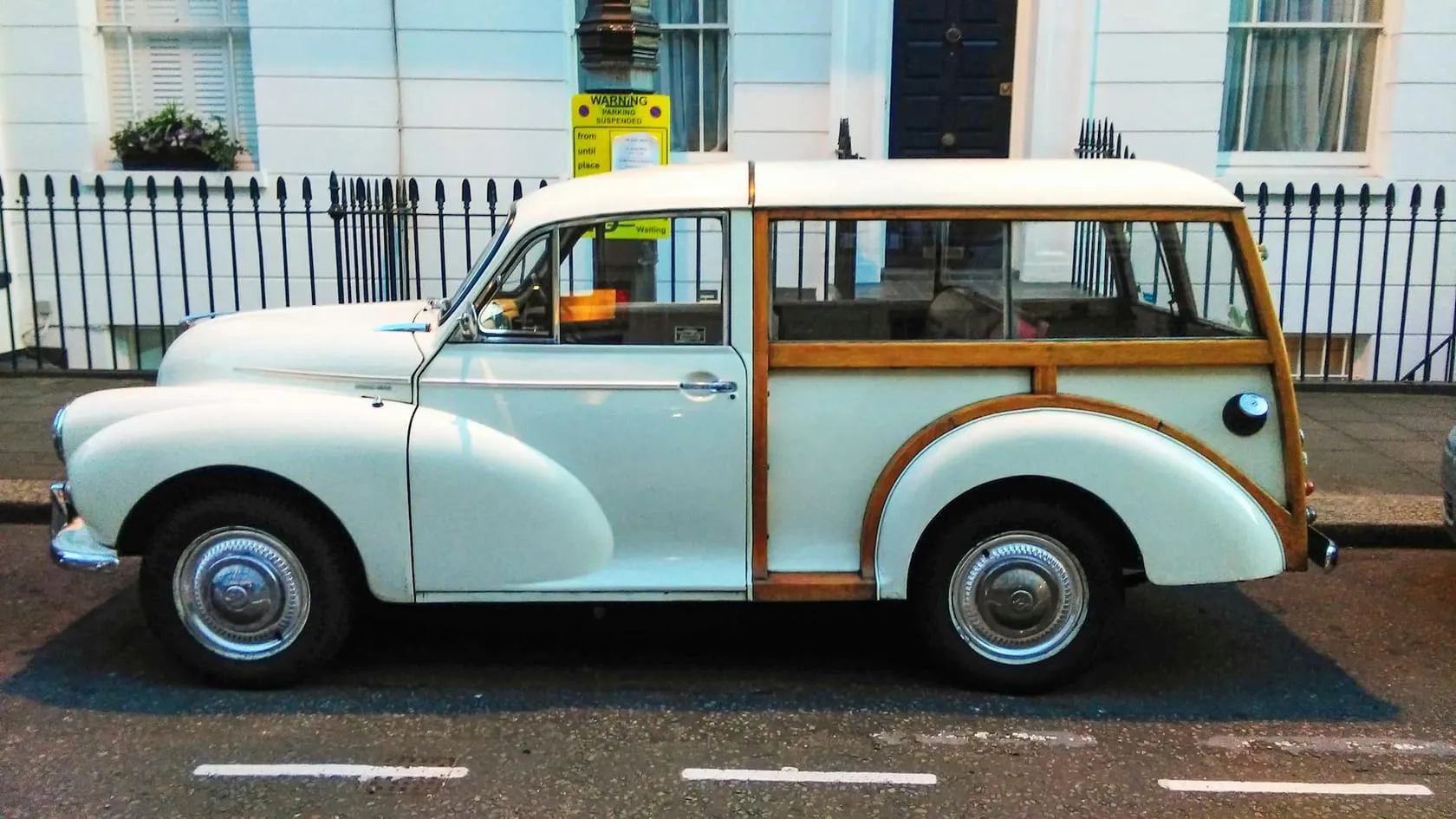
The first British car to sell a million was the Morris Minor, which passed the mark in December 1960, celebrated with 350 lilac Minor Million saloons.
The furthest ahead of its time was arguably the Jensen FF of 1966: the first production road car to combine four-wheel drive with anti-lock brakes, using the aviation-derived Dunlop Maxaret system, decades before either became ordinary.

The fastest men on earth
For most of the twentieth century the outright land speed record was a British possession, and every major barrier fell to a British car.

- 200mph. Henry Segrave, Daytona Beach, 29 March 1927, in the Sunbeam 1000hp: 203.79mph, the first car past 200.
- 300mph. Sir Malcolm Campbell, Bonneville Salt Flats, 3 September 1935, in Blue Bird: 301.129mph, his ninth and final record.
- 400mph. John Cobb, Bonneville, 16 September 1947, in the Railton Mobil Special: a 394.196mph average, with a single pass beyond 400mph, a record that stood for well over a decade.
- The sound barrier. RAF pilot Andy Green, Black Rock Desert, 15 October 1997, in ThrustSSC: 763.035mph, the first supersonic land speed record. It still stands.

Motorsport firsts
The world’s first purpose-built motor racing circuit was British. Brooklands, the great banked oval at Weybridge in Surrey, was built by landowner Hugh Locke King and opened on 17 June 1907 with a procession of 43 cars. With a blanket 20mph limit on the public road, it was the only place in Britain a car could legally find its limit.
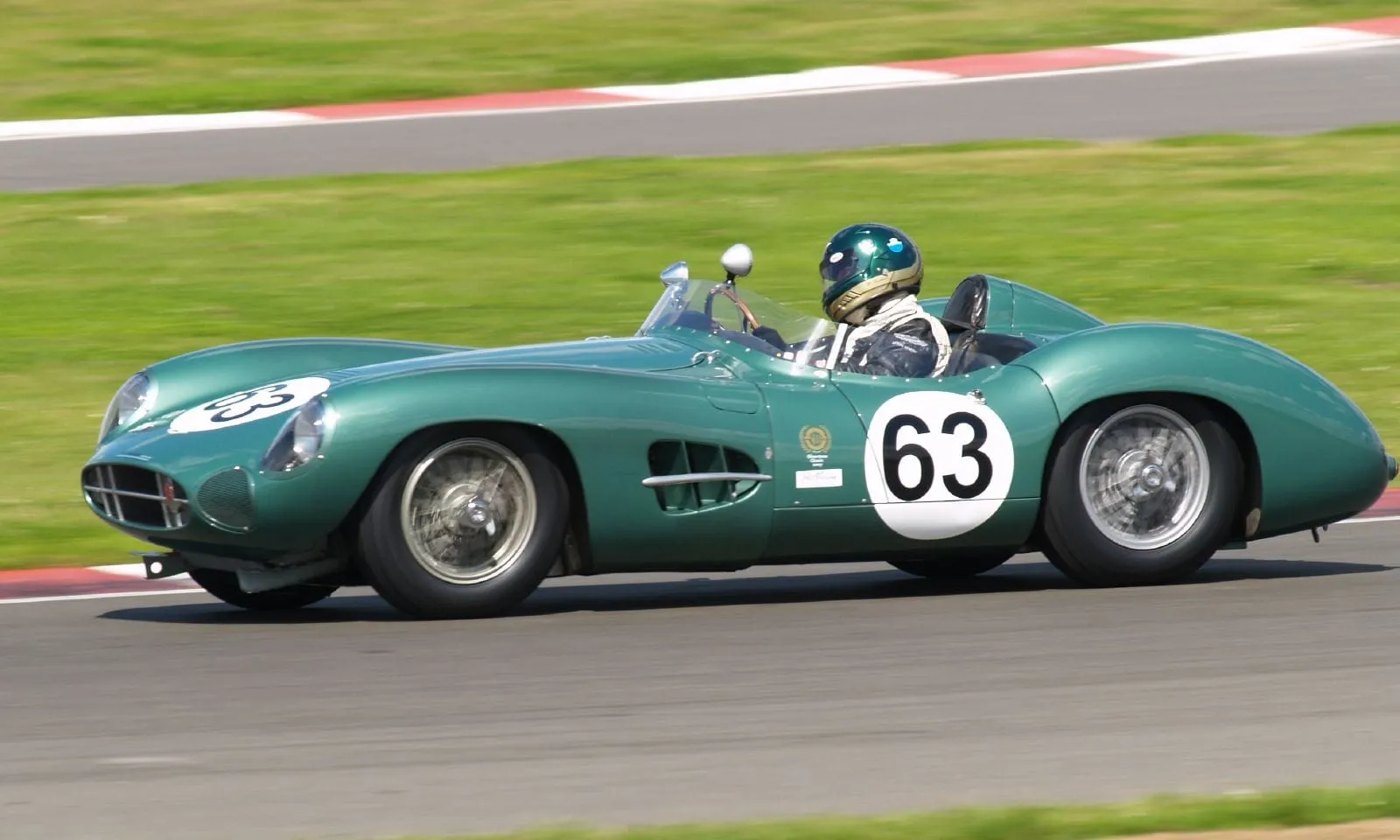
The first British win at Le Mans came in the race’s second running, on 14 and 15 June 1924, when John Duff and Frank Clement brought their Bentley 3 Litre home a lap clear. Bentley would win four more by 1930 and fix the race in the British imagination for good.
The first British Grand Prix was held at Brooklands in 1926, and in 1950 Silverstone staged something bigger: the opening round of the first Formula One World Championship, on 13 May 1950, the only grand prix ever attended by a reigning British monarch, King George VI.
Britain’s first Formula One world champion was Mike Hawthorn in 1958, the same season Vanwall took the inaugural constructors’ title for Britain. By the end of 1959 Cooper of Surbiton had won both championships with a rear-engined car, and every Formula One car since has followed its layout.

The pattern in the firsts
Read together, the list has a shape. Britain was slow to let the car exist (the pioneers were prosecuted before they were celebrated) and then relentless once it did, from the first million-seller to the only supersonic car. The machines behind these dates are covered across this site marque by marque, or you can follow the same story chronologically through the decades, from the pioneers to the modern classics.