What makes a car a classic? Every official definition, and why they all disagree
The guides
Ask what makes a car a classic and you will get a dozen confident answers, and the reason they disagree is simple: there is no single authority. Nobody in Britain holds the definition. Instead, half a dozen bodies each define the term for their own purpose, the purposes differ, and the definitions differ with them.
That is not a muddle to be resolved. It is the actual position, and a car owner needs to know which definition applies to which question. Here they all are, in order of how much they cost you to get wrong.
Vehicle tax: forty years, fixed cut-off, from April
The definition that affects the most people is the one that decides whether a car pays road tax. The historic vehicle tax class is set in legislation, and the wording makes it a fixed annual cliff: a vehicle is exempt for the twelve months beginning 1 April in any year if it was constructed more than forty years before 1 January of that year.
As of April 2026 that means cars built before 1 January 1986. The threshold advances by one year each April, so a car becomes eligible not on its fortieth birthday but at the first April cliff after it. A car built in June 1986 waits until April 2027.
This is a regulatory definition, it is the one DVLA applies, and it is the one most other schemes borrow. It is also not automatic: the car must be moved into the class by application, and then taxed at zero each year.
The MOT exemption: forty years, rolling, with conditions
The second forty-year rule is administered separately and works differently. A vehicle does not need an MOT once it was built or first registered more than forty years ago, provided no substantial changes have been made to it. The regulations describe such a car as a vehicle of historical interest.
Unlike the tax rule, this one rolls with the individual car: it arrives on that vehicle’s own fortieth anniversary, not at a common April date. And it carries conditions the tax rule lacks. The substantial-change test looks at the chassis or bodyshell, the axles and running gear, and the engine, and excludes vehicles with Q registrations, kit cars from mixed parts, kit conversions and reconstructed classics regardless of age.
So the same car can be exempt from testing while still paying tax, or eligible for free tax while still needing an annual test because it has been modified. The two rules are compared in detail in our guide to tax and MOT exemption.
Customs: thirty years, out of production, original
The taxman uses a different number entirely. For customs classification on import, HMRC treats a car as a collectors’ item, taxed on a reduced value that gives an effective five per cent import VAT, if it meets three cumulative tests: it is at least thirty years old, it is of a model or type no longer in production, and it is in its original state, meaning no substantial changes to the chassis, body, steering, braking, transmission, suspension or engine. Restoration is allowed; modification is not.
That is a legal definition from the tariff, and it is ten years more generous than DVLA’s. A 1994 car is a collectors’ item to HMRC and an ordinary used car to DVLA. The practical consequences for anyone bringing one in are covered in importing a classic car.
Clean air zones: three different answers
Emissions schemes have produced three definitions of their own.
The London ULEZ has two limbs: all vehicles built before 1 January 1973, a fixed date that never moves, and any vehicle over forty years old that is registered in the DVLA historic tax class. The second limb borrows DVLA’s definition and adds the requirement that the paperwork has actually been done.
English clean air zones outside London use the national exemption for “a historic vehicle”, which in practice means the DVLA historic tax class.
Scotland’s low emission zones use their own statutory definition of a vehicle of historical interest: manufactured or first registered at least thirty years ago, of a type no longer in production, and preserved in its original state without substantial technical changes. That is the HMRC shape with the MOT’s originality condition, and it is ten years ahead of England.
All three are regulatory, all three are applied automatically from the vehicle record for UK-registered cars, and the differences between them are set out in daily driving a classic.
The international standard: thirty years, preserved, not daily
The Fédération Internationale des Véhicules Anciens, the international federation of historic vehicle clubs, defines a historic vehicle as one at least thirty years old, preserved and maintained in a historically correct condition, not used as a means of daily transport, and therefore part of technical and cultural heritage. The Federation of British Historic Vehicle Clubs is the UK member.
This is a club convention rather than law, but it is an influential one, because it is the definition the organised movement uses when talking to governments, and it is the ancestor of the thirty-year tests that appear in the Scottish and HMRC rules. Its “not daily transport” limb is also the origin of the conditions classic insurers attach to limited-mileage policies.
Veteran, vintage, post-vintage: the oldest definitions of all
Before anyone had a tax class, the clubs had their own vocabulary, and it predates every official definition above by decades. By the convention of the Veteran Car Club and the Vintage Sports-Car Club:
- Veteran: specification dated before 1 January 1905. These are the cars eligible for the London to Brighton run.
- Edwardian: from 1905 to the end of 1918.
- Vintage: between 1919 and the end of 1930.
- Post-vintage thoroughbred: selected cars of quality from 1931 onward, to the end of 1940 on the VSCC’s approved list.
None of this is law. All of it is understood by everyone in the old-car world, and using “vintage” to describe a 1970s saloon marks the speaker as an outsider in a way no regulation does.
Classic, by contrast, has no fixed club meaning. It emerged as the catch-all for post-war cars considered worth preserving, and it has stretched to cover everything from a 1950s saloon to the 1990s hot hatches now crossing the thirty-year line. “Modern classic” and “future classic” are the labels enthusiasts reach for to keep the term useful as it stretches.
Insurance: whatever the policy says
The insurance industry has no regulatory definition of a classic. Each insurer sets its own criteria for a classic policy, and they vary widely: some will cover cars from fifteen or twenty years old, some require thirty, and most attach the conditions the international definition implies, limited mileage, secure storage, and another car available for daily use.
The Financial Ombudsman notes only that agreed-value policies are normally used for valuable or classic vehicles, without defining the term. What matters is not what the policy calls the car but what the policy promises, which is the subject of agreed value insurance.
The same car, six answers
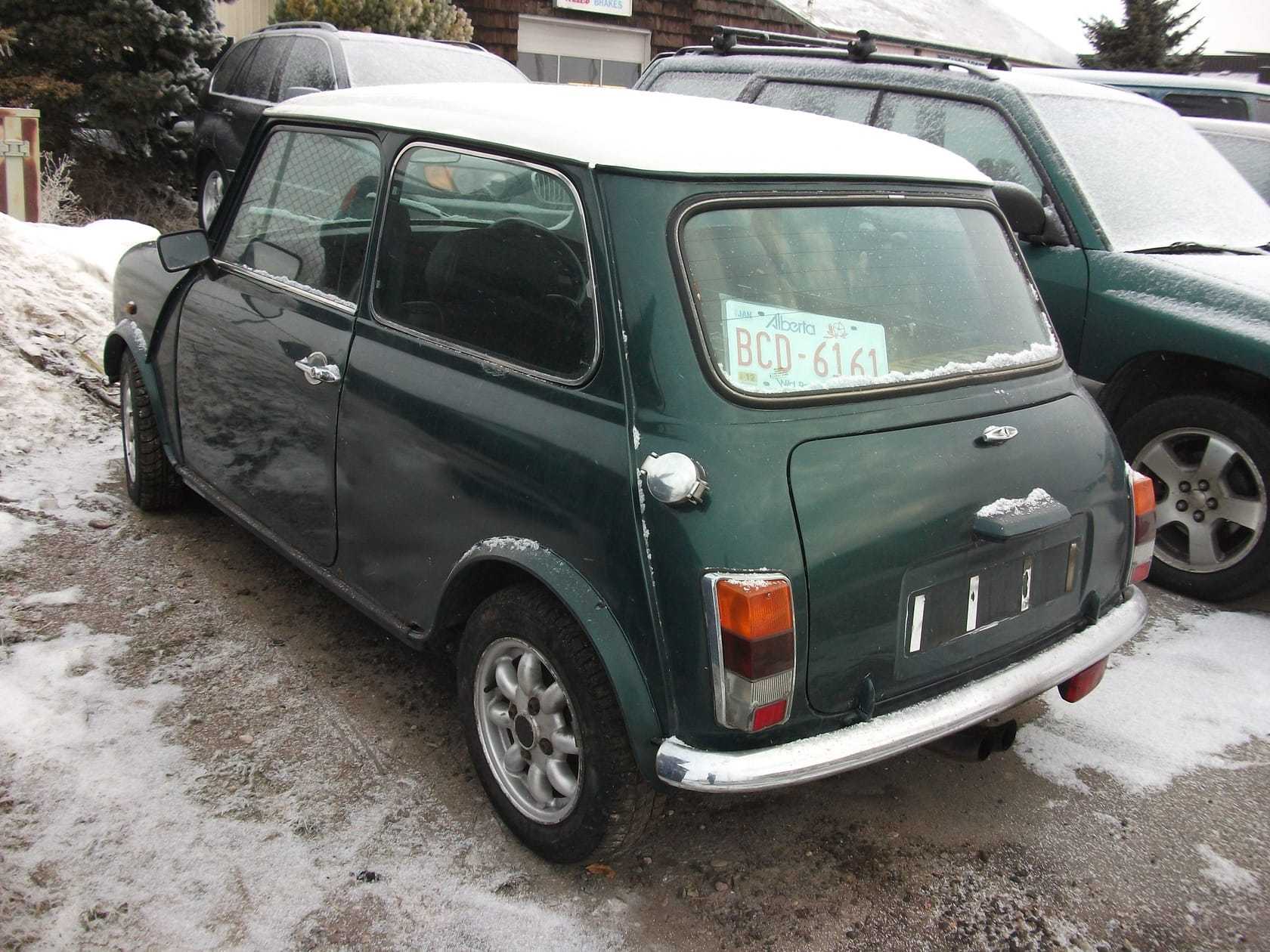
Put a single car through all of this and the point makes itself. A Rover Mini Cooper built in 1994 is, in 2026:
- a collectors’ item to HMRC (over thirty, out of production, original);
- a vehicle of historical interest in Glasgow and Edinburgh (over thirty, original);
- a historic vehicle to the international federation (over thirty, preserved, not daily driven);
- not a historic vehicle to DVLA, so it pays full road tax until April 2035;
- not MOT exempt, so it is tested every year until its fortieth birthday in 2034;
- not exempt from the London ULEZ on either limb;
- and to the Veteran Car Club, not a candidate for any of its categories at all.
Every one of those is correct. The question “is it a classic” has no answer until you say who is asking.
What this means in practice
For an owner, the useful discipline is to stop asking whether the car is a classic and start asking which rule applies to the decision in front of you. Tax and MOT: the two forty-year rules, which run on different clocks. Import: thirty years and originality. A Scottish city: thirty years and originality. London: 1973 or the tax class. Insurance: the policy wording. A club: its own convention.
For a buyer, the same discipline cuts through sales copy. “Classic” on an advertisement means nothing in particular. “In the historic tax class” means something specific and checkable on the V5C. “MOT exempt” means something specific and conditional. The precise claims are the ones worth paying for.
And for the rest of us, the lack of a single definition is not a failure of the system. It is what happens when a category created by enthusiasts, for cars they loved, gets borrowed by tax authorities, emissions schemes and insurers, each for its own reasons. The car does not change. The question does.