When does a car become a classic?
There is no single age. Road tax and the MOT both use forty years but run on different clocks, customs and Scotland use thirty, London uses 1973, and the market, the clubs and the owner keep their own time. Every answer, and which one applies to your car.

There is no single moment. A car becomes a classic several times over: once for road tax, once for the MOT, at thirty years for customs, Scotland and the international clubs, and then on its own schedule in the market, in the magazines and in the eyes of whoever owns it. Those moments rarely land in the same year, and nobody in Britain holds a master definition that would settle it.
So the useful question is not “is it a classic?” but “a classic to whom?” Here is who is asking, and where each of them draws the line.
| Who is asking | Where the line falls | The condition |
|---|---|---|
| Road tax (DVLA) | Built before 1 January forty years earlier, from each 1 April | You apply; it isn’t automatic |
| MOT | Forty years from build or first registration, car by car | No substantial changes |
| Customs (HMRC) | Thirty years | Out of production, original state |
| Scottish low emission zones | Thirty years | Out of production, original state |
| London ULEZ | Built before 1973, or in the historic tax class | The second route needs the paperwork done |
| The international clubs | Thirty years | Preserved, not used daily |
| Veteran and vintage clubs | Before 1905, 1919 to 1930 and so on | Club convention, not law |
| Insurers | Whatever the policy says | Usually mileage, storage and a second car |
The legal lines come first below, because they have dates. The moments that decide whether anyone actually wants the car come after.
Road tax and the MOT: two forty-year rules on different clocks
The line most owners mean when they say a car “turns classic” is forty years, and it is really two separate rules that are easy to confuse.
Road tax works on a fixed annual cut-off. The historic vehicle tax class is set in legislation: a vehicle is exempt for the twelve months from 1 April in any year if it was built more than forty years before 1 January of that year. As of April 2026 that means cars built before 1 January 1986. The line moves once a year, so a car becomes eligible not on its fortieth birthday but at the first April cut-off after it, and the keeper has to move it into the class and then tax it at zero every year.
The MOT exemption rolls with the individual car. A vehicle no longer needs a test once it was built or first registered more than forty years ago, provided it has not been substantially changed, which the regulations measure against the chassis or bodyshell, the axles and running gear, and the engine. Q-plated cars, kit cars built from mixed parts, kit conversions and reconstructed classics are excluded at any age.
The two rarely arrive together. A car built in October 1986 can drop its MOT when it turns forty in October 2026, but on the current rule it keeps paying road tax until 1 April 2027. The dates, the paperwork and the substantial-change test are worked through in classic car tax and MOT exemption, and the 40-year rule entry has a checker for a specific car.
Thirty years: customs, Scotland and the clubs
Three other definitions draw the line a decade earlier, and all three add a condition about originality.
Customs. For import classification, HMRC treats a car as a collectors’ item, taxed on a reduced value that gives an effective five per cent import VAT, if it is at least thirty years old, of a model or type no longer in production, and in its original state, with no substantial changes to the chassis, body, steering, brakes, transmission, suspension or engine. Restoration is allowed; modification is not. What that means for anyone bringing a car in is covered in importing a classic car.
Scotland’s low emission zones exempt a vehicle of historical interest, defined in their own regulations as manufactured or first registered at least thirty years ago, of a type no longer in production, and preserved without substantial technical change. That is the customs shape with the MOT’s originality test, and it puts Glasgow and Edinburgh ten years ahead of anywhere in England.
The international clubs. The Fédération Internationale des Véhicules Anciens (FIVA), the international federation of historic vehicle clubs, defines a historic vehicle as one at least thirty years old, preserved in historically correct condition and not used as daily transport. The Federation of British Historic Vehicle Clubs is its UK member. This is a club convention rather than law, but it is the one the organised movement uses when talking to governments, and its “not daily transport” limb is the same condition classic insurers write into limited-mileage policies.
London and the English clean air zones
The London ULEZ exempts two groups: every vehicle built before 1 January 1973, a fixed date that never moves, and any vehicle over forty years old that is actually registered in the historic tax class. The first group can only shrink. The second grows each April, but only for owners who have done the paperwork.
Clean air zones elsewhere in England use the national exemption for a historic vehicle, which in practice means the DVLA historic tax class. Both are applied automatically from the vehicle record for UK-registered cars, and how each zone treats a classic in regular use is set out in daily driving a classic.
Veteran, vintage, post-vintage: the oldest definitions of all
Before there was a tax class, the clubs had their own vocabulary, and it is decades older than any official definition. By the convention of the Veteran Car Club and the Vintage Sports-Car Club:
- Veteran: specification dated before 1 January 1905. These are the cars eligible for the London to Brighton run.
- Edwardian: from 1905 to the end of 1918.
- Vintage: between 1919 and the end of 1930.
- Post-vintage thoroughbred: selected cars of quality from 1931 onward, to the end of 1940 on the VSCC’s approved list.
None of this is law, and all of it is understood by everyone in the old-car world: calling a 1970s saloon “vintage” marks the speaker as an outsider in a way no regulation does. Classic, by contrast, has no fixed club meaning. It grew up as the catch-all for post-war cars worth preserving, and it has stretched to cover everything from a 1950s saloon to the 1990s hot hatches now crossing the thirty-year line.
Insurance: whatever the policy says
Insurers have no regulatory definition of a classic. Each sets its own criteria, and they vary widely: some will cover cars from fifteen or twenty years old, some want thirty, and most attach conditions on mileage, storage and having another car for daily use. The Financial Ombudsman notes only that agreed-value policies are normally used for valuable or classic vehicles, without defining the term. What matters is less what the policy calls the car than what it promises to pay, which is the subject of agreed value insurance.
One car, seven answers
Put a single car through all of this. A Rover Mini Cooper built in 1994 is, in 2026:
- a collectors’ item to HMRC (over thirty, out of production, original);
- a vehicle of historical interest in Glasgow and Edinburgh (over thirty, original);
- a historic vehicle to FIVA (over thirty, preserved, not daily driven);
- not a historic vehicle to DVLA, so it pays full road tax until April 2035;
- not MOT exempt, so it is tested every year until its fortieth birthday in 2034;
- not exempt from the London ULEZ by either route;
- and to the Veteran Car Club, not a candidate for anything at all.
Every one of those is correct. “Is it a classic?” has no answer until you say who is asking.

What makes a car a classic beyond the paperwork
Every rule above counts years and checks paperwork. None of them asks whether anyone wants the car, which is why the forty-year line applies as evenly to a written-off 1985 Ford Fiesta in a scrapyard as to a 1985 Bentley Mulsanne with fifty thousand careful miles.
The rest of the answer is made of moments no statute records. They are harder to date, but they decide whether a car is a classic in the sense most people mean, and they often run years ahead of the law or years behind it. A 1985 Ford Sierra could drop its MOT in 2025 and join the historic tax class in April 2026, by which point the cultural recognition of the Sierra (the Cosworths aside, which got there much earlier) was already well under way.
The market moment
Somewhere before or after the legal lines, the market turns. The price stops following the usual depreciation curve, flattens for a while, and starts to climb. The bottom of that curve is the market’s signal that the car has stopped being a used car and become something else, and it is the most useful moment to spot if you are buying: a car that has just turned from depreciating to appreciating is the cheapest in real terms it will ever be. The specialist price guides track those turning points across hundreds of models.
The timing is largely demographic, a nostalgia cycle: cars become collectible roughly when the generation that wanted them as teenagers can afford them as adults. The Ford Capri’s emergence as a classic in the early 2010s coincided with the people who watched The Professionals in 1978 reaching their late forties, and the Sierra Cosworth’s climb past £40,000 in the 2020s follows the same generation into its fifties.
Cars nobody loved at the time don’t become collectible just by getting old. The Austin Allegro qualifies legally, but its market remains a niche of a niche, kept going by a small group of owners who rather like the fact that nobody else cares.

The cultural moment
Close to the market moment, but not always in step with it, is the moment of recognition: the first cover of a classic-car magazine, an owners’ club starting regular events, concours classes at the major shows, a place in retrospectives and museum displays. It is hard to pin to a year and easy to recognise once it has happened. The Range Rover became culturally a classic around the time the four-door Classic was discontinued in 1996, when the magazine coverage shifted from “workmanlike off-roader” to “design icon.”
The press drives much of this. Practical Classics, Classic & Sports Car and the marque titles have a fairly predictable rhythm: a car gets a feature once reader interest crosses some threshold, and once covered properly it comes back with every major anniversary. A feature drives interest, interest drives values, and values drive more features, so by the fourth or fifth a model is safely a classic to the people who read those magazines, who are mostly the people who buy the cars.
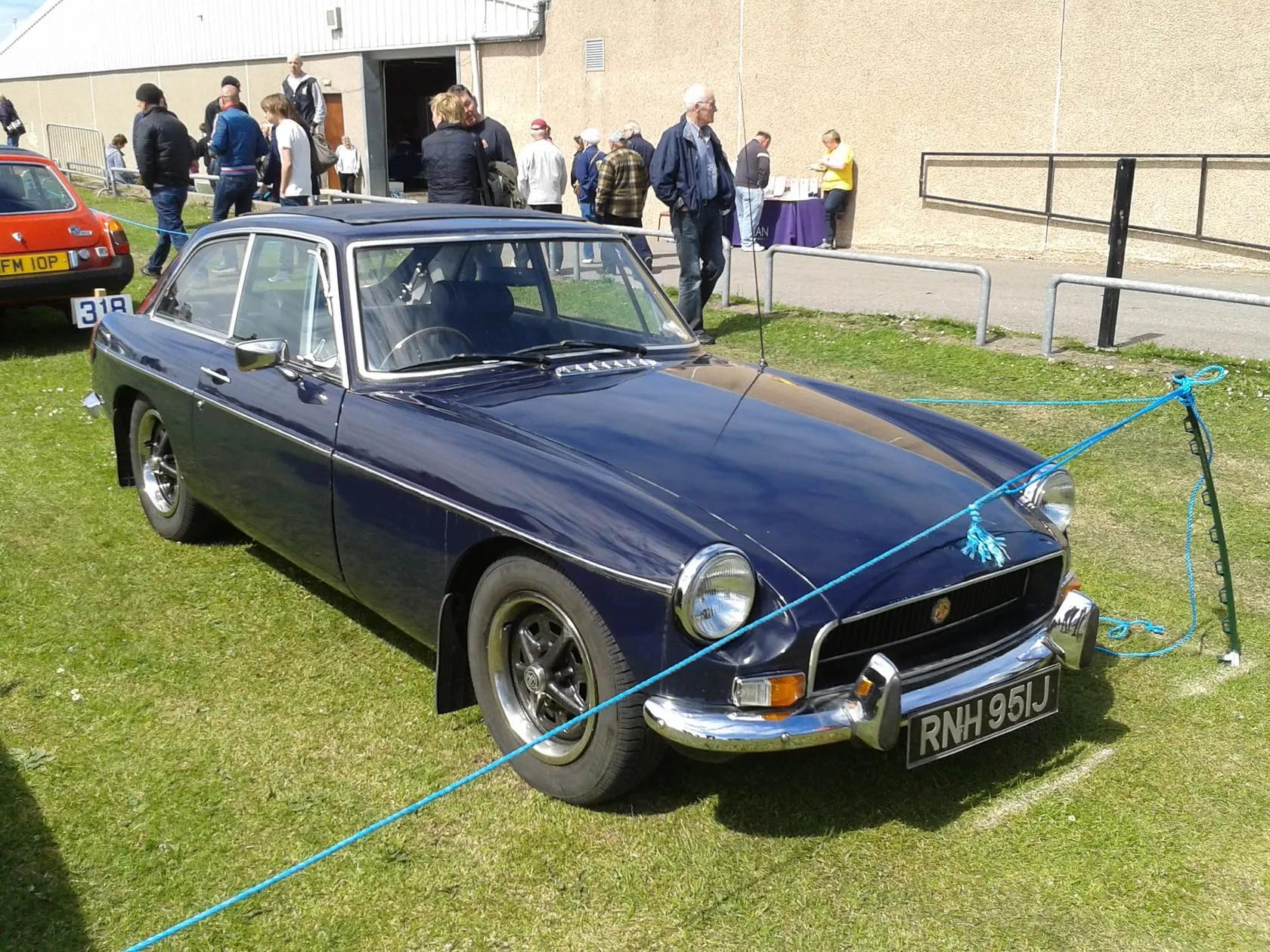
When the cultural moment runs ahead of the law, the infrastructure is in place long before the paperwork changes. The MG Owners’ Club was treating the MGB as a classic from at least the late 1980s, when the last cars off the line were not yet ten years old; the final ones only reached the forty-year MOT line in 2020, by which time the specialist insurers, the parts network and the clubs had been there for decades and the date was an administrative formality. When the law arrives first, the picture is patchier. The Maestro has nothing like the MGB’s network of clubs, specialists and press coverage: legally a classic, without the ecosystem of one.

The personal moment
The one moment the owner has any say in is the personal one: when the keeper starts treating the car differently. The daily driver becomes a fair-weather car. It gets parked in the quiet corner of the supermarket car park. Maintenance turns into restoration, and the question shifts from “what does it need to keep going?” to “what does it need to be properly right?”
For some owners that comes early: someone who bought a 1988 Sierra Sapphire RS Cosworth in 2005 may have garaged it and rationed the miles from week one. For others it is invisible until it has passed, like the 1990 MG Maestro that sat outside a house for twenty years as a sensible old car until its owner noticed how few were left and started looking after it.
It is also the only moment that changes the car itself. The tax class doesn’t touch it, rising values don’t, and a magazine cover doesn’t make the cylinder head any more reliable. Cars that reach forty in usable condition usually got there because somebody had a personal moment about them around year twenty.
When the moments disagree
The interesting cars are the ones where the moments don’t line up.
Some are culturally classics long before they are legally one. The Lotus Elise, launched in 1996, has been treated as a classic for at least a decade, and the specialist price guides have been valuing it as one for years. The earliest cars only reach the forty-year MOT line in 2036, and the historic tax class in April 2037.
Some are legally classics that never quite reached the cultural moment: the Austin Maestro, the Morris Marina, the Princess. The paperwork says classic, the market mostly says old car, and their owners are often intensely committed precisely because the wider world doesn’t share the enthusiasm.
Some are clearly on their way but still depreciating. The Ford Focus RS Mk2 (2009 to 2010) and the Renault Sport Megane R26.R (2008 to 2009) are widely tipped by the specialist press, neither is anywhere near a legal line, and their prices sit in the gap between falling and rising.
And some never quite settle. The DeLorean DMC-12 (1981 to 1983) is legally and culturally a classic, but trades in a narrow band sustained almost entirely by the Back to the Future films rather than by its engineering. The Reliant Robin got there by a different route: a classic in law and in affection, just not one anyone quite knows how to take seriously.
A more honest answer
Ask when a particular car became a classic and the accurate answer is usually a list rather than a date. For a car built in mid-1984 it might look like this:
- Market started flattening: roughly 2008
- First major magazine feature: 2011
- Owners’ club concours class created: 2014
- This owner started taking it to shows: 2019
- Forty-year MOT line: 2024, and the historic tax class from April 2025
Several moments spread over nearly twenty years, each meaningful in its own way. The legal entries are the only ones with exact dates, which is why they get quoted, but they are rarely the ones that mattered most.
So “is this car a classic yet?” is really four questions: is it one in law, is the market treating it as one, is the cultural infrastructure in place, and is its keeper looking after it as one? A yes to any of them makes it a classic in some sense. A yes to all four is when it has fully arrived. The other half of the question, which makes and models count as British classics at all, has its own answer in which cars count as British classics.
Frequently asked questions
How old does a car have to be to be a classic in the UK?
Is a 40-year-old car automatically a classic?
Is a thirty-year-old car a classic?
What is the difference between veteran, vintage and classic?
Why is the London ULEZ cut-off 1973?
Which definition actually matters for an owner?
Related across themes


Recently added

Bentley S-series: the quiet twin with the beautiful secrets (1955–1965)

Rolls-Royce Silver Spirit and Silver Spur: the last Crewe bargain (1980–1999)

Rolls-Royce Corniche: the coachbuilt survivor that outlived its makers (1971–1995)
