British classic cars of the 1970s
By British Classic Cars · Last reviewed May 25, 2026
Part of our guide: British classic cars by decade
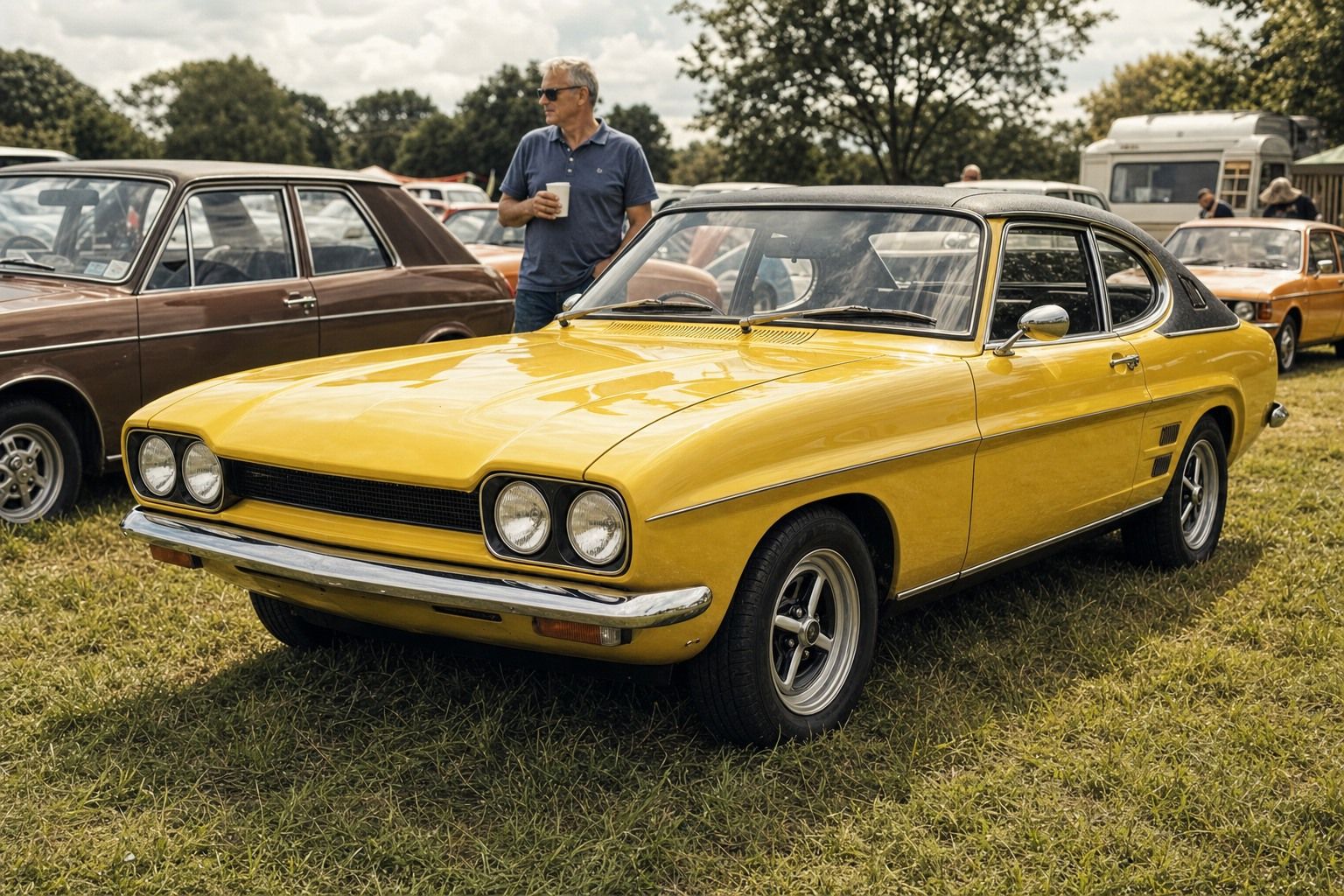
The 1970s in British motoring is a difficult decade to summarise without arriving at one of two oversimplifications. The first is that it was a disaster: a long argument about strike action, a broken nationalised industry, rust-prone bodies, and the steady encroachment of foreign rivals. The second is that it was a golden age: the Capri, the Stag, the Esprit, the XJ Series 2, motorsport saturation on every channel, and a kind of confident oddness in design that nobody has quite replicated since. Both are true. The cars that came out of British factories between 1970 and 1979 sat at the awkward overlap.
Sports cars and roadsters
If there’s one image that fixes the 1970s in British sports-car form, it’s the MGB. The B was already eight years old when the decade opened and would soldier on until 1980, by which point the rubber-bumper US-spec safety regulations had given it a slightly unfortunate facelift but hadn’t dulled its appeal as an honest, fixable, fun roadster. Demand on the second-hand market remained strong throughout, and the MG Owners’ Club spent the decade growing to the membership size it still has today. The MGB GT, the closed version, became the practical-classic recommendation it remains now.
The Triumph TR6 ran from 1968 to 1976 and is the 1970s Triumph roadster: the straight-six engine, the Karmann-designed body, the solid square-shouldered look. The Spitfire continued through the decade as well, with the Mk IV arriving in 1970 and the 1500 replacing it in 1974. Spitfires were the affordable end of the classic-sports-car market and still are. The TR7, when it arrived in 1975, divided opinion at the time and has been re-evaluated upwards in the years since.
Lotus had its identity crisis at the start of the decade and came out the other side with the Esprit. The original Esprit launched in 1976, the Giorgetto Giugiaro wedge that became famous in the Bond films a year later, and it defined the late-1970s British supercar shape every other manufacturer tried to copy. The Lotus Elan finished its production run in 1973, giving way to the more GT-shaped Elite and Eclat that didn’t quite catch on the same way.
GTs and grand tourers
The Jaguar XJS arrived in 1975 and was, depending on your disposition at the time, either a brave act of GT engineering or the wrong successor to the E-Type. It was actually both, and the intervening fifty years have shown it the kindness of being re-evaluated as the more interesting of the two cars to own and maintain today. The XJ6 saloon Series 2 ran from 1973 to 1979 with the same set of mixed feelings attached: stunning looks, troubled build quality during the worst of the Leyland years, and a following that has stuck with it.
Aston Martin spent the 1970s in financial turmoil and produced fewer cars than at any time since the 1950s. The V8, launched in 1972, was the front-engined muscle Aston that ran in various forms until 1989. The Vantage version arrived in 1977 and is the one collectors talk about. Aston’s survival through the decade is a small miracle of British classic-car history; the company changed ownership several times and very nearly didn’t make it to the 80s.
The Ford Capri Mk1 carried over from 1969 into the early 1970s, the Mk2 ran from 1974 to 1977, and the Mk3 launched in 1978. The Capri is the British coupe of the 1970s in the everyman sense: cheaper than an Aston, more attainable than a Jaguar, more aspirational than a Cortina. The 3.0-litre versions are the ones owners’ clubs keep alive today. The Mk1 RS2600 and RS3100 are now five-figure classics and rising.
Saloons
Rover’s SD1 arrived in 1976 and was unlike anything else on a British forecourt. The hatchback five-door body was designed by David Bache to evoke a Ferrari Daytona, the V8 engine was the Buick-derived all-aluminium 3.5-litre that powered everything from Range Rovers to TVRs, and the early build quality was famously patchy. SD1s that survived the decade have become some of the more interesting British classics, with the Vitesse and Vanden Plas EFI versions particularly sought after.
The Ford Cortina, in Mk3 (1970 to 1976) and Mk4 (1976 to 1979) form, was the British family car of the 1970s by sales volume. It defined what a normal car looked like for an entire generation. GT, GXL and 2000E specifications added the sporting flavour. Cortinas were unloved during the 1990s and largely scrapped; survivors today are valuable precisely because so few are left.
Triumph Stag is the awkward one to talk about. Beautiful body, brilliant idea (V8 grand tourer with a removable hardtop), and an engine that overheated and warped its cylinder heads with such predictability that Stags developed a reputation for unreliability that lasted decades. Modern owners’ clubs have largely fixed the cooling problems with uprated radiators and proper maintenance, and the Stag is now one of the more rewarding 1970s buys if you find a properly sorted one.
The Austin Princess (1975 to 1981) was the wedge-shaped saloon British Leyland produced for the middle market and which sold in reasonable numbers despite the press treating it as a punchline. Princesses are now rare survivors, and the design has aged interestingly.
Hot hatches and sporting variants
The Escort RS series defines British performance Fords in the 1970s. The Mk1 Escort Mexico (1970 to 1974) was built to celebrate the London-to-Mexico World Cup Rally win and became a club-racing staple. The RS1600 with the Cosworth BDA engine ran through the Mk1 era, and the RS2000 took over from 1973. When the Mk2 Escort arrived in 1975, the RS Mexico and RS2000 names continued; the Mk2 RS2000 with its droopsnoot front is the car most people picture when someone says “classic fast Ford.”
The Sunbeam Lotus, late in the decade (1979 to 1981), was the hatchback-rally homologation special with a Lotus-twin-cam engine in a Chrysler bodyshell. It won the World Rally Championship in 1981. Few were sold; survivors are six-figure cars now in good condition.
The Hillman Avenger Tiger (1972), a Special Tuning division homologation run of about a thousand cars, sits in the same conversation as the early Escort RS variants and is correspondingly thin on the ground.
The everyday cars
The Mini soldiered on through the entire decade in essentially the shape Issigonis drew in 1959. The Mini Clubman with its squared-off front arrived in 1969 and ran through the 1970s alongside the round-fronted original. By the end of the decade the Mini was a seventeen-year-old design competing against new front-wheel-drive superminis from across Europe. It outlasted most of them and ran on until 2000.
British Leyland’s 1970s was largely defined by three cars that the press never forgave: the Morris Marina (1971 to 1980), the Austin Allegro (1973 to 1982), and the Maxi (which actually launched in 1969 and ran until 1981). All three sold in enormous numbers at the time and were largely scrapped before the end of the century. The few survivors that exist today have a passionate following that’s grown roughly in inverse proportion to the cars’ original critical reception. There’s something about owning a really unfashionable car that turns out to be more rewarding than buying the conventional choice.
The curios
The Reliant Robin (Mk1, 1973 to 1981) needs no introduction beyond itself. Three wheels, fibreglass body, an Austin-Healey-derived 840cc engine, and a regulatory loophole that let you drive one on a motorcycle licence. Forty thousand sold across the Mk1 run, and the Robin has aged into the most British of British classics in the sense that everyone has a strong feeling about it.
The Bond Bug (1970 to 1974) was the Reliant Group’s three-wheeled sporting answer, designed by Tom Karen at Ogle Design and looking nothing like anything else on the road. Two thousand were made. Survivors today are collectible curiosities.
TVR spent the 1970s building the M-series (1600M, 2500M, 3000M) and then the Taimar (1976 to 1979), the hatchback version that’s the most usable of the period TVRs. The M-series is the era of fibreglass-bodied, Ford-or-Triumph-engined, hand-built British sports cars that defined what TVR did before the Wheeler-era muscle cars of the 1980s and 1990s.
What made the 1970s distinctive
Three things shaped the decade in British motoring more than any others.
The first was the 1973 oil crisis, which hit British cars hardest because so many of them were thirsty straight-sixes and V8s in an overnight environment of petrol rationing and queues at the forecourt. Output dropped sharply in 1974, and small-engined cars like the Mini suddenly looked very sensible. The crisis also accelerated the work on more efficient engines that would define the 1980s.
The second was the formation and steady industrial collapse of British Leyland. The merger that created BL had happened in 1968, but the 1970s was when its consequences played out: too many overlapping models across too many badges (Austin, Morris, MG, Triumph, Rover, Wolseley, Riley, Jaguar, Daimler, Land Rover), chronic underinvestment, and labour relations that became the backdrop to the news bulletins of the entire decade. The nationalisation of BL in 1975 stabilised the situation only partially.
The third was the rise of motorsport as a mass-market signal. Rally homologations (Escort RS, Sunbeam Lotus, later the MG Metro 6R4) turned ordinary saloons into special-edition collectibles. Touring car racing on television built the Capri and the SD1 into household names. The British motorsport ecosystem that built up in the 1970s became the engineering supply chain that the rest of the British classic-car industry still benefits from today.
The 1970s ended with British Leyland still in existence, Austin Rover’s K-series engine project under way, the SD1 finally selling, the XJS established, and Lotus and TVR both surviving as small-volume specialists. The decade that followed would be where the survivors consolidated. But by 1979 the cars themselves were already cementing the reputations they’d carry forward into the collector market: the Capri as the people’s coupe, the Stag as the beautiful problem, the SD1 as the underrated executive, the Escort RS as the affordable fast Ford, the XJS as the contrarian’s choice.
If you want to read forward into the next decade, the 1980s page picks up the thread. If you want to read backwards, the 1960s is where most of these models started life. For broader scope, see which cars count as British classics, which sets out the working definition this site uses across all the decade pages.