British classic cars of the 1990s
By British Classic Cars · Last reviewed May 25, 2026
Part of our guide: British classic cars by decade
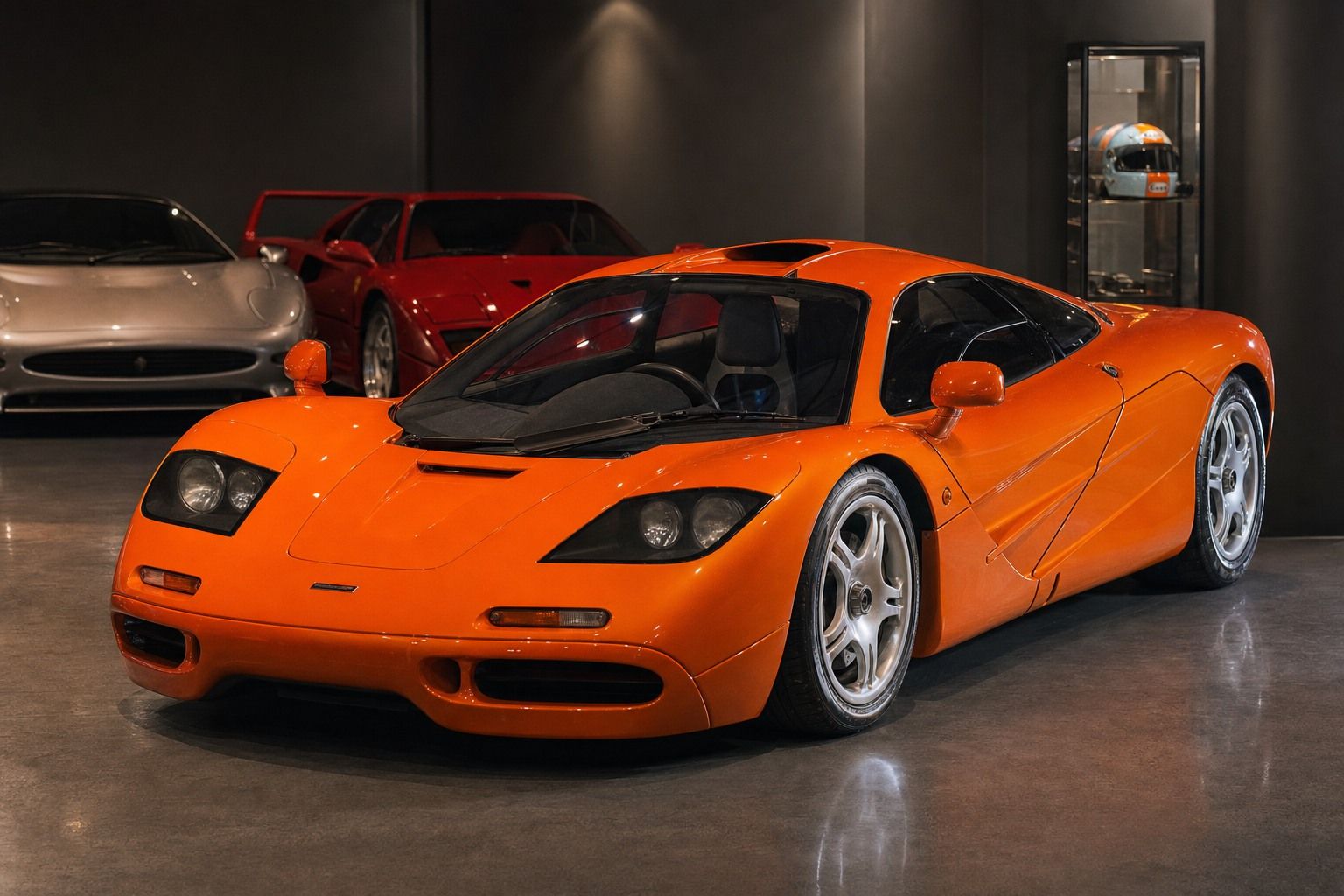
The 1990s in British motoring is two stories running in parallel. One is the long unwinding of Rover Group, from BMW’s takeover in 1994 to its sale and breakup in 1999, with Land Rover passing to Ford, Mini going to BMW, and the rest sold to the Phoenix Consortium for £10. The other is the renaissance of British small-volume sports-car manufacturing under Peter Wheeler at TVR, under Colin Chapman’s successor team at Lotus, and at the top end under Gordon Murray at McLaren Cars. The big factories were dying. The specialists were having their best decade in living memory.
The McLaren F1
The McLaren F1 (1992 to 1998) was the supercar of the decade. Gordon Murray’s design, BMW V12 engine, central driving position, gold-foil engine bay, three-seat layout, naturally aspirated, no electronic driver aids. 106 cars built in total across road, GTR, LM and GT variants. Held the production-car speed record at 240 mph from 1998 until 2005 when the Bugatti Veyron beat it.
The F1 was British in every way that mattered. Designed in Woking, built by hand, used a BMW engine because Murray needed specific power and torque characteristics no other manufacturer would build to spec. F1s today sell for £15 million and upward in good condition; the F1 LM cars at considerably more. The car remains the benchmark by which late-twentieth-century supercars are measured.
The Lotus Elise
The Lotus Elise launched in 1996 and changed what a British sports car could be. Aluminium extruded bonded chassis, fibreglass body, Rover K-series 1.8-litre engine in the original car, weight of 725 kg. Faster around a circuit than cars with three times the power. Made Lotus profitable for the first time in years.
The Series 1 Elise (1996 to 2001) is the purer original; the Series 2 (2001 onward) is a 2000s story. The Elise also became the basis for the Lotus Exige (1999 onward), the harder-edged track-day version that became a category in itself.
The Elise is the car that proves the 1990s wasn’t all decline. It was an entirely new platform from a small British manufacturer, priced approachably (under £20,000 when new), and brilliant in a way that British sports cars hadn’t been since the original Lotus Elan. It also kicked off the modern lightweight-sports-car movement that the Caterham, the Ariel Atom (2000), and the BAC Mono (2011) all developed from.
TVR’s Wheeler-era peak
Peter Wheeler bought TVR in 1982 and spent the 1980s rebuilding it into a credible volume sports-car maker. The 1990s is where that work paid off.
The Griffith (1991 to 2002) was the first of the new-shape TVRs, launched at the 1990 Birmingham Motor Show to a famously rapturous reception, with the Rover V8 engine in a fibreglass body. The Chimaera (1992 to 2003) was the slightly more practical version, softer, more touring. The Cerbera (1996 to 2006) introduced TVR’s own AJP8 V8 engine and was the proper hard-edged TVR of the period. The Tuscan (1999 onward) brought back the model name from the 1960s and became, briefly, an icon of British excess.
TVR’s 1990s output was probably the most coherent run of cars the company ever made. Build quality was famously variable, electrics were temperamental, and the cars demanded driving attention in a way no modern manufacturer would accept. They were also faster, more dramatic, and more characterful than anything else available at the price. By the end of the decade TVR was building several thousand cars a year, more than at any point before or since.
The Cosworth Escort and the end of fast Ford
The Escort RS Cosworth launched in 1992 and ran until 1996. It took the Cosworth-engined formula that had defined the Sierra and Sapphire and put it into a smaller, four-wheel-drive hot hatch with a comically large rear wing. Group A rally homologation; 2.0 turbo four-cylinder; 220 horsepower from the factory and a great deal more from tuners. Theft was a serious enough problem that insurance for an Escort Cosworth in the mid-1990s was famously difficult to obtain.
When production ended in 1996, the modern fast-Ford line ended with it. The Focus RS arrived in 2002 with a different formula (front-wheel drive, smaller engine). The 1990s Cosworth Escort is the last car of the lineage that started with the Sierra Cosworth in 1986.
Jaguar’s 1990s
Ford acquired Jaguar in 1989 and the 1990s is the Ford-era story. The XJ Series carried over from the 1980s as the XJ40 with various updates, ending in 1994. The X300 (1994 to 1997) refreshed the XJ shape, bringing back some of the curved styling of the original 1968 XJ6. The X308 (1997 to 2003) introduced the new V8 engine that would run for the next two decades.
The XK8 launched in 1996 and was Jaguar’s first proper sports-GT since the XJS was facelifted in 1991. The XKR supercharged version arrived in 1998. These cars looked back to the E-Type for styling inspiration and were Jaguar’s most successful new-model launches of the decade.
The XJ220 (1992 to 1994) was Jaguar’s supercar moment: 542 horsepower, 217 mph, twin-turbo V6 (controversial after the concept’s V12 was changed for production reasons). Sales were troubled, prices crashed, and the XJ220 spent fifteen years as the unloved Jaguar before re-evaluation lifted prices back up.
The MG revival
MG returned in the 1990s after a decade away from sports-car production. The MG RV8 (1992 to 1995) was the limited-edition revival of the MGB shape with a Rover V8 engine. Around 2,000 built. Briefly mocked at launch; now collectible.
The MGF (1995 to 2001) was the proper return: a mid-engined K-series roadster competing with the Mazda MX-5 and the BMW Z3. The F sold in reasonable numbers and is one of the more affordable late-1990s British classics today. The MG TF facelift carried it into the 2000s.
Rover’s slow decline
Rover Group spent the 1990s in transition. BMW bought the company from British Aerospace in 1994 and invested in new models, including the Rover 75 (1998 to 2005) which was a credible upmarket saloon. The Rover 200 (1995 to 1999) and 400 (1995 to 1999) hatchback-saloons were the Honda-collaborated mid-market cars. The Rover 600 (1993 to 1999) sat above them, badge-engineered with the Honda Accord.
By 1999 BMW had decided the investment was not paying back. The group was broken up. Land Rover went to Ford for £1.85 billion. The Mini brand went to BMW. The rest (MG, Rover, the Longbridge plant) was sold to the Phoenix Consortium for £10. The new MG Rover collapsed in 2005, ending the lineage of British mass-market car manufacturing that ran back to the 1900s.
Aston Martin’s DB7
The Aston Martin DB7 launched in 1994 and is the Ford-era Aston that paid for everything that followed. Designed by Ian Callum, sharing platform components with the Jaguar XJS and the XK8, built at Bloxham (and later Wisconsin), the DB7 sold roughly seven thousand units across coupe and Volante variants and the V12 Vantage version. It was an order of magnitude more cars than any previous Aston Martin model. Without the DB7’s commercial success Aston wouldn’t have been able to develop the DB9 and the modern lineup.
The DB7 was joined by the V8 Coupe (1996 to 2000), the last of the old-school front-engined V8 Astons in the William Towns body that went back to 1972.
Land Rover, Range Rover, and the Discovery
The Range Rover Classic finished production in 1996, replaced by the P38a Range Rover (1994 to 2002). The P38 was divisive at launch: more refined, more electronic, more troublesome in ownership. Survivors today are appreciating as buyers re-evaluate the cars away from period prejudice.
The Discovery 1 (1989 to 1998) continued through most of the decade, with the Discovery 2 (1998 to 2004) closing it out. The Defender 90 and 110 (continued from 1983 / 1990 onward) ran through the decade with periodic engine changes (Td5 from 1998).
Land Rover under Ford ownership from 1999 produced the cars of the 2000s; the 1990s cars were all designed and largely built before the sale.
The everyday cars
The 1990s mainstream had Ford on top of British family-car sales, Vauxhall close behind, and Rover slowly fading.
The Ford Mondeo (1993 to 2000 for the Mk1, then continuing) replaced the Sierra and became the mid-market default. Mondeo CR2 and ST24 variants are the sporting versions enthusiasts now value. The Ford Fiesta Mk3 (1989 to 1995) and Mk4 (1995 to 2002) covered the small end. The Ford Escort Mk5/6 (1990 to 2000) continued through the decade in steadily-less-interesting form before being replaced by the Focus in 1998.
Vauxhall’s 1990s ran the Cavalier Mk3 (1988 to 1995) into the Vectra (1995 to 2002), the Astra Mk3 (1991 to 1998) and Astra Mk4 (1998 to 2005). Astra GTE and GSi variants are the period sporting options.
The Mini ran until 2000 in essentially the 1959 form. The John Cooper Mini Cooper editions of the 1990s are now particularly collectible. The Mini Cooper Sport, the run-out final version, remains one of the most desirable Minis.
The Ford Puma
The Ford Puma (1997 to 2002) deserves its own paragraph. Built at Niehl in Germany but designed by Richard Parry-Jones’s UK team, the Puma was the Ford Fiesta-platform coupe that became one of the best-handling small cars of its decade. Sold in 1.4, 1.7 and 1.7-litre Racing variants. The Racing Puma (1999 to 2000) is a short-run special-edition coupe with widened bodywork and a tuned engine, now collectible.
The Puma sits awkwardly in our scope (built in Germany, not strictly a British classic) but is included because it was Ford-Britain-designed and aimed at the British market more than anywhere else. Whether you count it as British depends on which test you apply from which cars count as British classics.
What made the 1990s distinctive
Three threads through the decade.
The first is the end of mass-market British car manufacturing as a distinct industry. By 1999 the major British marques were owned by Ford, BMW or by the Phoenix Consortium (which would collapse in 2005). The decade closed the chapter that ran from BL’s formation in 1968 through privatisation in the 1980s.
The second is the small-volume British renaissance. McLaren, TVR, Lotus, the rebooted MG, the surviving Caterham, the development of Pagani-rival small-makers and what would become Ascari and Noble and BAC Mono. These were not manufacturing volumes that could support a national industry, but they restored Britain’s reputation for engineering distinctive sports cars after the volume manufacturers had largely lost it.
The third is the start of the modern-classic market. By the late 1990s the 1970s and earlier cars were established as classics, and the cars built between 1986 and 1995 (the Cosworth Fords, the V8 Astons, the Esprit Turbo, the Bentley Turbo R) were starting to appreciate. The market began separating “old car” from “modern classic” as a recognised category, with specialist insurers, magazines and auction houses building products specifically around it.
By 1999 the decade had closed with the McLaren F1 as the British supercar peak, the Lotus Elise as the British sports-car comeback, the Aston DB7 as Aston’s commercial salvation, the Range Rover moving upmarket, and the Mini about to end. The decade that followed would consolidate the modern Aston and Jaguar identities under Ford, see Land Rover passed from Ford to Tata in 2008, and watch the Lotus Elise spawn an entire generation of imitators.
For broader scope, see which cars count as British classics. Reading backwards through the chronological sequence: the 1980s, the 1970s, the 1960s.